#142-Close-Up

Quick recap: Close-Up is a semi-documentary about a man who pretended to be famed Iranian director Mohsen Makhmalbaf and was later arrested for it.

Not Mohsen Makhmalbaf

Not Mohsen Makhmalbaf

Fun (?) fact: All people involved in the case play themselves, although many of the scenes are recreated.

Not Mohsen Makhmalbaf

Not Mohsen Makhmalbaf

My thoughts: If you are looking for a documentary with twists and turns, this isn’t it. It’s simply about a man pretending to be someone else. I knew this going into the film but a small piece of me still expected there to be something shocking at the end, like Sabzian murdering everyone or actually being the director Makhmalbaf. It always annoys me when directors take creative license with the truth (*ahem* Foxcatcher) by exaggerating or making up events, but in this case I could’ve handled a bit more suspense.

That’s not to say I didn’t enjoy Close-Up. Being a bit underwhelmed with the case made it possible for me to instead focus on the people involved. As I’m sure the director intended, I felt sorry for Sabzian from the moment he entered the screen. From his story, we learn that he is just a poor man with a minimal wage job who ran with the chance to be seen as a famed director because he wanted respect. His mother is also in the film and she is even more sad than Sabzian. They seemed like good people, even though he was caught up in a case like this. There were many times that the family implied there were ulterior motives to take money and burgle the house, but that doesn’t seem likely. As one of the family members put it, Sabzian was a sick man, the sickness being poverty, and the only way to get better and stop doing illegal things would be to get a decent job and find something to do with his life.

The family’s account of the deception seemed straightforward enough, yet I found it hard to believe that they were really all that hurt by Sabzian. They seemed like decent enough people but there were times, especially when the father became suspicious, that it felt more like they were just being cruel instead of turning him into the authorities. In a couple of the scenes it felt like Sabzian was being mocked, although that could also be because he really wasn’t that good of a fake and gave himself away so easily.

The most powerful part of the film arrives at the end as Sabzian meets up with the director he impersonated. After buying a plant for the Ahankhah family, Makhmalbaf and Sabzian ride to the family’s house where the director becomes the mediator between the two parties. The apology felt real and gave me hope that everything turned out ok.

Not Makhmalbaf

Not Makhmalbaf

Final review: 3/5. An intriguing film about truth but not really something that kept my attention for long.

Up next: Amores Perros

#141- Up in Smoke

Quick recap: Two stoners unknowingly drive a van made entirely of marijuana from Mexico to the US and hijinks ensue.

HI-jinks, get it??

I’m sorry. So very sorry for that one, but I can’t guarantee there won’t be more.

fa4b5271fa434df3bc517fdb2b466616-pokemons-misty-is-cheech

Fun (?) fact: The dog that stole the burrito was not actually part of the movie but was instead a stray that had just wandered onto the set.

litoE

My thoughts:  Much like breaking the first rule of Fight Club (which I suppose I am doing right now by even mentioning Fight Club) I broke cardinal rule while watching Up in Smoke: I was not high. I felt that it would really be lame to watch this movie completely sober so I instead decided to kick back a couple of beers while watching, hoping that I would feel some of the same effects.

The first thing that surprised me about this movie was that there was a plot, but just barely. Good on them for putting something cohesive together, although I think it would’ve been just as funny and probably more existential to have Cheech and Chong just driving around, getting high. It would be sort of like Two-Lane Blacktop but with more shenanigans and less James Taylor.

And as for the shenanigans, there were plenty: from a girl taking a hit (is that what the kids call it?) of the cleaner Ajax to smoking a blunt as big as a burrito. I laughed throughout several of these scenes but I didn’t find it all that creative or revolutionary. Which is not to say that it should’ve been. I think part of the issue is that the ‘stoner comedy’ has been done SO many times since then that watching the original is kind of underwhelming. Also, I wasn’t high while watching this so I felt like I wasn’t the intended demographic.

They call them fingers, but I've never seen them fing....

They call them fingers, but I’ve never seen them fing….

Final review: 2/5. Alcohol does not in fact replace marijuana.

Cheech and Strong Bad sound almost exactly alike. Remember Strong Bad? Good times.

Cheech and Strong Bad sound almost exactly alike. Remember Strong Bad? Good times.

Up next: Close-Up

#140- Tongues Untied

Quick recap: A quasi-documentary about the lives and experiences of black gay men, as told through spoken word and personal stories.

also a helpful tutorial for snapping properly like a diva!

also a helpful tutorial for snapping properly like a diva!

Fun (?) fact: Tongues Untied originally ran on PBS, and was therefore partially funded by the government. As expected, this did not go over very well for conservatives, who called this ‘pornographic art’, which I think sounds kind of nice.

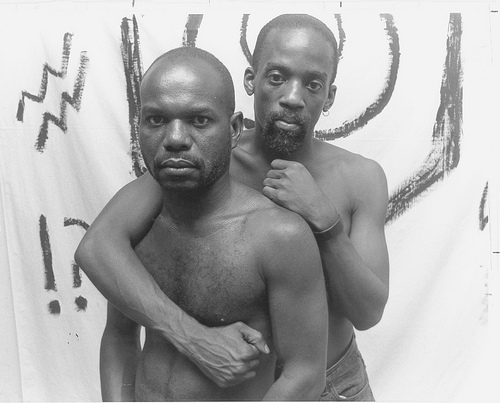
My thoughts: I think this movie, above all others really took me out of my element and made me see a subset of America I had not thought deeply about before: the black gay male. Seeing as I am neither black, nor gay, nor male, I wasn’t too sure how I would react to the documentary, but it ended up being the perfect example of why we watch movies: to experience something new as well as gain empathy for others.

Tongues Untied is a documentary in the sense that it is true experiences of the men involved, but there are no interviews or narration. Instead, most of the words are poems from Marlon Riggs, the director of the film who also appears on screen detailing his experience growing up gay and black. The rhythm of the movie was a little hard to get into at first, mostly because I’m not too familiar with poetry. I warmed up very fast to the concept once I stopped focusing on the words and instead focused on the people and emotions being showcased.

I’m no expert in late 80’s black gay culture, but Riggs seemed to show a full spectrum of men: drag queens, old guys, young guys, muscular guys, ‘sissies’ (a great discussion of this word occurs during a scene when a bunch of men are eating and talking about what they have been called). I loved that Riggs didn’t focus on the names of the men in the documentary because it made it feel like this could be anyone in the role, detailing their situations. The anonymity ended up making the movie feel more personal to me, as if I would recognize someone I knew at any moment.

The most powerful point of the film comes at the end, as the faces of young gay black men who have died of AIDS appear on screen. The theme of silence pops up throughout the poems in Tongues Untied, and refers to the silence men go through in hiding a part of their identity. Reading the obituaries in the film made me aware of how many men were forever silenced by the disease. 4 years after completing this film, Marlon Riggs himself succumbed to the AIDS virus.

5247605262_578a72e185

Final review: 5/5. Never in a million years would I have watched this on my own, but I am so glad I did.

Up next: Close-Up

#139- Farewell, My Concubine

Quick recap: This is the story of two men, Douzi and Shitou, whose friendship spans over 50 years in China.

best friends, being bros, doing bro things

best friends, being bros, doing bro things

Fun (?) fact: This is going to be a big one, so be prepared:

Ready?

China banned this movie. I KNOW. Crazy right?!

showing young boys being beaten and tortured was cool for China, but not the homosexual vibes going on between the two characters

showing young boys being beaten and tortured was cool for China, but not the homosexual vibes going on with Douzi

My thoughts: You guys, opera is badass. Seriously. I know next to nothing about it, and what little I do know concerns Italian opera. I think I was aware that China had their own productions but I wasn’t aware how, well, badass it all was. Chinese opera has the same themes as opera around the world: love, death, war, but they have an added element of acrobatics, amazing feats of strength and stunning costumes. Watching Farewell, My Concubine makes me want to hunt down a show and watch it live because although the movie was good, it’s not the same as watching the real thing.

The plot is straightforward enough: two friends stay close for over 50 years. But oh my god, the things these two men went through. I don’t know if you are aware of this, but China has some really messed up history. At times, it felt like the director was going for melodrama, with one tragedy occurring after another, but then again Farewell, My Concubine takes place during a very turbulent time in China’s history. Although this story is fictional, I imagine most of what the movie portrays is something someone lived through at some point.

One thing that really captured my attention was the depth of the characters. Douzi is the main character, whose story starts with his mother abandoning him at the training headquarters for the Peking Opera. He is initially rejected because of an extra finger on his hand, but his mother chopped it off and walked away. The training was brutal, with boys constantly being beaten with swords and expected to be perfect. Douzi is strong, but feminine, and so is trained to perform the Dan (female) roles. Throughout the movie, he maintains his feminine personality, to the point of being overly dramatic, like many people thought homosexuals acted back in 1993. Shitou is the more masculine of the two, but very caring. He has a very short temper but somehow endless patience for Douzi. I really enjoyed not having to pick a protagonist and root for one person because everyone in this film had faults.

the story is that a king is defeated in war. All his soldiers abandon him, except for his horse and concubine. The concubine stands until the very end and then kills herself with his sword.

the story is that a king is defeated in war. All his soldiers abandon him, except for his horse and concubine. The concubine stands until the very end and then kills herself with his sword.

Final review: 5/5. Many of the scenes were very difficult to watch but I was engrossed the entire 3 hours and at the end, it felt like it was almost too short of a film

Up next: Tongues Untied