#121- Persona

Quick recap: Netflix told me that this was a story about a nurse who cares for an actress who is unable to speak anymore. The two move to a summer cottage so that the actress can recuperate and in the process, the two women form a bond. Nice try, Netflix, but you aren’t tricking me that easily.

Netflix also neglected to tell me about the giant spider I would have to encounter in the opening.

Netflix also neglected to tell me about the giant spider I would have to encounter in the opening.

Fun (?) fact: The opening sequence features among other things, a cartoon shown upside down, A GIANT SPIDER, a lamb being slaughtered and Jesus crucified. It was all very weird and unsettling to me,but it turns out all the images reference other Ingmar Bergman films.

My thoughts: This is my second Bergman film, which pushes me ever closer to the line of pretentiousness. Not too close however, because I can’t understand a damn thing from either movie without spending a couple of hours researching what the hell I just watched. It makes me feel like I’m back in high school, looking up the meaning of almost every line in a Shakespeare play on Sparknotes and being so proud of myself for finally getting it. And then a minute later regret overcomes me and the whole piece of work has been cheapened just a little.

Just like Winter Light,  I loved how stylized and simple everything is. The film was shot in black in white and the characters also wear dark and light clothing. Watching the two converse (the actress couldn’t talk so it was just the nurse talking) was like watching a play where the focus is on nothing else but the characters. In some ways it made the film easier to identify with but in other ways, it just made everything seem significant. Why was Elisabet perched on that rock? What does that rock stand for? Alma cuts her left wrist, not her right. What could it mean???

The idea of Persona is an interesting one. It certainly drew me in more than Winter Light did. In the beginning of the film Alma is seen as the stronger of the two since Elisabet is unable to speak or do much. As the two become closer at the summer cottage, Alma starts to divulge some dark secrets, including an abortion she had after sex with a couple of underage boys. It’s at this point that Elisabet becomes the sane one. After a night of drinking, Alma observes how much alike she and Elisabet are, which references the title of the film and the idea that we see ourselves in others, but not always in the best way. The most mind blowing scene is when Alma confronts Elisabet about her past and a son that was born after failed abortion attempts. Elisabet’s face becomes more and more pained as Alma continues and then in one shot, it appears as if the women’s faces have merged together.The story could easily be Alma’s.  The realization horrifies her as she can truly see who she is and so Alma is finally able to escape.

url

Final review: 4/5. I can see myself watching this again, this time paying more attention to detail.

Up next: The Burmese Harp
#110- If…

Quick recap: A private school in England is filled with cruel prefects and delinquent students who later take their revenge by murdering a ton of people. It’s a jolly good romp!

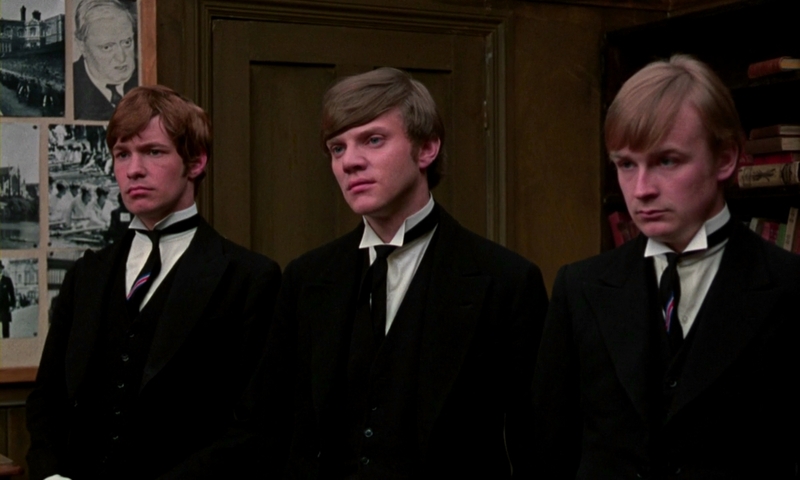
The guy on the right looks about 40, but I vowed to not let it bother me.

The guy on the right looks about 40, but I vowed to not let it bother me.

Fun (?) fact:  Malcolm McDowell had a crush on his female costar and and asked the director if there could be a nude scene for her. The directer said yes, but only if the girl (Christine Noonan) said yes. Her reply? ‘I don’t mind.’

Before clothes came off. They pretended to be tigers or something? I didn't really get it.

Before clothes came off. They pretended to be tigers or something? I didn’t really get it.

My thoughts: I wasn’t really sure what to expect going into this movie. It was rated X, which I think is my first on this list and is listed as an allegory as well as satire. Okay, then. I was so excited to see Malcolm McDowell as the lead role because I loved him in A Clockwork Orange, where he also played a delinquent teen. The first scene is of him arriving to school in a *gasp* mustache! That’s… kind of delinquent? The British have a much different view of what ‘rated x’ means than I do, apparently.

The movie switches back and forth between color and black and white, which led me to spend the entire time trying to figure out the symbolism. This is an allegory after all, so I knew there was some reason. My first hypothesis was that the black and white was fantasy and the color was reality but towards the end it seemed like the opposite might be true. I finally looked up the answer and it turns out that there is NO reason at all. The director just wanted random shots of black and white to distort the viewer. Great job, because I was totally distorted.

My main issue with this movie lies in the fact that it is supposed to be a satire of private schools and yet nothing really seemed over the top. One of the punishments involved making the boys stand in a cold shower for two minutes which sounds bad but not what I would consider cruel. My bias might have to do with the other massive amounts of pop culture depicting private schools in England being hellish. The prefects are mean but to be fair the three main boys spend their time getting drunk, stealing motorcycles and having sex on the floor of a coffeeshop with a random girl. And then there’s the mass shooting. I guess it comes down to the idea that I was supposed to root for Travis (Malcolm McDowell) and the other boys, but I didn’t much care for them.

If.. is supposed to be seen as a link between realist films coming out of England at the time, to the zany British humor we all know and love today. The scene where the boys kill the priest who later pops up in a box to be apologized to was reminiscent of some of the scenes in Brazil. Overall, though, I either didn’t get the satire or I have seen it done much better.

Final review: 2/5. Seriously, if you have to switch between black and white and color, make up a reason!

Up next: Texas Chainsaw Massacre, which I’ll be watching at the Alamo Drafthouse. Can’t wait for this one!

#109- Winter Light

Quick recap: Everybody is sad. Super sad, you guys.

No one has ever had it worse than me. Am I right, Jesus?

No one has ever had it worse than me. Am I right, Jesus?

Fun (?) fact: Director Ingmar Bergman’s favorite film from his career. He says that Winter Light was the most personal for him and helped him realize who he was during the filming. Which makes this movie even more sad.

Seriously, just Google this movie and you will see that all of the images are of the characters being sad.

Seriously, just Google this movie and you will see that all of the images are of the characters being sad.

My thoughts: I keep using ‘sad’ as a descriptor for the mood of Winter Light, but I really should be using words like ‘depressing’ , ‘existential’ and ‘I hope I have enough beers to make it through this movie’. In all fairness, I do normally enjoy movies that don’t end happily because such is life. But this movie was sad from the very beginning. I mean, it is called Winter Light, which is the perfectly depressing name for a movie.

Visually, the movie is beautiful. The use of black and white was the perfect choice for such a dreary film, and although they made me uncomfortable, I liked the close ups. It made the mood all the more depressing, but that was the point of the film so you might as well drive it home, you know? Especially impressive was the 6 minute shot of Tomas reading Marta’s letter. It is simply her looking right at the camera, and speaking the contents of the letter.

The story itself, of a priest going through an existential crisis is understandably a heavy subject. I get the feeling that Bergman didn’t create Winter Light (which is actually part of a series) as a date night movie, or something to make out to. Although I’m sure that there are plenty of people out there who would be into that sort of thing. Moving on. The plot is pretty straightforward and I don’t think it is any surprise that when the priest, Tomas, is unable to successfully counsel Jonas, Jonas kills himself. Like I said, if you are going for bleak, might as well go full force. Although this was a short movie, it is one that should be taken in small doses or at least through several sittings to truly grasp all that is going on. Not me, of course, but you guys go ahead and knock yourselves out.

now there's a priest with a true existential crisis

now there’s a priest with a true existential crisis

I don’t think it’s possible to have a ‘favorite part’ because it’s just not that sort of movie, but I was extremely interested in the discussion of Christ at the end of the movie. Algot, one of the members of the church, counsels Tomas after he has renounced his faith and brings up the point that everyone focuses on the physical suffering of Jesus. He goes on to say that instead, people should look at all the betrayals that He suffered including praying to God while He was near death, and not getting a response. Algot ends with the opinion that God’s Silence is worse than anything else. Like I said, heavy stuff.

Final review: 3/5. Wouldn’t watch again, but if you are looking for your own existential crisis (come on, who isn’t these days?), then this is the movie for you.

Up next: If….

#94- My Night at Maud’s

Quick recap:  A devout Catholic runs into an old friend, who identifies himself as a Marxist. The two decide to visit a recent divorcé (Maude), where they spend a night discussing philosophy.

maud

Fun (?) fact:  Want to host the most boring movie marathon EVER? My Night at Maud’s is the 3rd movie in a series entitled ‘Six Moral Tales’. 

Is philosophy really that exciting? No. No, it is not.

Is philosophy really that exciting? No. No, it is not.

My thoughts: Oh, France. I came into this project with some very stereotypical views about the French: Whimsy? Check.   Corrupting of youth? Check.    Existential art film? Check.  A story in which a penniless writer falls in love with a can can dancer from the Moulin Rouge? Check. And now add to that list a pretentious film, where every single bit of dialogue is stuffed with references to philosophy that some people might get, but I sure didn’t. Fact: If you have to spend more time researching what you just watched in order to understand the basic point, it’s not worth it.

The entire film is based off of the ideas of Pascal, who wagered that since it’s impossible to prove God exists, you might as well believe. If you live a good life and God does exist, you will be rewarded in the afterlife. If you do good and God doesn’t exist, then at least you didn’t waste your life.Vidal, the Marxist, likes the idea of Pascal but his friend Jean-Louis, the Catholic, does not. Jean-Louis doesn’t agree with his view on Christianity for several reasons I never understood. When the two friends end up at Maud’s, the conversation turns to Jean-Louis and his love for a woman he has never met. At some point, Vidal leaves and he is left with a choice: whether to sleep with Maud, who he clearly has an attraction to, or a random woman. Maud, for her part, is trying really hard to get Jean-Louis into bed. He is able to hold firm to his convictions until the middle of the night when he crawls into bed with her to get warm. In the morning, she rolls over and he embraces her. My first reaction was approval at his logic. But then he ultimately rejected her advances, and maybe that was for the best. When Jean-Louis meets his dream girl the very next day, he is seemingly rewarded for not backing down. The two get married and live happily ever.

My husband came up with the idea that Jean-Louis bet on meeting the girl of his dreams and, even if she had never appeared,  made the right choice not to sleep with Maud. I’d think about the movie further, except it has already exceeded the time spent watching the movie and so I am obligated to stop.

Final review: 2/5. My brain hurts.

Up next: Who knows?