#189- The Firemen’s Ball

Quick recap: A fire department throws a party (or ball, if you will) to honor their outgoing chief. They screw everything up with both hijinks and shenanigans.
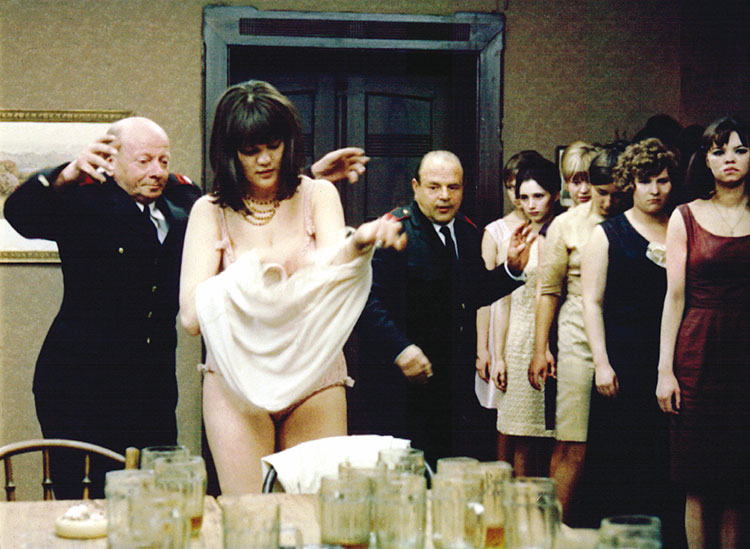
If you like your hijinks to be creepy as hell, this is the movie for you!

If you like your hijinks to be creepy as hell, this is the movie for you!

Fun (?) fact: The firemen portrayed in the film are not actors, but instead real firemen from the town the movie was filmed in.

Hitler mustaches were still the rage in Czechoslovakia in the 1960s!

Hitler mustaches were still the rage in Czechoslovakia in the 1960s!

My thoughts: I’m just going to jump right in and say that I didn’t find The Firemen’s Ball all that funny. That’s not to say that the movie was devoid of humor, but I don’t think I was the right audience. Set during the Cold War in Czechoslovakia, I can see how people in that country might be falling out of their seat in laughter, but seeing as how I am neither under a Communist regime (shut up, Ted Cruz) or Czechoslovakian, it didn’t interest me very much. For one, it’s a film with very dark humor, which I normally love, but these jokes landed closer on the side of just being mean. One of the main plot points is that the firemen want to organize a beauty pageant so that they might choose a beautiful girl to present the award to their former chief. Many girls don’t want to participate though, and the ones that do are not very attractive. One of the only girls they want shows up during the ball to reveal that she is wearing a bikini, since this is a competition. This leads to a very awkward situation where she is strutting around in basically her underwear while all these old creepy guys leer at her. I see the humor, but I’m not laughing.

After the film was over, I read the entry in my 1001 Movies to See Before you Die book to see if there was something I might have missed. There was. Turns out, the whole film was an allegory about the Communist regime. Knowing this pissed me off because I didn’t get that at all. So not only did I not find the movie all that hilarious, I apparently completely missed the entire point of the film. And then, in reading the Wikipedia entry, I read that the director didn’t mean for the movie to say anything about Communism. People couldn’t help but assign meaning. What the movie represents is a corrupt society with a corrupt leadership. That could literally be anywhere. It just so happens that the movie was filmed in a country with Communism so that’s what people saw, but corruption is at all levels,my friend.

I feel like knowing what the director thought gives me permission to assign my own meaning and in doing so, I can see the humor more than I did before. Throughout the film, items from the raffle keep getting stolen and it’s even revealed at some point that one of the firemen’s wives is in on it. One of the firemen asks the crowd to return the items and the lights would be turned off so that no one would be embarrassed. While the lights are off, the rest of the items get stolen. At the end of the film, after everyone has gone and the party essentially ruined, the men unceremoniously give the chief their present which, when he opens the box- has also been stolen. Take whatever lesson you want to in that scene, but it made me chuckle because you know, sometimes the drapes are just blue.

Final review: 3/5

Up next: She Done Him Wrong

#182- Buffalo ’66

Quick recap: It sounds like a typical set up for a romantic comedy- a guy lies to his parents about having a girlfriend and must find someone at the last second to keep the deception alive. Except that the guy just got out of prison. Except that his parents are total nut jobs. Except that the way he finds a girl is to kidnap one from dance class. Except that the girl is a teenager. Ignore all that and you have a solid romantic comedy!

awww.

awww.

Fun (?) fact: Vincent Gallo wrote, directed, composed music for and starred in Buffalo ’66.

tumblr_lxpf51KSfZ1r2odvuo1_1280

My thoughts: Buffalo ’66 is an ‘indie’ movie, to be sure, but so much darker than anything Wes Anderson could have or would have dreamed up. On its surface, it seems like the perfect film for a community like Tumblr to latch on to (and believe me, many have). The characters are beyond nutty yet also really sad and they get together in the end which is always nice. Nice, that is, if you are into ex-cons hooking up with teenage girls they have kidnapped. I personally wouldn’t go around pasting pictures of the movie with the hashtag #relationshipgoals, but to each his own, I suppose.

Shady ethical questions aside, I really did love this movie. Vincent Gallo has been called a control freak (see above fun fact), but in this case, it worked out perfectly. He was able to put all the pieces together in a way that he might not have been able to do with a partner. It’s difficult to describe the character of Billy Brown (although the word ‘tragic’ comes to mind), and I can’t imagine anyone else playing him besides Gallo. Seeing as how Gallo wrote the screenplay, only he knows the true ins and outs of the character like no one else could’ve pulled off. He disparaged Christina Ricci (his costar) in interviews about the film, and although I think she did a fine job, I don’t think anyone could’ve met Gallo’s expectations for the character Layla. Except maybe Gallo. Maybe he should’ve just been a one man show and taken full control of everything.

The characters in Buffalo ’66 are equal parts cringe-worthy, tragic and unintentionally funny. Honestly, each character could have his/her own analysis but I am in no way qualified or interested to do so. Most people might gravitate towards Billy Brown or his mother, but for me it’s Layla who I think is the most complicated. She justifiably scared when she meets him but then is able to turn into a loving wife when she meets the parents. It’s not very believable, though, which is why I loved the scene so much. I wonder what her motivation was at the time, because it had to be more than just fear of Billy Brown. When she recounts the (fictional) story of how they met the whole thing turns into a young girl having a serious infatuation with someone out of her league. And yet he isn’t, which is why the two stick together. She tells him that she loves him in the end, but is it true love or simply a teenage girl not knowing what she really wants? And Billy Brown reacting to her advances only shows how immature he is emotionally, but I still wanted it to end well, no matter how twisted the ending was.

Final review: 4/5. Let me tell you, this was a complicated movie to review, much more complicated than I originally thought it might be.

Up next: Alphaville

#180- Le Million

Quick recap: A man loses a million dollar lottery ticket, which sucks for him because he told all of his creditors that he is rich now and can afford to pay his debts.

those are his creditors dancing for joy because this guy was kind of a jerk and apparently owed a ton of money

those are his creditors dancing for joy because this guy was kind of a jerk and apparently owed a ton of money

Fun (?) fact:  Nothing. Zip. Nada. First time in 180 movies that the trivia page on IMDb was empty, but it’s bound to have happened at some point.

My thoughts: The fact that I had such a hard time finding anything out about Le Million says a lot. It wasn’t a good or bad movie. It just was. For a movie made in 1931, I was most impressed by the sound quality, which is the reason, I think, for including it in The List. The songs (yes, this was a musical) were catchy, although they kind of drifted in and out through the movie, never really beginning and never really ending. It was weird, but also made the movie’s events seem more plausible, almost as if it was a dream.

One of the reasons I didn’t really embrace Le Million is because of the characters. Michel is the jerk who lost the lottery ticket. He’s a penniless artist who has a fiancée but also sees girls on the side, which she totally knows about but refuses to break it off. Classy guy, that one. His friend (or rival?) Prosper is not much better and challenges Michel that if he finds the ticket, he gets half of the fortune. There’s also a mob guy, Grandpa Tulip, who takes the jacket that the ticket was in, and then the opera singer, Ambrosio, who buys the jacket and refuses to return it. I spent most of the film trying to figure out whether I wanted Michel to find the ticket or not, but ultimately rooted for him because his fiancée Béatrice was the one who gave the jacket away initially and I wanted something good to happen to her.

Looking on the positive side, although I can’t really say that I ‘enjoyed’ myself, I certainly wasn’t bored. I never laughed at any of the funny parts but I recognized that they were supposed to be funny, if that’s a thing. One scene in particular stood out: when the opera singer is on stage and Michel sneaks on to take the jacket. It had many elements of Moulin Rouge, including the way the audience was seated. I couldn’t find anything online, but I’m curious if Le Million inspired Baz Luhrmann in any way. It’s also possible that I see Moulin Rouge in practically everything.

Final review: 2/5. A very ‘meh’ movie.

Up next: The Ballad of Narayama

#172- Being There

Quick recap: A man who isn’t very bright somehow gets himself wrapped up with some of America’s most powerful politicians

 (Photo by Cooper Neill/WireImage)

(Photo by Cooper Neill/WireImage)

Fun (?) fact: from IMDb, because I couldn’t have said it any better, “The inscription “Life is a state of mind” is on Rand’s tomb and also serves as the last line in the movie. These words were also inscribed on Peter Sellers’ own tomb, when he died a year after the movie was released.

My thoughts: This movie was wonderful but it is so difficult to settle on why exactly I loved it so much. Being There is one of those movies where you spend the entire time feeling sorry for the protagonist, almost cringing at times, yet wanting him to succeed despite it all. A couple of examples come to mind: 40 Year Old Virgin and Stranger than Fiction (but not Forrest Gump. A different rant for a different day, my friends).

So, on a completely superficial level, the premise of this movie is hilarious. Peter Sellers plays Chance the gardener, who is LITERALLY a gardener and everything he says has to do with either gardening or tv, another favorite past time. At one point, Chance gets an opportunity to sit down with the President and talk about the economy. The President wants to know Chance’s thoughts on its current state and he responds by naming the different seasons. The President interprets what Chance is saying as the economy is growing and will continue to grow with a proper gardener. Women are just as enamored as the President is and with every weird thing Chance does, people see it as something profound.

Being There is as deep as you make it. Like Chance the gardener, the movie itself is a vacuum for which you can project whatever meaning you would like. Racial inequality? Political ineptitude? The clueless rich? It’s all there for the interpretation. Or you could just sit back and laugh because it’s good for that, too.

Final review: 5/5. Also, Satine from Moulin Rouge absolutely recreates a scene from this movie. If not for anything else, watch Being There for that.

Up next: The Battle of Algiers