#364- Ikiru

Quick recap: A bureaucrat finds out he has terminal cancer and realizes how much of his life he has wasted.

Fun (?) fact: Similar to Amarcord, I assumed the title was the name of the main character. It is not, however. Ikiru is a Japanese word meaning ‘to live’.

My thoughts: Ikiru is such a downer of a movie ,yet I felt so motivated and inspired by the end of it. Kanji Watanabe, played by Takashi Shimura, is just about the saddest person I have seen in film ever. I felt sorry for him as he sat through his boring desk job but once he got the cancer diagnosis, he just became pitiful.

The best part of the movie for me is that I never knew what direction it would take. There was some humor in the first few scenes that made me wonder if the diagnosis was a mistake and maybe Kanji could just learn a lesson and live for a very long time. And then he meets a man who teaches him how to spend money frivolously as well as a former coworker who shows him how to have a nightlife. At this point I expected Kanji to realize that family was most important or maybe realize that life should be enjoyed daily. But no, nothing of substance ever materializes and I’m left to watch Kanji continue to suffer.

AND THEN KANJI DIES WITH AN HOUR LEFT INTO THE MOVIE

I absolutely wasn’t expecting this. Where was the life lesson? Where was the grieving son who finally reunited with his father? Instead, the wake is attended by a few family members, bureaucrats, and high ranking government officials. Throughout several flashbacks, which I thought were very creatively done, the friends and family members find out that Kanji knew he was dying yet didn’t broadcast it to the world. Instead, he spent his final months helping to transform a sewage dump into a nice little park for kids to play in. As it usually goes, though, his work is mostly ignored until he is dead and everyone is able to come together and realize how good of a person he was.It was such a sweet way to end the movie, knowing that Kanji chose to help however he could and without any expectation of reward. The final scene recounts how he actually died in the park that he helped create. It’s such a beautiful scene to see Kanji swinging on the play set and singing a song about not wasting any moment. The snow is falling all around him, he knows he doesn’t have much time left and he is completely at peace.

Final review: 5/5. I didn’t get into it much but this movie is also beautiful, every single scene.

Up next: Tabu


#363- The Killing Fields

Quick recap: As I may have mentioned one or two times before, war is hell. Journalist Sydney Schanberg is momentarily stuck in Cambodia during the mass murder cleansing campaign ‘Year Zero’ along with his friend and translator, Dith Pran. While Schanberg is eventually rescued, Pran, a native Cambodian, is left to fend for himself in a country now hostile to its citizens. OH! AND THIS IS A STORY BASED ON TRUE EVENTS.

I made the mistake of Googling ‘The Killing Fields’ . Don’t do that.

Fun (?) fact: Haing S. Ngor, the actor who played Dith Pran has a tragic story that almost rivals the one told in the movie. His wife died during childbirth during the Cambodian cleansing campaign because even though her husband was a doctor, seeking his help would mean the Khmer Rouge finding out about him and murdering him. Ngor eventually escaped to America and was chosen to play Pran. He was later murdered in what many people believe to be a revenge killing for speaking out against the Cambodian atrocities.

My thoughts: Time to let my American ignorance shine through as I admit to knowing next to nothing about Cambodia’s history before this movie. I had heard of Pol Pot and Khmer Rouge but I had no idea how evil it all was. The killing Fields is a tough movie to stomach for several reasons, but for me there is a lot of guilt and anger that this piece of history was never discussed or mentioned in school. As evidenced from this movie, though, Americans alive while this happened weren’t aware of the atrocity either. The final scene of the movie explains that as of 1984, the film’s release, Cambodia was still recovering. Even today, there are remains that have yet to be identified.

History lesson aside, This movie was just as powerful as I expected it to be. The Killing Fields is told in two parts: the first part is about Sydney Schanberg and his crew trying to make it out of Cambodia and the second part focuses on Dith Pran’s struggle to survive as he is left behind. As much as I liked Schanberg, the performance felt a little heavy handed at times. It never crossed over into him being the victim thankfully but it got close several times. Pran’s part of the film had my full attention. The real Pran coined the term ‘Killing Fields’ when he stumbled into a body of water lined with thousands of bodies, people murdered from the regime. That scene has stuck with me several days later.

What I appreciate most about this movie is that it never feels sanctimonious or preachy about the plight of the Cambodians. The story focuses on these two friends and how they navigated such a terrible time in our world’s history. Looking at the suffering close up really drives home how horrible it all was and I was better able to grasp the atrocities. The conflict reminds me a lot of Syria and the images shown daily of the refugees and dead children. Will we hear of stories like this in 10 years and feel the same shame and regret that we didn’t pay attention sooner? Time will tell.

Final review: 4/5

Up next: Ikiru


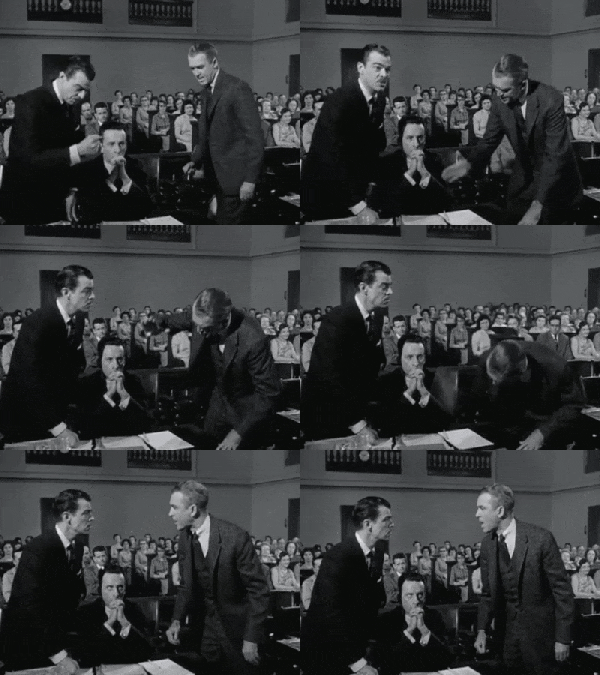
#362- Anatomy of a Murder

Quick recap: Lt. ‘Manny’ Manion is accused of murdering his wife’s rapist and it’s up to James Stewart to prove his innocence.

That’s some good lawyering right there

Fun (?) fact: James Stewart’s father HATED this movie so much he took out a full page ad in a newspaper urging people not to go see it.

I wonder why…

My thoughts: Here are a few words I never expected and/or want to hear from James Stewart again:

  • jiggle
  • sexual climax
  • sperm

And the absolute worst:

PANTIES

As you can ascertain, this movie was scandalous for its time (1959). Much of the plot revolves around a woman who has been assaulted and raped, who may or may not be telling the truth. And honestly, I still have no idea what to make of the ending. Lt. Manion was found not guilty by reason of temporary insanity but there really is no way to know for certain whether he did it. The bigger point is what the movie is attempting to say. Both scenarios are troubling but also both speak to the times in a way that mirrors what is currently debated in our country.

Scenario #1- Laura was really raped and her husband killed the accuser in a fit of rage

So if this is what ended up happening, then this movie is one of the most fiercely feminist out there. Every single piece of evidence points to Laura coming on to her accuser and this having been a consensual affair. At no time does Manion’s attorney, Biegler, imply anything other than Laura telling the truth. There are several moments of him losing it during the trial when anything else is suggested, which is surprising because the idea about a woman ‘inviting rape’ is still a prevalent one in today’s society. What the verdict says is that it doesn’t matter what a woman wears or how she moves or hips or if she gets into a stranger’s car- she doesn’t deserve rape.


Scenario #2- Laura had an affair and her husband is insanely jealous and probably abusive

This is the scenario with the most evidence. And if this is the truth, then James Stewart is actually the villain of the film not the hero he usually is. He is just a lawyer looking to win with tricks rather than finding out the truth. In this perspective, the entire court case is one big circus act. It says a lot about our broken criminal system and how it comes down to who can argue best, not what the actual evidence is.


The end of the film finds Biegler visiting Manion and his wife, only to learn they have skipped town. The caretaker observes that Laura was upset and crying and the whole place is a mess. Manion has left a note which makes a joke about his insanity defense. Everyone laughs and happy music plays as the scene fades to black. This is either a happy ending where everything worked out because the criminal justice system works or it’s an incredibly bleak one where everything is broken and a murderer is loose. What a dilemma.

Final review: 4/5. Interesting concept but everything is so muddled, I don’t know what to make of it all.

Up next: The Killing Fields

#360- The Young and the Damned

Quick recap: A group of boys from the slums of Mexico City resort to crime in order to survive.

Jaibo’s ill-fitting overalls are all you need to know he is up to no good

Fun (?) fact: The movie was very poorly received when it first came out but after people had a chance to calm down, they realized that it held a lot of truth. The Young and the Damned is now considered one of the greatest Mexican films of all time.

My thoughts: I’ve seemingly been caught in a ‘wayward youths’ movie vortex as of late and it’s hard to tell whether I can escape any time soon. I’ve lucked out up until now because almost all of the films have a glimmer of hope attached, even though most of the movie is very grim. (I’m looking at you, City of God)

The Young and the Damned, as I should’ve gleaned from the title, is a different beast altogether. It lured me in at first, making me think this was just a cute cautionary tale about bad boys who drink and smoke but who are just little scamps in the big picture of things. And actually, that part might be true until the Ultimate Wayward Youth, Jaibo, shows up after breaking out of reform school. The boys immediately take to him as he shows them how to rob a blind man of his money. It’s a cruel scene, but nothing I haven’t seen before. They take it to a new level however when they chase the man and throw stones at him. That’s when I realized no one was playing around. Every actor in the film is believable as a corrupted youth. I was blown away with how complicated they showed their characters to be. As mean as some of the boys are (including a scene where Jaibo straight up murders a kid), it’s very obvious that the director fully believed poverty was to be blamed for all their hard lives.

Pedro, the main character, is about as real a kid as you can get. He tags along with the gang but never really does the bad stuff. He befriends a lost boy and gets him food to eat and he does his best to listen to his mother, even though they both know she can’t really take care of him. He gets caught up with Jaibo, however, and thus starts his downward spiral that ultimately ends in his tragic death. His murder really broke me in a way that is hard to convey because I wasn’t expecting that kind of ending at all. I kept thinking something good would eventually turn up but it didn’t. The final scene of the farmer throwing his body down a hill is so sickening but really hit home the point that Mexico City was in a crisis with poverty at the time.

Final review: 5/5

Up next: Trouble in Paradise