#302- Braveheart

Quick recap: A mostly fictitious tale of William Wallace, the man who (maybe?) freed Scotland from England.
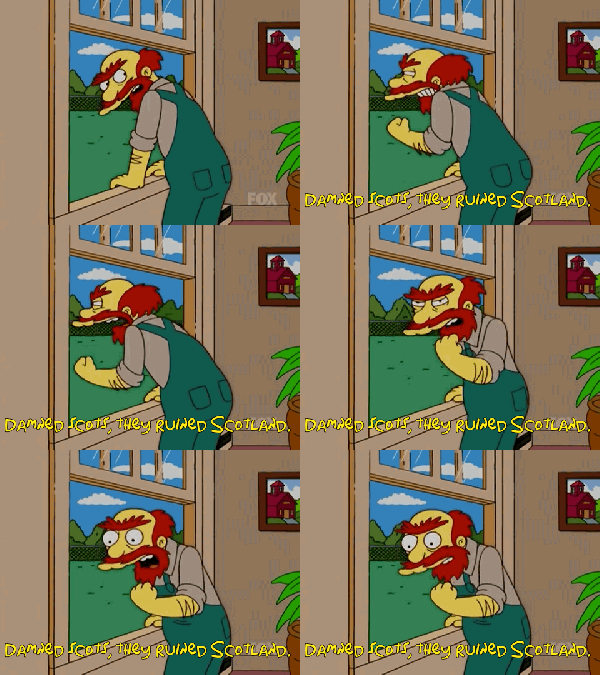
Fun (?) fact: ‘Braveheart’ was actually Robert the Bruce’s nickname, not William Wallace’s. He, unlike Wallace, is considered a Scottish hero and many Scots were angry with the way he was portrayed in the movie.

Come to think of it, they probably don’t care for Groundskeeper Willie either

My thoughts: Oh, Braveheart, my first ‘grown up’ movie I fell in love with. Speed was actually first, but there was just something more mature about a hunky, shirtless Mel Gibson than a bus that couldn’t slow down. Knowing what I know now about the film’s take on historical events as well as what I’ve learned about Mel Gibson, I worried that Braveheart wouldn’t have the same impact as it did on 11 year old Me. Fortunately, it totally holds up.

I don’t know if it’s a fair comparison, but in my mind, Braveheart and Shawshank Redemption are always grouped together. Both are ‘epics’ and both are universally loved. Despite the MANY historical inaccuracies, it was hard not to fall in love with Braveheart all over again. It’s an uplifting film (um…besides all the blood and torture) like Shawshank ,and a message that any toddler could grasp. And as much as I don’t want to admit it, it’s the kind of movie that sticks with you long after it’s over. Mel Gibson may be an ass in real life, but he is a hell of an actor. He absolutely nails the role of William Wallace. It’s those blue eyes, I think. How does he do it?

Treating Braveheart like a folktale (think Robin Hood) is the best way to go about enjoying this movie. William Wallace is larger than life and there are several nods to this in the film. I was a little put off by the fact that Wallace essentially freed Scotland because his wife was murdered but I think the point is that the desire was in him all along. I’m glad that it still holds up, over 20 years later, even if it is mostly not true.

Final review: 4/5

Up next: Faces

#301- The Curious Case of Benjamin Button

Quick recap: Benjamin Button is born an old man and ages backwards,taken from a short story by F. Scott Fitzgerald.

 Fun (?) fact: There are several nods to the concept of ‘backwards’ in the film- a hummingbird, which is the only bird able to fly backward, and a hurricane which spins in the opposite direction depending on the hemisphere.

Even if I had hated this movie, I’d watch it again and again for young Brad Pitt

My thoughts: Before anyone else says it- logically,I know that 32 isn’t that old. I’ve never wanted to be one of those people that lied about my age or tried to ‘stay’ 25 until I was 50. But a few weeks ago, while in a hotel room getting ready to go out, I had a freak out about aging. I was blow drying my hair and noticed a (to me) huge patch of gray that had definitely not been there a couple of weeks ago. It was such a sudden change to my body and it took me by surprise. I don’t feel old but there was something about seeing myself age that terrified me. I’ve seen The Curious Case of Benjamin Button before, back when it was in theaters, and at the time, all I remember was being impressed by the special effects. Had I watched this movie two months ago, I would’ve felt the same. But seeing it now, at this weird time in my life, it just means so much more.

By my estimation, the first 2/3 of the movie is largely forgettable. It’s not bad, but it’s also not profound. My main motivation for continuing to watch was to see how Brad Pitt would look next and when he would finally stop looking so old. The movie picked up towards the end as I finally understood the importance of the relationship between Benjamin and Daisy, his true love. I had grown tired of their ‘will they, won’t they’ issues and when they finally hooked up, I kept waiting for the shoe to drop and both to realize that this would never work. But that’s not what happened. The last 1/3 of the film explores the true consequences of aging- the fear of being a burden and the regret of missing out on life. The way Daisy cared for Benjamin in his last few years, until he was just a tiny infant was beautiful and spoke to the longing most people have-for someone to love them no matter what. Aging isn’t going to stop, nor should it, but it also shouldn’t keep us from opening up to those who truly care.


Final review: 4/5

Up next: Braveheart

#300- The African Queen

Quick recap: She’s a missionary, he’s a riverboat captain who delivers the mail to remote areas in Africa. Together, they team up to fight the Germans and maybe even fall in love.

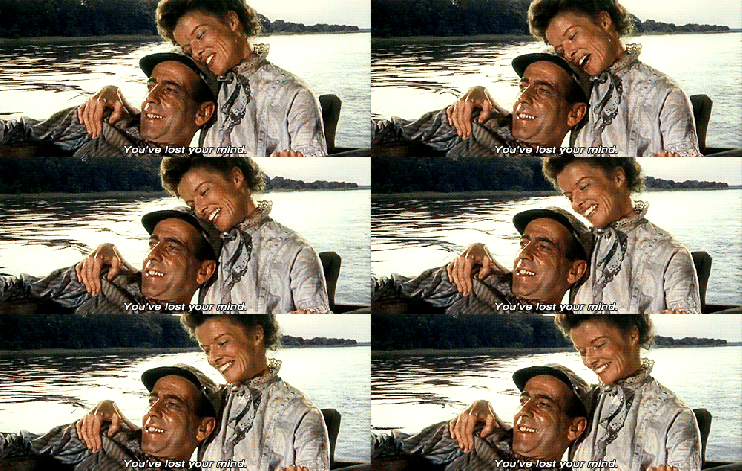
Fun (?) fact: Katharine Hepburn was so disgusted with John Huston and Humphrey Bogart’s drinking during filming that she stuck to water only. As a result she got dysentery, which is some kind of life lesson I feel I should pay attention to.

My thoughts: In the hierarchy of Romantic movies, the ‘ uptight woman falls in love with spineless man’ is probably my least favorite. I was worried that’s what I was heading into with this film, but I’m so glad that ended up not being the case.

I loved Katharine Hepburn as Rosie and I would even venture to say she is one of my favorite characters I have encountered on this list. There was just something about her instant love of adventure that immediately endeared her to me. I’d like to think I would do the same in her situation, except picking leeches off the love of my life. Sorry. Rapids, yes. Germans, hell yes. Leeches, no. I also loved Hepburn’s chemistry with Humphrey Bogart’s Charlie. It was a little too much at times but the moments when they were just sitting together and enjoying each other were really sweet. He seemed to genuinely care for her and she for him. I didn’t buy the ending where their tiny little boat sank a German ship but my heart might have melted a bit when at the end they were able to celebrate the fact that they just got married.

The constant threat of danger got a little old after awhile but it also made for an entertaining film so I won’t fault the plot too much. The scenery was lovely and I really appreciated that they filmed on location. Anything less would’ve made this movie a laughing stock, I think. Still, it doesn’t make me want to pack up and trek through Africa anytime soon.  I love a good adventure but the director made it seem that I would be attacked the second I landed.


Final review: 5/5

Up next: In Retrospect Part 3!

#299- Mr. Smith Goes to Washington

Quick recap: A naive man becomes a senator and learns very quickly how much of a cesspool DC is.

Fun (?) fact: Mr. Smith Goes to Washington was considered controversial to Americans who felt that it showed the government in a less than positive light. Meanwhile, Nazi Germany and other Socialist countries refused to screen the film because they felt it showed Democracy working as it’s supposed to.

Me: just stick to that Simpsons episode
Also me: bring in Trump

My thoughts: People always say, ‘greatest thing since sliced bread!’ and it makes me wonder what people compared awesome stuff to before sliced bread. Same concept goes for this movie. What did people compare DC drama to before this movie? I’m sure there were books and political cartoons, but this movie is just so perfect for so many situations. Back in the day, reporters had to go out and look for a comparison. ‘Gulliver’s Travels?’ they would say, hesitantly. ‘That sort of fits, I guess.’ But then, Mr. Smith Goes to Washington came out. ‘ This article practically writes itself!’ the same reporters said and left their typewriter to go swim in their giant piles of money.

I’m not sure if this is an unpopular opinion or not, but Jefferson Smith (played by James Stewart), did not do a very good job as Senator. He came in with an idea for a law that wouldnot only benefit a very small percentage of the population but would certainly benefit his home state. The senators against him wanted a dam in the same area, which is actually not that bad of a plan, considering this was the Depression and jobs were desperately needed. Surely there were more important pieces of legislation to debate besides a camp for boys? Despite all this, it’s hard to not get caught up in Smith’s excitement about being a part of the government. Despite my current bitterness for anything concerning politics, I couldn’t help but cheer him on. He was fighting the Political Machine, something that even in 2017 we haven’t figured out how to do.

Yes, this movie was ridiculous but it really does sell a person on Democracy. I’ve been so angry these days with the political climate so it was a nice reminder that some things never change. The only part of the movie I didn’t love was the love subplot. Jean Arthur as Saunders was such a badass. She really ran the show and would’ve made for a better senator than Smith, but of course she gets relegated to Love Interest. Mr. Smith Goes to Washington is in fact a romance- between the people and Democracy, and that should’ve stayed the focal point. As it is though, still a very powerful movie.

Final review: 5/5, and yes there were spinning newspapers galore!

Up next: #300