#97- L’Age d’or

Quick recap: A man and woman want to get it on but keep getting interrupted by the church, society and family. LAME.

ruins the mood a little

ruins the mood a little

Fun (?) fact: Director Luis Buñuel and Salvador Dalí were good friends but had a falling out before the movie was set to start filming. The first day on the set Buñuel chased Dalí off the premises with a hammer.

My thoughts: I don’t even know. L’Age d’or begins with a documentary about scorpions and ends with an orgy with Jesus so……. basically, it’s your typical French film. I started out somewhat interested, especially when it came to the scorpions. I have severe arachnophobia and I was just thinking to myself  last night how nice it would be to have a new fear and what better than another arachnid?? But then the scene changed to a bunch of soldiers who are fighting some religious guys and I was a little confused, but figured I would catch on as the film went on. And then in the next scene the religious guys were skeletons and a man and woman were trying to have sex in public and at that point I threw my hands in the air and just went with it.

The problem I had with L’Age d’or is not that it was all symbolic, but that it was symbolism I had never seen before. At this point, I’m just going to assume everything I watched was a reference to sex in some way. On the positive side, I learned a whole new crop of euphemisms for sexual repression: ‘kicking the violin down the street’, ‘cow in the bed’, ‘slap an old woman’, and my personal favorite- ‘ murder a child for no reason’. Fun times, I’m telling you.
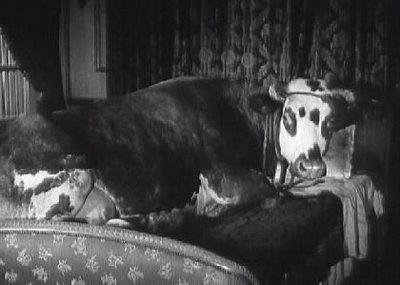
No, really.

No, really.

So, did the man and woman ever hook up?? I don’t know, kind of? At one point they were making out while a symphony played a few feet away and then they had each other’s hand in the other’s mouth, so I guess that counts as second base? The woman starts fellating a statue’s toe a little later on so I assume she wasn’t satisfied. At the end of the film, the two lovers are holding each other and having pillow talk- discussing how sleepy they are and how nice it is to murder children. And then the next scene the guy has blood all over his face. Luckily, I had checked out way before this scene came on and I wasn’t too traumatized.

L’Âge-d’Or

Final review: 1/5 and I don’t really think I need to go into detail as to why.

Up next: Babe!

#94- My Night at Maud’s

Quick recap:  A devout Catholic runs into an old friend, who identifies himself as a Marxist. The two decide to visit a recent divorcé (Maude), where they spend a night discussing philosophy.

maud

Fun (?) fact:  Want to host the most boring movie marathon EVER? My Night at Maud’s is the 3rd movie in a series entitled ‘Six Moral Tales’. 

Is philosophy really that exciting? No. No, it is not.

Is philosophy really that exciting? No. No, it is not.

My thoughts: Oh, France. I came into this project with some very stereotypical views about the French: Whimsy? Check.   Corrupting of youth? Check.    Existential art film? Check.  A story in which a penniless writer falls in love with a can can dancer from the Moulin Rouge? Check. And now add to that list a pretentious film, where every single bit of dialogue is stuffed with references to philosophy that some people might get, but I sure didn’t. Fact: If you have to spend more time researching what you just watched in order to understand the basic point, it’s not worth it.

The entire film is based off of the ideas of Pascal, who wagered that since it’s impossible to prove God exists, you might as well believe. If you live a good life and God does exist, you will be rewarded in the afterlife. If you do good and God doesn’t exist, then at least you didn’t waste your life.Vidal, the Marxist, likes the idea of Pascal but his friend Jean-Louis, the Catholic, does not. Jean-Louis doesn’t agree with his view on Christianity for several reasons I never understood. When the two friends end up at Maud’s, the conversation turns to Jean-Louis and his love for a woman he has never met. At some point, Vidal leaves and he is left with a choice: whether to sleep with Maud, who he clearly has an attraction to, or a random woman. Maud, for her part, is trying really hard to get Jean-Louis into bed. He is able to hold firm to his convictions until the middle of the night when he crawls into bed with her to get warm. In the morning, she rolls over and he embraces her. My first reaction was approval at his logic. But then he ultimately rejected her advances, and maybe that was for the best. When Jean-Louis meets his dream girl the very next day, he is seemingly rewarded for not backing down. The two get married and live happily ever.

My husband came up with the idea that Jean-Louis bet on meeting the girl of his dreams and, even if she had never appeared,  made the right choice not to sleep with Maud. I’d think about the movie further, except it has already exceeded the time spent watching the movie and so I am obligated to stop.

Final review: 2/5. My brain hurts.

Up next: Who knows?


#91- Monsieur Verdoux

Quick recap: Charlie Chaplain plays Monsieur Verdoux, a perfectly charming gentleman.Faced with the difficult situation of caring for his wheelchair bound wife and young son after losing his job at the bank, Verdoux does what any stand up man would do-he becomes a mass murderer.

I'm going to murder you all!

I’m going to murder you all!

Fun(?) fact: Chaplain bought the idea for the movie from Orson Welles for $5000

My thoughts: City Lights is one of my favorite movies, and so I was hesitant to watch Chaplain in a ‘talkie’. In all honesty, I had kind of assumed he had retired once the era of silent films was over. Apparently not, and it was quite a relief to see how easily he had transitioned, yet still keeping his over the top expressions he was known for.

The film apparently takes place in France, although everyone has an english accent. That’s one of my biggest pet peeves in movies- when the accent doesn’t match the region (I’m talking to you, Tom Cruise). There were a lot of characters thrown in at the beginning of the movie, which was confusing at first, until I learned to just focus on Verdoux. Chaplain’s character is a little guy, but an expert at wooing women. He is supremely charming when he needs to be and has to summon up a lot of patience for some of the women he deals with. I especially loved the little quirks of his, such as how quickly he thumbed through the money and his continually failing to kill one of his wives. Hilarious!

1083875860

I thoroughly enjoyed myself until the end of the movie, when Verdoux is finally caught and sentenced to death for all the murders. In his speech to the court, Verdoux basically says that everyone finds him horrible, yet bombs are killing women and children every day and no one cares. It’s not that I disagree with the message, but I don’t like having to sit through a movie only to realize it was political satire this whole time. And I do love me some satire, but not in this way. If the speech had just been edited out, it would’ve been a perfectly fine comedy. Satire can be subtle but not so nonexistent so that the main character has to make a speech about the point of the movie. Chaplain was apparently extremely left-wing and felt this film to be one of his best. It was controversial when it came out and was the beginning of the end of Chaplain’s career.

Final review: 3/5. Still a nice little gem of a movie, if you take away the ending.

Up next: Star Wars: Episode IV


#90- Seven Samurai

Quick recap: A group of farmers, tired of being pillaged by bandits year after year (and really, who isn’t?) ,decide to hire samurai to keep their town safe. Seven samurai, to be precise.

seven-7-samurai-akira-kurosawa-1954

Fun (?) fact: Seven Samurai was the first film to showcase a ‘reluctant hero’, as well as the gathering of the heroes, now common in a film like Ocean’s 11.

My thoughts: Nothing can kill my excitement for a movie quicker than ‘3 hours and 27 minutes’. I have heard people talk how amazing this movie is, but I just can’t see anything being worth 3 hours and 27 minutes. Except for Jeanne Dielman, but that was an action filled time watching her cook dinner and wash dishes. No way Seven Samurai could top that.

From the first scene, when the bandits decide to save their pillaging for another time when there will be stuff to pillage (common sense), there was non stop action. Maybe not action in the sense of fighting, although there was plenty of that, but action that drove the plot. I can’t think of a single scene that was unnecessary to the story, or a time that I felt bored. In the same respect, there wasn’t so much going on that I was confused. Although it is a long running time, it is well justified.

I think my favorite aspect of Seven Samurai and the part I was most surprised by, is the emotion. As the villagers and samurai became used to one another and started to work as a team, I became more invested in each character and although I  knew that the ending would be sad, it still took me by surprise. I think most of that stems from watching how kind the samurai were to the entire village. Save for Katsushirō, the samurai who fell in love, everyone respected the farmers and went to great lengths to prove they weren’t all that bad. But in the end, samurai are warriors and they had to do what they were hired to do.

The final scenes in battle and the final moments with the samurai are some of the more emotional I have watched. The final scene especially: the 3 surviving warriors watching the happy villagers plant their crops and sing, almost as if they had forgotten all of the violence that led to their freedom from the bandits. Instead of being angry at the seeming callousness towards the fallen men, the samurai note that it is the villagers who are the victors and so should be celebrating. They have done their job.

seven_samurai_by_sulley1993-d38knqy

Final review: 5/5. Watch this movie. Doesn’t matter if you dislike war films or having to read subtitles or whatever the excuse- watch this movie.

Up next: Monsieur Verdoux