#147- October (Ten Days that Shook the World)

Quick recap: October is a silent propaganda film chronicling the Bolshevik revolution and storming of the Winter Palace.

Fun (?) fact: The actual storming of the Winter Palace wasn’t very photogenic on account of the chaos, so scenes from October are now used as historical evidence.
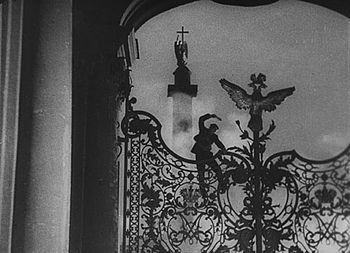
350px-Eisenstein_Zimnii

My thoughts: Propaganda films fascinate me for many reasons, but I mostly look forward to watching them because it’s fun to see if I will fall into the agenda the film pushes. Salt of the Earth is a great example of this. I anticipated watching October even more because I have little to no knowledge of Russian history and wanted to see if that would affect my thinking in any way.

A little history before my review: First, the Tsarist government was overthrown and a new government was set up of mostly aristocrats. They were then overthrown by the working class, who formed the Bolshevik party. From there, they elected their own members and the Soviet Union was born. I learned none of this from the movie, by the way. After October finished, I rushed to Wikipedia and read up on what the hell I had just watched.

So, October is not the sort of movie anyone should watch without context, like I chose to do. All I saw was two hours of people running around with guns and it was all very confusing. Add to that, the director put in artsy images to drive home his point, all of which went over my head. For example, in one scene a fat guy with really bad teeth was shown talking and looking important. Spliced in with that guy was an image of a really creepy bird that kept turning its head. Afterwards, I learned that the bird was actually a peacock, the symbolism being that the aristocrat was preening, as a peacock does.
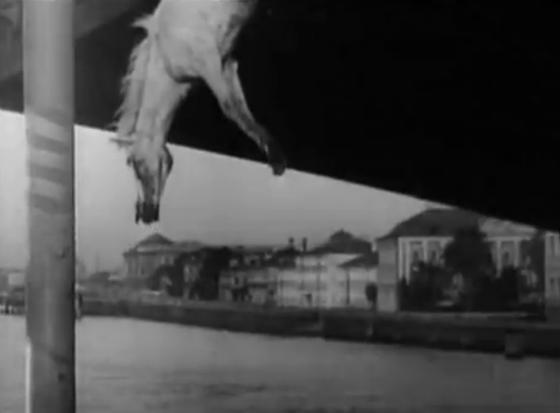
also, this dead horse hanging from a bridge was symbolic of something

also, this dead horse hanging from a bridge was symbolic of something

October surprisingly works really well as a propaganda film. As a moviegoer in the 20s I would’ve probably been moved by the Bolsheviks’ idea of helping the working class and poor.Director Eisenstein turned everything black and white, trying to show clearly who was working for the good of the people and who wasn’t. It’s easy to get caught up in something like that, especially seeing images of people starving while bureaucrats sit in their fancy houses and dine on fine food and expensive alcohol.   Time is on my side though and I know how this story turned out and so in watching this film in 2015, I was mostly unmoved.

Final review: 2/5. It would’ve earned a 1, but watching October has spurred my interest in Russian history so that’s not a bad thing to take from this.

Up next: The Story of a Cheat

#44- All the President’s Men

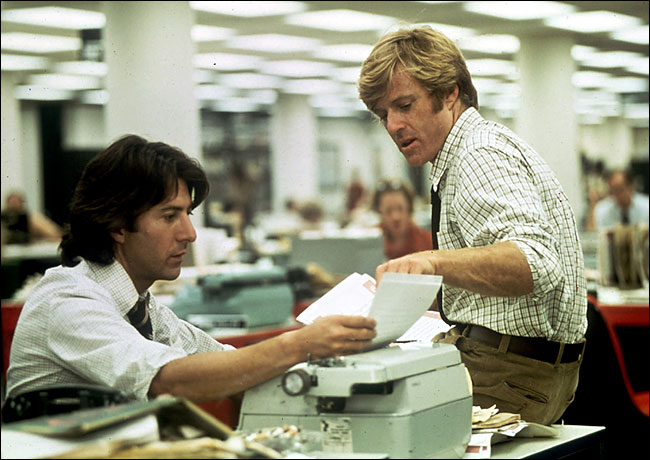
Quick recap: In the early 70’s,  journalists Bob Woodward and Carl Bernstein were responsible for bringing the Watergate scandal to light. What starts out as a minor break in at the Democratic Headquarters eventually leads higher and higher up into the Republican Party and eventually implicating  then-President Nixon. SPOILER ALERT- Nixon is forced to resign.  I apologize if anyone was spoiled by that previous statement.

This was supposed to be an image of 'Deep Throat'. I don't suggest Googling the title.

This was supposed to be an image of ‘Deep Throat’. I don’t suggest Googling the title.

Fun (?) Fact: The movie was originally shot inside the real Washington Post office, but workers kept trying to get screen time so they rebuilt the office on a sound stage . The office shown on the film has meticulous details like real stickers and phone books that had been used during the scandal.

My thoughts:  I love politics. I love movies. But I do not enjoy political movies, for the most part. In fact, the only movie I can recall really loving was ‘Frost/Nixon’, so maybe I just have a thing for Nixon? Personally, I find him to be one of the most interesting presidents we have had. Not one of the best, but interesting.

Richard Nixon's Head


This movie was odd in that I was really drawn to it at the very beginning and very end, but the middle was a little tedious at times. Maybe it was because I already knew the outcome, but I was rather bored sitting through several scenes of Woodward and Bernstein calling people. It just seemed too true to life for me at the point. On the other hand, the film did a great job turning phone calls into AMAZING REVELATIONS!. I’m thinking of one scene where Bernstein calls the librarian and asks her about books that have been checked out. She admits to seeing the person but then a few minutes later denies ever hearing the man’s name. Riveting stuff, really. It was around this point, that I had my own AMAZING REVELATION. As I was watching Woodward and Bernstein combing through the library records, it occurred to me that I was looking at this film from the entirely wrong perspective: This movie was not about Watergate, but instead about journalism itself. After realizing this, I found myself enjoy the movie much more.

Being married to someone who was a journalist at one point and eventually changed careers because print media is dying, made this movie all the more poignant. I was amazed by how much WORK went into blowing a scandal open like this. Every tiny detail had to be researched and then confirmed by several sources before it went to print. The journalists involved gave every waking moment to investigating the scandal and it paid off. I can’t really comment on the state of things now, seeing as I don’t have first hand information, but I imagine that investigative journalism just isn’t the same anymore. There is one scene in the beginning of the movie where Woodward is trying to figure out a name on a list. He asks his boss, who happens to know what the man’s title is and it is that knowledge that helps move the investigation further along. Had this happened in modern times, Woodward would’ve simply Googled the name, maybe emailed the guy and waited around. I love me some technology, but there is something to watching how all of the clues are being put together without a use of a computer, just by talking to people. I loved how Woodward and Bernstein could make people talk. It wasn’t like the sources had a reason to give info and many were afraid to do so, but they helped anyway and it helped bring down the presidential office, eventually. I see it on Twitter, both political parties always looking for their ‘Watergate’, but the thing is, that was a once in a lifetime story, and even then may have amounted to nothing if it hadn’t been for those two.  It’s a truly fascinating film to watch, if only to see the final death knell of traditional investigative journalism.

Robert-Redford-Screening-All-the-Presidents-Men-Revisited-in-Washington-DC


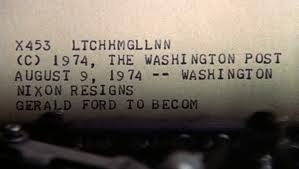
Final review:  4/5. The final few moments are some of the best in cinema history: Woodward and Bernstein writing the piece that finally blows everything open, as they watch Nixon’s inauguration on tv and the metaphor of the cannons blasting. And then summing up the rest of the events of Watergate, using the typewriter. Watch this movie, if only for these scenes. allthepresidentsmentypewriter

Up next: The Silence of the Lambs