#198- Little Big Man

Quick recap: A 121 year old man recounts his various adventures growing up in the wild west.

lbgunfighter

Fun (?) fact: I’m sure there’s some really interesting stuff out there about this movie, but what stuck out most to me was that Dustin Hoffman is 78 years old. No one else seems to think anything of this, but I’m still trying to wrap my head around it.
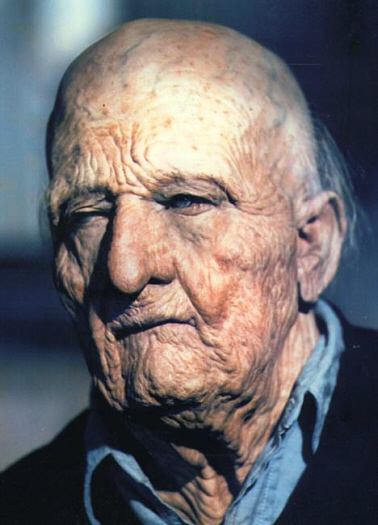
I don't see him looking like this at 121, but you never know

I don’t see him looking like this at 121, but you never know

My thoughts: As with anything Native American related, it’s usually very difficult to pull off anything that isn’t completely offensive, so I didn’t have high hopes going into Little big Man. In fact, I had already planned some of the snark I would say on this post related to such insensitivity. Alas, that version won’t happen because I thought everyone did a really good job (impressive, even) with the subject matter, managing to create something hilarious and heartbreaking and giving me the motivation to learn more.

Little Big Man is mostly about Jack Crabb’s (played by Dustin Hoffman) relationship with the Cheyenne nation. As a child, his entire family was wiped out from the Pawnee tribe, except for him and his sister, and a member of the Cheyenne took him in. His sister ran away, but he stayed until he was a young adult and became an honorary brother. Sure, there were some questionable things like the manner of speech the Cheyenne had and their various traditions, but overall, they were seen in a very positive light. Crabb fights with white men at some point and once he is discovered as one of them, he is shipped off to a town to learn some religion. It’s from here that the movie begins to bounce back and forth. He goes through every Western cliche you can think of ( helper at a medicine show, gun fighter, helping a woman at a whorehouse, and so on), but that’s what made the movie funny. This is a tall tale, you see, and I never really got whether or not we are supposed to believe it ( think Big Fish), but it was very entertaining, nonetheless.

One of my reasons for liking this movie so much is the way Crabb always finds his way back to the Cheyenne. He is white, yet it is with these people that he connects with the most. There were several stereotypical characters, but they were portrayed with compassion, especially compared to the white people Crabb encountered elsewhere.  The scenes where Custer and his men tore through the villages killing women and children were very difficult to watch and it was shocking, compared to the lightheartedness of the rest of the movie. This movie was made in 1970, at the height of the Vietnam war so there were many parallels to what was going on in that part of the world at the time.

The movie isn’t perfect and my biggest annoyance was how Forrest Gumpy the plot felt at times. For example, Crabb meets up with Wild Bill during his gun fighter stage, and sees him accidentally kill a man. Seven years later, the two meet up again at a bar and out of nowhere, a kid comes in and shoots Wild Bill dead. It turns out the kid was the son of the man Bill killed earlier and Crabb just happened to be there when it all went down. I have nothing against Gumpy, but it got old after awhile knowing that some ironic thing was about to happen.

Final review: 4/5. For a long film, I didn’t get bored once

Up next: Orphans of the Storm

#197- Gun Crazy

Quick recap: Bart Tare is into guns. Like, really into guns. But not in that way (killing people). His wife on the other hand is totally into guns AND killing people. I guess you could say they are………gun crazy!

csi_miami_yeah

Fun (?) fact: During the credits it says that the script was written by MacKinlay Kantor and Millard Kaufman. In reality, there was no Kaufman, but instead a guy named Dalton Trumbo, who was blacklisted at the time.

dude REALLY loves his guns. Can't say that enough

dude REALLY loves his guns. Can’t say that enough

My thoughts: With all of the talk on gun control and me being a crazy person who thinks not everyone should have all the guns, I wasn’t expecting much from this movie. The late 40s/early 50s were a different time when guns were used mostly for recreation and not terrifying mass murders, so a young boy with a fascination with guns didn’t really register with people that this was alarming. Case in point, the very beginning of the movie has a young Bart break into a hardware store to steal a gun. The reason he stole it was because his mean old teacher took away his other gun when he was showing it off to the class. That was the punishment, by the way- bring a gun to school and it will get taken away……and that’s about it.

Teaching_Firearm_Safety_in_the_Classroom

The director went out of his way to show that Bart was a sweet kid (I know this because he guns down a chicken in a flashback scene and then cries about it. Aww.) and it wasn’t guns that made him violent. Instead, what caused his crime spree was all the woman’s doing. Annie Laurie Starr is the Bonnie to Bart’s Clyde and from the very beginning of their relationship, it’s pretty obvious that the reason Bart loved guns so much was because he really wasn’t all that bright. He is told on several occasions that this woman was no good and yet he couldn’t resist her. She talks him into robbing every chance they get, which is bad enough, but then (according to her), Starr has this habit of getting nervous and killing people. This, understandably, gets the two of them into trouble with the law until they are finally cornered and must surrender. In one of the more beautiful moments of the film, Bart, who hasn’t killed anyone or anything since that chicken, turns the gun on his wife, who was about to shoot his friends. Gunfire is returned and Bart is also killed. The final shot is of them in the marsh, their dead bodies lying slumped against each other.

It might be the ridiculousness of the plot or how ‘B-movie’ certain scenes felt, but I really enjoyed Gun Crazy. It was a lot of fun and didn’t take itself too seriously. I kept expecting some larger discussion about guns, but really, it just came down to an idiot in love with a woman who kills.

Final review: 4/5

Up next: Little Big Man

#196- The Kid Brother

Quick recap: Harold Lloyd Plays Harold Hickory, the youngest brother in a family of sheriffs. He is the very opposite of them-timid and always getting himself into trouble somehow.

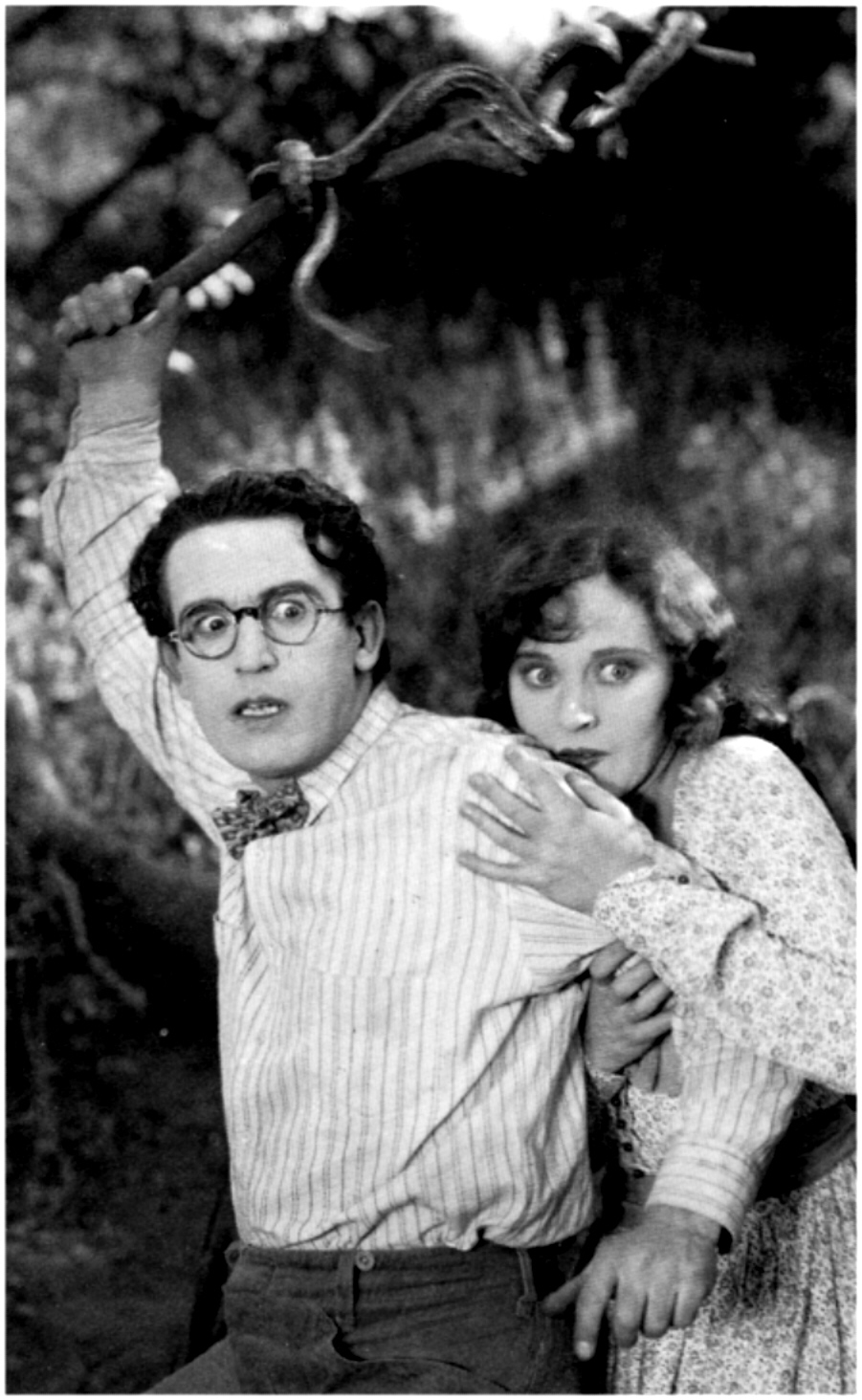
he's also prone to picking up snakes. What shenanigans!

he’s also prone to picking up snakes. What shenanigans!

Fun (?) fact: An elevator was constructed for the camera to follow Harold as he climbed a tree to see the woman he loved.

Considering 8 gagmen were hired for this film (which I didn't even know was a profession) you can probably guess what is going to happen next

Considering 8 gagmen were hired for this film (which I didn’t even know was a profession) you can probably guess what is going to happen next

My thoughts: Apparently Harold Lloyd was a thing back in the day. Charlie Chaplain had the emotions, Buster Keaton had the stunts and this guy had the laughs. Or something like that. Now, I didn’t personally laugh out loud ( or ‘lol’, as the kids are calling it), but I did recognize that humor was being used. I can imagine an audience back in the 20s eating this stuff up, much like audiences today loving mindless humor now and then.

The thing that keeps me from fulling embracing this guy is that he’s like, 40. Ok, 34, at the time of this film, but still. WAY too old to be anyone’s ‘kid brother’. The opening scenes have him picking a fight with the neighbor boy (who’s also, like, 40) and then trying on his father’s sheriff vest (essentially playing dress up). It’s weird, a little creepy, and totally familiar. Instead of my usual indignation over actors playing much younger than they actually are, I realized that his movie might just be the inspiration for one of my favorite characters of all time:

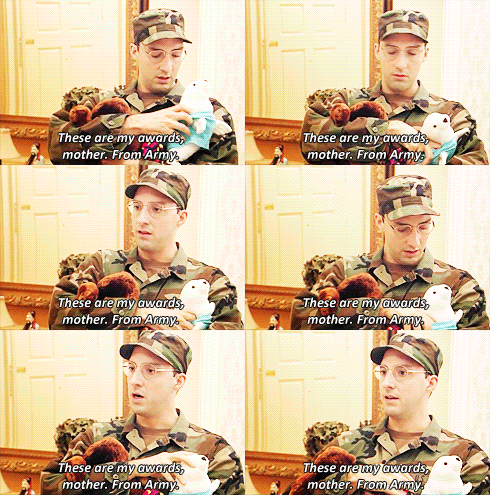
Buster-Bluth-Excitement

Thinking of Harold as the original Buster Bluth made this film a little more enjoyable to watch than when I first started it. The plot was entirely predictable ( he saves the day AND gets the girl. What a country), but I liked seeing exactly how he would do it. The fight scene at the end of the movie was surprisingly complex and although I think a real person stuffed into lifesavers and rolled down the road would most likely die, it was was still fun to watch.

one more for the road

one more for the road

Final review: 2/5. Arrested Development, though is a solid 5 and you should go watch it

Up next: Gun Crazy

#195- All that Jazz

Quick recap: Joe Gideon is so busy with his job as a choreographer, as well as keeping up with his girlfriend, ex-wife and daughter that he doesn’t pay attention to a life threatening heart condition.

Always with the jazz hands, or 'Fosse hands', since this is basically a biography about Bob Fosse

Always with the jazz hands, or ‘Fosse hands’, since this is basically a biography about Bob Fosse

Fun (?) fact: Shirley MacLaine says that she is the one who gave Bob Fosse the idea of All that Jazz while he was recovering from a heart attack.

John Lithgow in All that Jazz

John Lithgow in All that Jazz

My thoughts: I had no idea who Bob Fosse was before watching All that Jazz, which is kind of ridiculous considering my love of Chicago and my like of Cabaret. Not knowing who he was didn’t detract from the film, even though it is a thinly veiled biography about his life. Instead, I researched his life afterward and it made the ending (which I’ll get to in a minute) all the more sad. I think that if I had known about him beforehand, it wouldn’t have had the same emotional impact that it did.

Essentially, All that Jazz is about a dying man who either doesn’t know he is dying, or refuses to believe that he is. The very first scenes show Joe Gideon in his element, casting the dancers for his new show and flirting with just about everyone. And then there is a scene with Gideon where he appears to be backstage with a woman all dressed in white. He is flirtatious with her as well, and it took me awhile to figure out the structure, that this wasn’t part of his real life, but a way for the audience to gain insight into who he was and where he started. Throughout the entire movie, I don’t think I could call Gideon loveable or even very likeable, but a part of me still rooted for him, and even during the final number where he sings about dying, I hoped he would pull through. In a weird way, I was in my own state of denial that this would be the ending, even though Fosse foreshadowed the death from the very beginning with the woman in white. I also loved the scenes that started each day, with Gideon in the shower, popping pills and then doing jazz hands in the mirror. His energy is drained eventually until he can’t even say his line, ‘It’s showtime, folks!’.

I could go on for several more paragraphs about this movie but I’ll skip ahead to the scene that impacted me most. As Gideon slips further and further into his own mortality, he starts hallucinating about the people he cares for, in the form of musical numbers of course. The final number is the one that did me in, with Gideon singing, ‘I think I’m gonna die’. It’s the perfect finale and lasts for almost 10 minutes, as he sings and works his way through the ‘audience’, full of friends, family and co-workers he wants to say goodbye to. What made this so sad for me was that all of this was going on in his head and he never actually got a chance to really say what he wanted to say. I wouldn’t say that his life was filled with regrets, but he was the sort of person who lived for the moment, and not really the future.Had he taken better care of himself, this could’ve all been prevented. It just seemed like a realistic depiction of how many people die, with loose ends. The woman in white shows up and Gideon starts moving toward her, as the number begins to wind down. It was beautiful the way he was shown slipping away, and then the last scene was of the dead body being put into a bag. It was such a cold, jarring ending that made me feel as if I had lost someone I personally knew, and wasn’t really watching a movie.

The 1979 Best Picture nominee ÒAll That JazzÓ will be screened as the next feature in the Academy of Motion Pictures Arts and SciencesÕ ÒGreat To Be NominatedÓ series. The Bob Fosse film, based on FosseÕs own life as a womanizing, drug-using choreographer, will screen on Monday, May 7, at 7:30 p.m. in the AcademyÕs Samuel Goldwyn Theater. Several members of the cast and crew, including actors Deborah Geffner, John Lithgow and Kathryn Doby; film editor Alan Heim; associate producer and assistant director Wolfgang Glattes; executive producer Daniel Melnick; production sound mixer Chris Newman; production designer Philip Rosenberg; cinematographer Giuseppe Rotunno; and music editor Michael Tronick will participate in a post-screening discussion. Pictured here: Roy Scheider (center) and dancers.

Final review: 5/5. I’m tempted to watch it again before having to mail it back to Netflix, I loved it so much

Up next: The Kid Brother