#75- the Bride of Frankenstein

Quick recap: In this heartwarming tale, Frankenstein’s monster is lonely and looking for a mate. Given his penchant for murdering practically everyone, it is decided that the best course of action would be to create a female monster made from dead bodies. How romantic!

Fun (?) fact: Elsa Lanchester, who played The Bride, said that the idea of hissing came from some swans she ran across at a park once. Swans are jerks.

My thoughts: Let’s just get this out of the way: the title of this movie is the most misleading of anything I have ever run across. 1) the Bride is never a bride because she never marries Frankenstein 2) Frankenstein is the name of the creator, not the monster, although I’m just about to give up in that area because people just don’t care and finally, 3) The Bride is onscreen for less than 5 minutes, yet the title makes it seem that this was who the entire movie would be about. Lies. Damn lies.
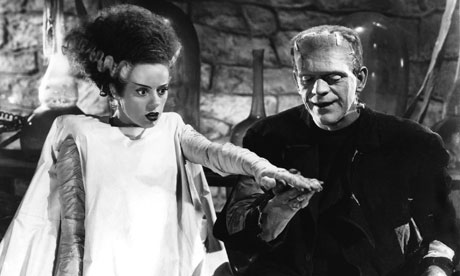
not the happiest portrait of the couple

not the happiest portrait of the couple

So, what was I expecting? I don’t know. I guess I was hoping for a little more monster romance. I had it built up in my mind that I would get to see Frankenstein’s monster wooing a grotesque monster like himself and then fall head over heels with her. At some point, he would ask for her hand in marriage and her hand would literally POP off! Pure comedy gold, but alas, that is not what I was treated to. Instead, I had to sit through 80 minutes of everyone hating the monster and running away at the very sight of him. He finally finds a friend in a blind priest, only to be run off again. To make things even more depressing, the monster is given a voice and a few words, which make him seem more like a toddler than murderer. In the final scene, as the monster gets to meet the love of his life, his hopes are dashed when she hisses at him. Literally hisses. Who does that? Realizing the only thing that could possibly love him is instead repulsed by his very existence, he decides to blow the castle up and end it all.
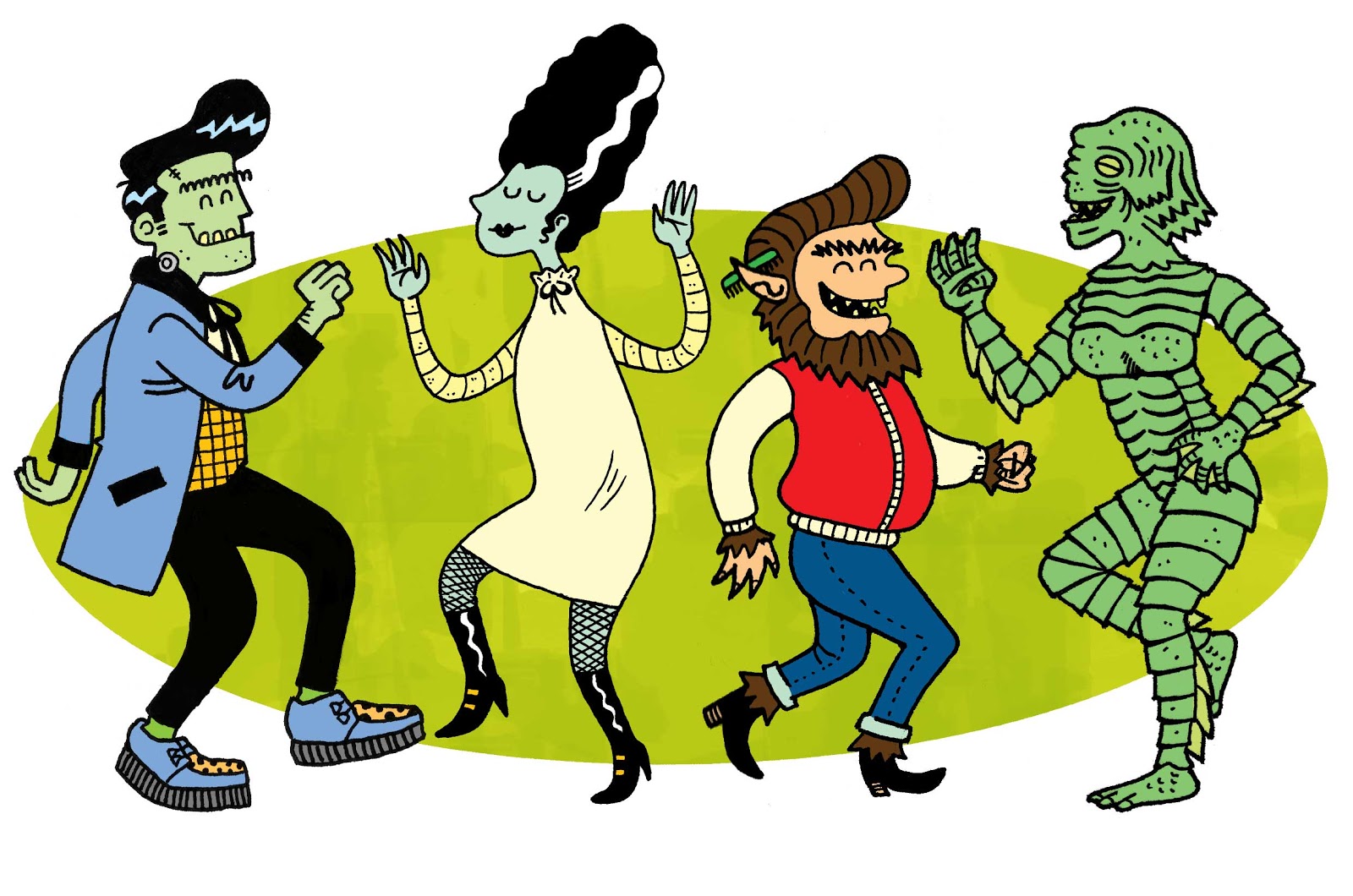
MORE LIES

MORE LIES

Final review: 2/5. I don’t see what was remotely scary about this movie. It should be relabeled as one of the most depressing films of all time.

Up next: Groundhog Day, because of course.
 

#74- Mr. Deeds Goes to Town

Quick recap: After a distant uncle leaves him millions, Longfellow Deeds moves from an idyllic small town to the big city. Once there, he is  taken advantage of and laughed at for such shocking things as giving donuts to a horse and playing the tuba. To make matters worse, the girl he falls in love with turns out to be an undercover reporter who has been writing all the sensational stories about him in the newspaper.

Fun (?) fact: The verb ‘doodle’ originated from this movie as well as the term ‘pixelated’, which was a popular word for a few years and then died out.

My thoughts: There is nothing I enjoy more than an American classic movie, provided I see the following: a spinning newspaper montage, a fainting lady, a climactic courtroom scene, and a random musical number. And boy howdy, did this movie deliver. After the 4th or so spinning newspaper montage, I realized that I had reached American classic movie heaven.

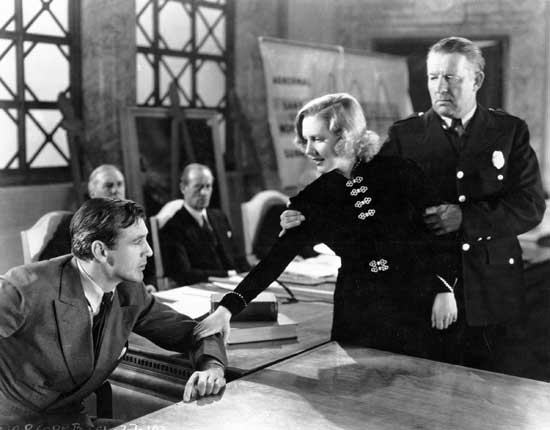
courtroom scene!

courtroom scene!

Seeing as how Mr. Deeds Goes to Town is labeled as a ‘screwball comedy’, I knew there wouldn’t be much thinking involved. I was disappointed with the first 10 or so minutes of the film because I couldn’t understand a word anyone said because they talked so fast. After I turned on the subtitles, however, I really started to enjoy myself. This movie is about as predictable as they come, and that’s okay sometimes. It was relaxing to find myself laughing over the sillier parts and rolling my eyes through the mushier ones. I think I was most surprised by the amount of heart this film had. Gary Cooper as Longfellow Deeds was the perfect fit. He was adorably naive, and yet was sometimes the sanest person around. I genuinely felt for him when the writers made fun of his poetry and my heart broke when he realized the woman he was in love with had secretly been making fun of him the entire time. Plus, Gary Cooper has a strong resemblance to Bill Nye that endeared him to me even more.

bow ties are cool

bow ties are cool

Mr. Deeds Goes to Town is adequately entertaining, but for me, really shines in a historical context. The way the small town is described is not what was really going on, but instead what Americans expected in the Great American Dream. In many ways, this movie sparked that idea of quintessential small town values trumping anything the big city has to offer. The tie in to the Depression was also an apt one. As Deeds tries to do good by not becoming a cynical fat cat, he ends up falling short of his own expectations when he realizes all the farmers he could be helping with his fortune. The scene were the farmer barges in on Deeds and points a gun at him was a little schmaltzy, but the movie’s heart was in the right place.

I felt the courtroom scene went on too long and all loose ends were tied up a little too neatly. As more and more witnesses came forward with their shocking tales of Deeds, I wondered how he could possibly explain away every person’s complaint, but somehow he did . I knew from the first few minutes of the film that I would get a happy ending, but I suppose I was hoping for a little more substance than what I got. Then again, this is an American classic, and a courtroom scene is a necessary trope.

Final review: 4/5. I’d watch again just for Gary Cooper.

Up next:The Bride of Frankenstein 


#73- Jeanne Dielman, 23 quai du Commerce, 1080 Bruxelles

Quick recap: Jeanne Dielman is a single mother who spends her days meticulously cleaning the house,cooking, shopping, and prostituting herself out as a source of income. That’s the entire movie. All 3 hours and 21 minutes.

On the edge of my seat, wondering if she would peel the potatoes in time for dinner!

On the edge of my seat, wondering if she would peel the potatoes in time for dinner!

Fun (?) fact: The director, Chantal Akerman, used a female only crew to make the film. She later said that it didn’t work out as well as she had hoped it would, because she was not in charge of which woman would be hired.

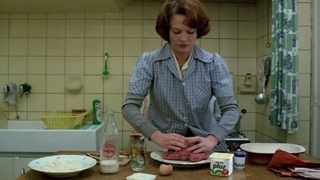
I think the was the point in the film when I started to go insane, watching her mold the meatloaf 10 billion times.

I think the was the point in the film when I started to go insane, watching her mold the meatloaf 10 billion times.

My thoughts: It’s an understatement to say that I dreaded watching this movie. For one, it’s FRENCH. Secondly, it’s labeled under the genre ‘art house’, and finally, it was 3 hours and 21 minutes long. And for 3 hours and 15 minutes, I had to sit through watching a woman clean her house and cook food. FOR 3 HOURS AND 15 MINUTES, YOU GUYS.

The movie opens with Jeanne Dielman letting a client into her home so they can have sex. My hopes were high at this point, that this would be more interesting than I had hoped. Dielman leads the man down the hall, closes the door, and……..that’s it. No sounds, nothing. The two emerge after it has gotten dark. The man pays Dielman and tells her that she will see him next week. Dielman then goes back to her routine of cleaning and cooking until her son comes home. Once again, my hopes were raised as the two of them sat down for dinner, but nobody said a word. Instead, I was treated to 15 minutes of people eating soup and then eating potatoes with stew. It didn’t take long for me to catch on that this was how the whole movie would play out.

Jeanne Dielman also taught me that I eat soup the wrong way

Jeanne Dielman also taught me that I eat soup the wrong way

In all fairness, I actually started to enjoy the film. As grating as it was to watch chores being played out in real time, I could fathom even less having to do that EVERY DAY. And as annoying as it was to sit through 3 hours and 15 minutes of this woman’s routine, it was necessary to understand her oppression. It just wouldn’t have worked to have a montage of Dielman doing her daily chores and looking mournfully at the screen while some sad song played. The only way to understand was to live it. It also made the scene where her routine starts unraveling (she drops a spoon) more noticeable. I appreciate that the director didn’t have to spell it out for the audience, but trusted that after sitting through 3 hours and 21 minutes of this woman’s life, we would figure it out.

The last 10 or so minutes of the film account for the only action to take place. SPOILER ALERT( not that you are going to run out and watch this, but just in case), during a session with a client, Dielman orgasms. After a conversation with her son earlier in the movie, I gather that this might have been the first ever for her. I suppose it empowers her or something because as she is putting her clothes on and the man is lying on the bed, she calmly goes over to him and stabs him to death with a pair of scissors. The last scene in the film is of her sitting in the darkened dining room, with blood on her shirt and hands and I think she is smiling.

Jeanne Dielmann

This film is considered to be one of the best feminist films out there, and I suppose I agree, although I don’t have much knowledge on the subject. Halfway through the movie, I started to become genuinely concerned for Dielman. I wondered what legacy she will have left, years from now. Will she only be seen as a caring mother? Probably. For me, the bleakest scenes came on the last day, as she sat quietly with nothing to do. It was as if her routine was her entire life: her enjoyment, her hobbies, and her passion. So if she didn’t have these routines, she was nothing. I’m not sure what to take from that, but at least I understood the feminist movement in the 70’s a little better.

jeannedielman

Final review: 4/5. This was a hard one to pin down because there is no way in hell that you could pay me to sit through this again, yet I still enjoyed the movie.

Up nextM:r. Deeds Goes to Town


#72- Kramer vs. Kramer

Quick recap: Joanna Kramer, unhappy in her marriage, chooses to leave her son and husband to find herself. Her husband, a workaholic, is left with the full responsibility of a child. He slowly builds up a new life for him and his son until Joanna comes back into the picture and sues for custody.

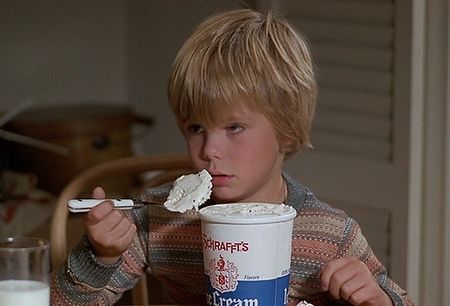
Fun(?) fact: The ice cream scene between Billy and his father was completely improvised, but the director loved it so much he kept it in the film.

500fullMy thoughts: A few years ago, I decided to try and watch all Academy award winners. Kramer vs. Kramer was first on my list and I remember enjoying it but not really identifying with it. Fast forward 4 years and I am married with a 4 year old boy. It was interesting to find myself almost unable to watch some scenes because now I was identifying with it too much. I understood the perspective of the father, the mother and even the kid. It would’ve been easy to leave it at that: a sad, but realistic portrayal of divorce. But the more I thought about, the more complicated everything was.

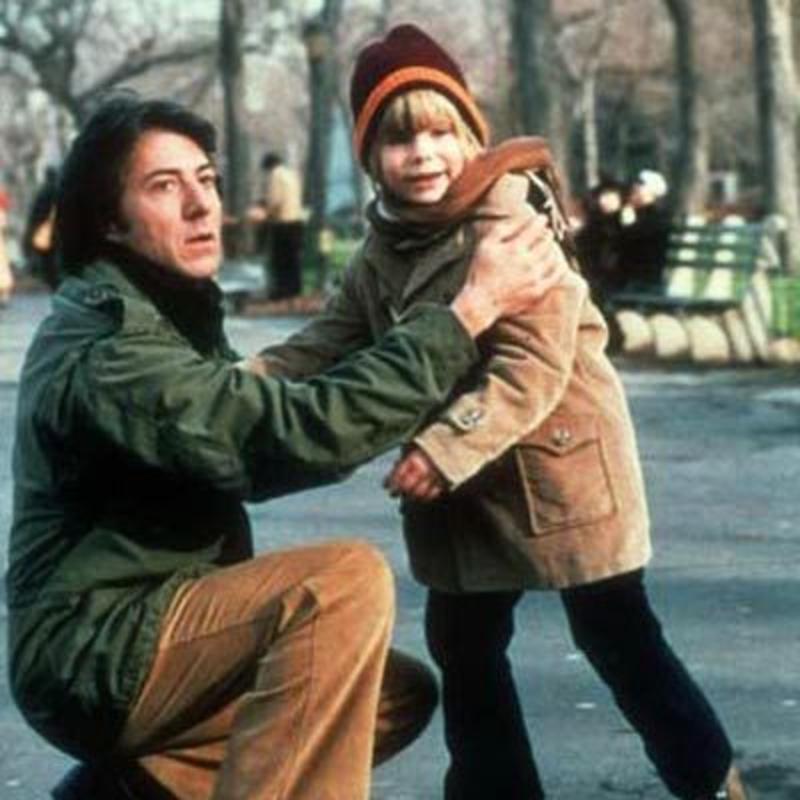
kramer_vs._kramer_1_hoffmanSo first of all, there is the character of Ted Kramer. Before I go any further, I need to point out how realistic all the performances were. Although the subject is an emotional one, all of the characters showed enough restraint so the audience could identify but not feel awkward. As for Ted Kramer, his character is the typical father seen during that time period. He devotes his time to his work and that is his way to show he loves his family. It is also the reason his wife leaves him. I really enjoyed watching the transformation as Kramer learned to care for his son, and it was especially evident when comparing the first time the two make French toast together  to the last time. As was portrayed in the movie, Kramer wasn’t a ‘bad husband’: no abuse or neglect. But he also wasn’t very sympathetic towards his wife’s needs. Kramer spends the entire movie angry at his ex-wife and it isn’t until the very last scene that I believe he sees her as a real person, not just the mother of his child.

I didn’t pay much attention to the character of Joanna Kramer the first time around, but found her much more fascinating and complicated this time. It’s very easy to cast her off as the villain in the film, seeing as how she willingly left her child to take care of herself. It seems such a cold thing to do and an open and shut case as to who should get Billy. I guess I am speaking as someone who lives in 2014, but I think the health of the mother is just as vital to a child as physically being there. Joanna was depressed and could no longer handle motherhood. She had no other job and it didn’t seem many friends, so her main source of conversation came from a 6 year old. There are many women who could do that, no problem. But there are many more who are still good mothers, yet need the balance and the chance to do something for themselves. In this case, it took Joanna leaving for her to get back on track. It might also have been the best solution for her to gain some sanity. I disagree with her fighting custody, but that was also the norm of the tim- for the mother to have primary custody. The final scene was heart wrenching, as Joanna understood where Billy really belonged. In the best interest of the child, Billy needed both parents. Joanna made the decision to leave, but that doesn’t mean she ever stopped loving her child and wanting him.

Final review: 3/5. Almost a 4, but I felt the courtroom scene to be a little silly. When the lawyer grilled Ted about losing his job because he missed a deadline, he was trying to show that he couldn’t be relied on. But the reason he missed the deadline was to take care of his son, therefore proving that he put his child before anything else.

Up next: Mr. Deeds Goes to Town