#47- Rome, Open City

Quick Recap: So, Italy was in bad shape during World War II. This movie tells the story of citizens fighting Nazi forces and trying to take back their country. Among the characters: a pregnant woman, a priest, and a ragtag group of boys help to lead the resistance. It sounds like your regular uplifting fare until you remember that these are the Nazis and so this will never end well.

tumblr_mcvs4y5pyz1rjcdh2o1_400

Fun (?) Fact: The film didn’t do so well when it premiered in Italy, mainly because the citizens had JUST gone through the horrifying events and weren’t looking forward to reliving them on the big screen. Italian audiences wanted escapism and Rome,Open City is just the opposite of that.

My thoughts: In case it hasn’t been spelled out well enough, this movie is BRUTAL. I knew it would be tough to watch because, you know, Nazis. But I wasn’t expecting this. After the credits, I immediately Googled what I could about the background of Rome,Open City and found that many of the characters are based off of real people. I think it was at this time that curling up into a ball sounded like the most plausible idea.

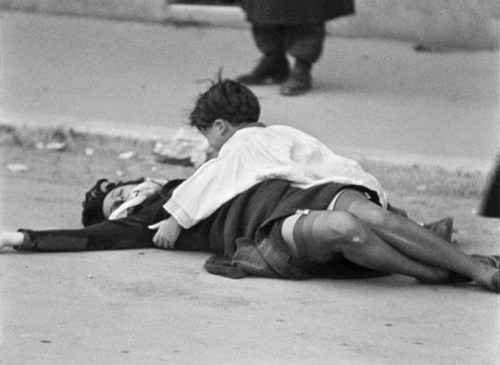
The first part of the movie is your typical wartime drama with the rebels quietly meeting up and forming a resistance and the enemy doing everything they can to stop them. One of the main characters, Pina , is a widow with a son and another baby on the way. She is set to marry Francesco. The two of them meet up with another patriot, Giorgio Manfredi, and attempt to help him continue fighting the Nazis while laying low. On the day of their wedding, Francesco gets captured and taken away to be tortured. As the truck drives off, Pina runs behind it, crying out for her love. The Nazis shoot and kill her while her young son watches. I think it’s safe to say that this is one of the most heartbreaking scenes in cinema and yet, IT GETS WORSE.
tumblr_lfmh6rBnZy1qz8rc5o1_500


The other main character is Don Pietro, a priest fighting in the resistance. He is mostly involved in smuggling things to other fighters because as a priest, he is able to stay out after curfew. His motives stay in line with his faith because he believes in helping good defeat evil. He is well loved in the community, especially with a group of boys who also do their part to take down the Nazis. You can see where this is going. During the second part of the film, Don Pietro gets captured with Manfredi and must witness his friend’s torture and death. He is then sentenced to firing squad, where we come to the second most heartbreaking film in cinema history- the soldiers tasked with killing the priest deliberately miss their target so the Nazi officer gets impatient, pulls out a gun and shoots him in the head. Not bad enough? Those boys who loved the priest so much witness everything, including Pina’s son. And then the movie ends.

don-pietro-shallow-focus1


So, yes, it goes without saying that this movie is disturbing and horrifying. But it’s at least a little comforting to know that Rome was eventually liberated and the Nazis ultimately defeated. The movie reminded me of ‘A Bell for Adano’, written by John Hersey. That novel also takes place during World War II, in the town of Sicily and the two forces at war are the Americans and the Fascists. The citizens of the town only want their old life back, and that includes a bell that means so much to them. The two are similar because both feature strong citizens who love their country. They aren’t looking for anything spectacular. World War II was complicated in many ways and it’s easy to get caught up in the military history, but to me, the most interesting stories are of the ordinary people just trying to survive.

Final review: 5/5. But I don’t recommend watching it unless you like to Ugly Cry.

Up next: HORRORFEST

#46- On the Waterfront

Quick recap: Terry Malloy, former boxer, is now a dockworker. In order to keep a steady stream of work, Malloy agrees to help the corrupt union, which also involves his brother Charley. He doesn’t mind it for the most part until he helps get a guy murdered and then he realizes that maybe this isn’t the direction his life should be headed. Around the same time, Malloy begins to see the sister of the murdered guy and also comes to the realization that being connected to the union that murdered the brother won’t win him any points with the girl. He attempts to stand up to the union but quickly realizes how dangerous this is because they control everything and also have guns.

Fun (?) Fact: The scene with Edie dropping her glove was for the most part, improvised. In the scene, Malloy picks up the glove and puts it on his hand, playing with it. He continues by talking to Edie about their childhood. The director loved it so much that it was kept in the movie.

On-The-Waterfront-glove


My thoughts: When I watch movies on my list, I typically like to do so alone. This is because I don’t want someone else pushing me towards a conclusion that is not my own. So when my husband offered to watch ‘On the Waterfront’ with me,  I was hesitant, seeing as how this is one of his favorite films. It turns out there really wasn’t much to worry about because I too loved this movie from the very beginning.

Although the story is compelling, it is the acting from Marlon Brando that blew me away. It was as if the director went to the dock, plucked him out, gave him a script, and sent him to work. His portrayal of Terry Malloy is one of the best examples of acting in the history of film. He delivers his lines without any real effort as well as his reaction to other characters. It’s a tiny scene, but I love how Brando interacts with the investigators as his waits on his job at the dock. He attempts to blow them off and then gets angry when they don’t leave him alone. After they do finally leave, he goes back to his buddies and gives off this look like he is confused but deep down, knows what really happened. It’s a great example of Brando fully bringing the character of Malloy to life.

When mentioning this  film, most people know the taxi cab scene when Brando says, ‘I coulda been a contender’. It is indeed a powerful exchange, as Malloy realizes that his brother has betrayed him. My favorite scene, however, happens as Malloy discovers that his brother has been murdered by the union. The image of his brother hanging from a hook, gunshot wounds to the heart, is so chilling. Brando is so convincing in his role as Malloy grieves. It was so heartbreaking to watch, although not as sad as when Malloy finds that his pigeons have all been murdered. Animal death is sad enough for me, but seeing Malloy try to mask his pain was almost too much.

Besides the acting, I think I loved this movie because the story is so compelling. The idea of a corrupt union wasn’t a new one and in fact, this movie brought to light real organizations that were doing this same thing to their members. It’s always nice when a movie can expand beyond pure entertainment.

Final review: 5/5. This is a dark movie for its time, but one that I think should be required viewing for any movie fan.

Up Next: Rome Open City and after that it will be October and Horrorfest!

#45- The Silence of the Lambs

Quick Recap: Clarice Starling, fledging FBI investigator, has been asked to interview one of the most notorious serial killers of all time- Hannibal Lecter. Although he is known to not talk to anyone, he takes a liking to Starling and decides to help her solve the case of another serial killer. Instead of just giving the FBI the information they need, Dr. Lecter gives clues in the form of anagrams and cryptic statements. In the end, Starling cracks the code and saves the day! Lecter, on the other hand, disappears to eat more faces. Awww.

There's a meme for everything! As well as fan fiction, but I'm not jumping down that rabbit hole tonight.

There’s a meme for everything! As well as fan fiction, but I’m not jumping down that rabbit hole tonight.

Fun (?) Fact: In interviews, Anthony Hopkins has said the voice of Lecter is a mix of Truman Capote and Katherine Hepburn.

My thoughts: In full disclosure, I must say that I saw this film back in high school and for some reason really loved it. I immediately went out and read the trilogy by Thomas Harris and also watched the other two movies in the series. Part of me is embarrassed by how much I took to the gruesome story of a serial killer, but then I see that there is a tv show called ‘Hannibal’ that is rather popular and I don’t feel so bad.

i.chzbgr-1


So, in rewatching this movie years later, I can still see why so many people are drawn to its elements. Hell, I was even considering a career in law enforcement after watching Jodie Foster’s excellent portrayal of Starling. A tale of murder is as old as time, if I am allowed to be serious for a moment. It’s an act that most of us can never fathom and thankfully, never have any contact with. And so we are drawn to it. If you are going to write a book about a serial killer, which will later be an Oscar winning movie, might as well make it as gruesome and terrifying as possible, am I right? Give the people what they want. It reminds me of my brief job in high school, working at the public library in my tiny rural town. I used to love the Saturday shifts because it was so quiet and because the patrons that did come in were easy to check out. Most of the time I got two kinds of people on those days: The older women who came in with their paper bags full of trashy romance novels and the older men who came in with their paper bags full of trashy true crime novels. The limit for checking out those kinds of books was like 25 and I remember being so impressed by how quickly these people could get through so many of them in a week. I finally got up the nerve to ask an old man one day and he simply chuckled and responded that he never read the whole book, just ‘the good parts’.

Hannibal Lecter’s character is satisfyingly complex. I spent the entire movie being repulsed by him, only to then find myself rooting for him, and then being repulsed by the fact that I was rooting for him. Like for example, when he agreed to help the investigation. He was flown to another facility, only to then insult and offend the woman who’s daughter had been kidnapped by Buffalo Bill. I found myself laughing at the awfulness of the situation and the fact that Lecter was just being himself. In looking at trivia for ‘The Silence of the Lambs’, I was amazed to find out that Anthony Hopkin’s total screen time for the movie was a mere 16 minutes and yet most people who have never seen the movie know who Hannibal Lector is and may even be able to quote some lines.

In the end, this movie accomplishes what it came to do- it was terrifying. The most unsettling scene for me was when Lecter has escaped. It’s a complex plan, but at one point the police officers are in the elevator, riding with another officer that they believe has had his face eaten. All of a sudden, drops of blood start materializing on the man’s white bed sheet. I knew what was going to happen and yet I was still completely horrified. There is nothing better than a movie that delivers a satisfying shock like that.

Final review: 5/5. Even without Lecter, this is one of the scariest films I have seen. It’s not one that gave me nightmares, but it was deeply unsettling and I think that’s the worst kind of scary.

Up next: If…

#44- All the President’s Men

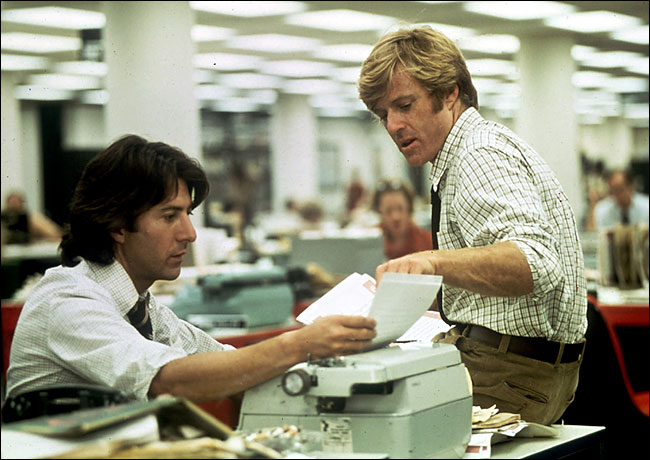
Quick recap: In the early 70’s,  journalists Bob Woodward and Carl Bernstein were responsible for bringing the Watergate scandal to light. What starts out as a minor break in at the Democratic Headquarters eventually leads higher and higher up into the Republican Party and eventually implicating  then-President Nixon. SPOILER ALERT- Nixon is forced to resign.  I apologize if anyone was spoiled by that previous statement.

This was supposed to be an image of 'Deep Throat'. I don't suggest Googling the title.

This was supposed to be an image of ‘Deep Throat’. I don’t suggest Googling the title.

Fun (?) Fact: The movie was originally shot inside the real Washington Post office, but workers kept trying to get screen time so they rebuilt the office on a sound stage . The office shown on the film has meticulous details like real stickers and phone books that had been used during the scandal.

My thoughts:  I love politics. I love movies. But I do not enjoy political movies, for the most part. In fact, the only movie I can recall really loving was ‘Frost/Nixon’, so maybe I just have a thing for Nixon? Personally, I find him to be one of the most interesting presidents we have had. Not one of the best, but interesting.

Richard Nixon's Head


This movie was odd in that I was really drawn to it at the very beginning and very end, but the middle was a little tedious at times. Maybe it was because I already knew the outcome, but I was rather bored sitting through several scenes of Woodward and Bernstein calling people. It just seemed too true to life for me at the point. On the other hand, the film did a great job turning phone calls into AMAZING REVELATIONS!. I’m thinking of one scene where Bernstein calls the librarian and asks her about books that have been checked out. She admits to seeing the person but then a few minutes later denies ever hearing the man’s name. Riveting stuff, really. It was around this point, that I had my own AMAZING REVELATION. As I was watching Woodward and Bernstein combing through the library records, it occurred to me that I was looking at this film from the entirely wrong perspective: This movie was not about Watergate, but instead about journalism itself. After realizing this, I found myself enjoy the movie much more.

Being married to someone who was a journalist at one point and eventually changed careers because print media is dying, made this movie all the more poignant. I was amazed by how much WORK went into blowing a scandal open like this. Every tiny detail had to be researched and then confirmed by several sources before it went to print. The journalists involved gave every waking moment to investigating the scandal and it paid off. I can’t really comment on the state of things now, seeing as I don’t have first hand information, but I imagine that investigative journalism just isn’t the same anymore. There is one scene in the beginning of the movie where Woodward is trying to figure out a name on a list. He asks his boss, who happens to know what the man’s title is and it is that knowledge that helps move the investigation further along. Had this happened in modern times, Woodward would’ve simply Googled the name, maybe emailed the guy and waited around. I love me some technology, but there is something to watching how all of the clues are being put together without a use of a computer, just by talking to people. I loved how Woodward and Bernstein could make people talk. It wasn’t like the sources had a reason to give info and many were afraid to do so, but they helped anyway and it helped bring down the presidential office, eventually. I see it on Twitter, both political parties always looking for their ‘Watergate’, but the thing is, that was a once in a lifetime story, and even then may have amounted to nothing if it hadn’t been for those two.  It’s a truly fascinating film to watch, if only to see the final death knell of traditional investigative journalism.

Robert-Redford-Screening-All-the-Presidents-Men-Revisited-in-Washington-DC


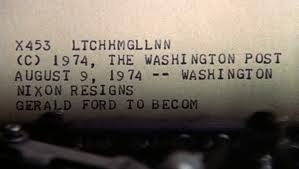
Final review:  4/5. The final few moments are some of the best in cinema history: Woodward and Bernstein writing the piece that finally blows everything open, as they watch Nixon’s inauguration on tv and the metaphor of the cannons blasting. And then summing up the rest of the events of Watergate, using the typewriter. Watch this movie, if only for these scenes. allthepresidentsmentypewriter

Up next: The Silence of the Lambs