#45- The Silence of the Lambs

Quick Recap: Clarice Starling, fledging FBI investigator, has been asked to interview one of the most notorious serial killers of all time- Hannibal Lecter. Although he is known to not talk to anyone, he takes a liking to Starling and decides to help her solve the case of another serial killer. Instead of just giving the FBI the information they need, Dr. Lecter gives clues in the form of anagrams and cryptic statements. In the end, Starling cracks the code and saves the day! Lecter, on the other hand, disappears to eat more faces. Awww.

There's a meme for everything! As well as fan fiction, but I'm not jumping down that rabbit hole tonight.

There’s a meme for everything! As well as fan fiction, but I’m not jumping down that rabbit hole tonight.

Fun (?) Fact: In interviews, Anthony Hopkins has said the voice of Lecter is a mix of Truman Capote and Katherine Hepburn.

My thoughts: In full disclosure, I must say that I saw this film back in high school and for some reason really loved it. I immediately went out and read the trilogy by Thomas Harris and also watched the other two movies in the series. Part of me is embarrassed by how much I took to the gruesome story of a serial killer, but then I see that there is a tv show called ‘Hannibal’ that is rather popular and I don’t feel so bad.

i.chzbgr-1


So, in rewatching this movie years later, I can still see why so many people are drawn to its elements. Hell, I was even considering a career in law enforcement after watching Jodie Foster’s excellent portrayal of Starling. A tale of murder is as old as time, if I am allowed to be serious for a moment. It’s an act that most of us can never fathom and thankfully, never have any contact with. And so we are drawn to it. If you are going to write a book about a serial killer, which will later be an Oscar winning movie, might as well make it as gruesome and terrifying as possible, am I right? Give the people what they want. It reminds me of my brief job in high school, working at the public library in my tiny rural town. I used to love the Saturday shifts because it was so quiet and because the patrons that did come in were easy to check out. Most of the time I got two kinds of people on those days: The older women who came in with their paper bags full of trashy romance novels and the older men who came in with their paper bags full of trashy true crime novels. The limit for checking out those kinds of books was like 25 and I remember being so impressed by how quickly these people could get through so many of them in a week. I finally got up the nerve to ask an old man one day and he simply chuckled and responded that he never read the whole book, just ‘the good parts’.

Hannibal Lecter’s character is satisfyingly complex. I spent the entire movie being repulsed by him, only to then find myself rooting for him, and then being repulsed by the fact that I was rooting for him. Like for example, when he agreed to help the investigation. He was flown to another facility, only to then insult and offend the woman who’s daughter had been kidnapped by Buffalo Bill. I found myself laughing at the awfulness of the situation and the fact that Lecter was just being himself. In looking at trivia for ‘The Silence of the Lambs’, I was amazed to find out that Anthony Hopkin’s total screen time for the movie was a mere 16 minutes and yet most people who have never seen the movie know who Hannibal Lector is and may even be able to quote some lines.

In the end, this movie accomplishes what it came to do- it was terrifying. The most unsettling scene for me was when Lecter has escaped. It’s a complex plan, but at one point the police officers are in the elevator, riding with another officer that they believe has had his face eaten. All of a sudden, drops of blood start materializing on the man’s white bed sheet. I knew what was going to happen and yet I was still completely horrified. There is nothing better than a movie that delivers a satisfying shock like that.

Final review: 5/5. Even without Lecter, this is one of the scariest films I have seen. It’s not one that gave me nightmares, but it was deeply unsettling and I think that’s the worst kind of scary.

Up next: If…

#44- All the President’s Men

Quick recap: In the early 70’s,  journalists Bob Woodward and Carl Bernstein were responsible for bringing the Watergate scandal to light. What starts out as a minor break in at the Democratic Headquarters eventually leads higher and higher up into the Republican Party and eventually implicating  then-President Nixon. SPOILER ALERT- Nixon is forced to resign.  I apologize if anyone was spoiled by that previous statement.

This was supposed to be an image of 'Deep Throat'. I don't suggest Googling the title.

This was supposed to be an image of ‘Deep Throat’. I don’t suggest Googling the title.

Fun (?) Fact: The movie was originally shot inside the real Washington Post office, but workers kept trying to get screen time so they rebuilt the office on a sound stage . The office shown on the film has meticulous details like real stickers and phone books that had been used during the scandal.

My thoughts:  I love politics. I love movies. But I do not enjoy political movies, for the most part. In fact, the only movie I can recall really loving was ‘Frost/Nixon’, so maybe I just have a thing for Nixon? Personally, I find him to be one of the most interesting presidents we have had. Not one of the best, but interesting.

Richard Nixon's Head


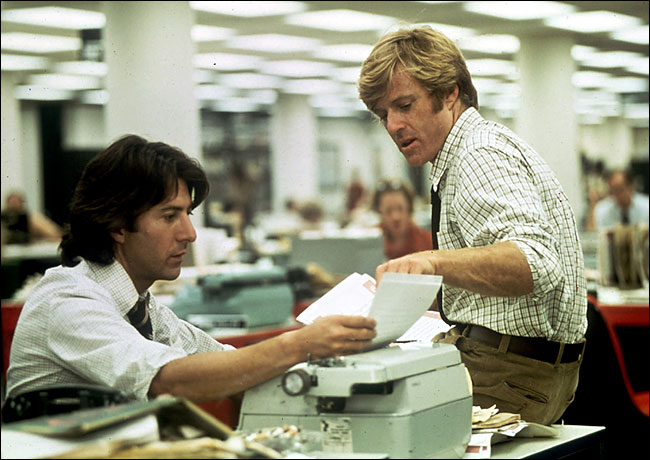
This movie was odd in that I was really drawn to it at the very beginning and very end, but the middle was a little tedious at times. Maybe it was because I already knew the outcome, but I was rather bored sitting through several scenes of Woodward and Bernstein calling people. It just seemed too true to life for me at the point. On the other hand, the film did a great job turning phone calls into AMAZING REVELATIONS!. I’m thinking of one scene where Bernstein calls the librarian and asks her about books that have been checked out. She admits to seeing the person but then a few minutes later denies ever hearing the man’s name. Riveting stuff, really. It was around this point, that I had my own AMAZING REVELATION. As I was watching Woodward and Bernstein combing through the library records, it occurred to me that I was looking at this film from the entirely wrong perspective: This movie was not about Watergate, but instead about journalism itself. After realizing this, I found myself enjoy the movie much more.

Being married to someone who was a journalist at one point and eventually changed careers because print media is dying, made this movie all the more poignant. I was amazed by how much WORK went into blowing a scandal open like this. Every tiny detail had to be researched and then confirmed by several sources before it went to print. The journalists involved gave every waking moment to investigating the scandal and it paid off. I can’t really comment on the state of things now, seeing as I don’t have first hand information, but I imagine that investigative journalism just isn’t the same anymore. There is one scene in the beginning of the movie where Woodward is trying to figure out a name on a list. He asks his boss, who happens to know what the man’s title is and it is that knowledge that helps move the investigation further along. Had this happened in modern times, Woodward would’ve simply Googled the name, maybe emailed the guy and waited around. I love me some technology, but there is something to watching how all of the clues are being put together without a use of a computer, just by talking to people. I loved how Woodward and Bernstein could make people talk. It wasn’t like the sources had a reason to give info and many were afraid to do so, but they helped anyway and it helped bring down the presidential office, eventually. I see it on Twitter, both political parties always looking for their ‘Watergate’, but the thing is, that was a once in a lifetime story, and even then may have amounted to nothing if it hadn’t been for those two.  It’s a truly fascinating film to watch, if only to see the final death knell of traditional investigative journalism.

Robert-Redford-Screening-All-the-Presidents-Men-Revisited-in-Washington-DC


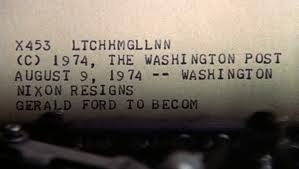
Final review:  4/5. The final few moments are some of the best in cinema history: Woodward and Bernstein writing the piece that finally blows everything open, as they watch Nixon’s inauguration on tv and the metaphor of the cannons blasting. And then summing up the rest of the events of Watergate, using the typewriter. Watch this movie, if only for these scenes. allthepresidentsmentypewriter

Up next: The Silence of the Lambs

#43- Spring in a Small Town

Quick recap:  A wife has grown tired of her daily life- chores, shopping, and taking care of her ailing husband. One day a man shows up who turns out to be the husband’s best friend but also the wife’s former love. Drama ensues as the two fall madly in love again. Once in awhile they remember that the husband is still around and sick to boot, and they feel like jerks in the end.

Fun (?) fact: The Communist party buried the film after its release in China because of lack of politics. It wasn’t until the 1980’s that people really started to appreciate the movie.

My thoughts: I audibly groaned when I found out this movie was next on the list because the whole thing seemed like torture to watch: a black and white foreign film about love and loss. Bleck. I especially winced as the opening credits came on the screen because they were jumpy and the audio kept going in and out. The opening scene is of the wife walking along the city wall as she does a voiceover explaining the unhappiness that is her life. It caught me off guard, to see such a ‘modern’ filmmaking tool such as voiceover to tell a story. I know this wasn’t the first film to do so, but it was still impressive to see, considering what the US had been churning out at the time.

As the plot revealed itself, I was calmed by its simplicity. Foreign films have a reputation as being hard to follow and I admit that I don’t have much experience watching films from China. So this was a pleasant surprise. ‘Simplicity’ might not be the best word to use to describe the film because the emotions that are laid out for the audience are quite complex. The friend cares deeply for the husband and his health but he is also still in love with the wife. He is a good person and really, all of the characters can be described as ‘good’. I felt sympathy for everyone, even the wife as she must make a decision to stay or go. Her love for her husband was apparent but she also had to reconcile with the reality that she had married a very sick man who was unable to give her what she needed.

Above everything else, I was mostly blown away by the fact that the entire story is told in two settings and between 5 characters. Big budget films can draw audiences in, but in the end, sometimes simplicity is needed to truly tell a story.

url


Final review: 4/5. Modern audiences can still appreciate the story, although it isn’t for everyone.

Up next: All the President’s Men

#39- The Best Years of our Lives

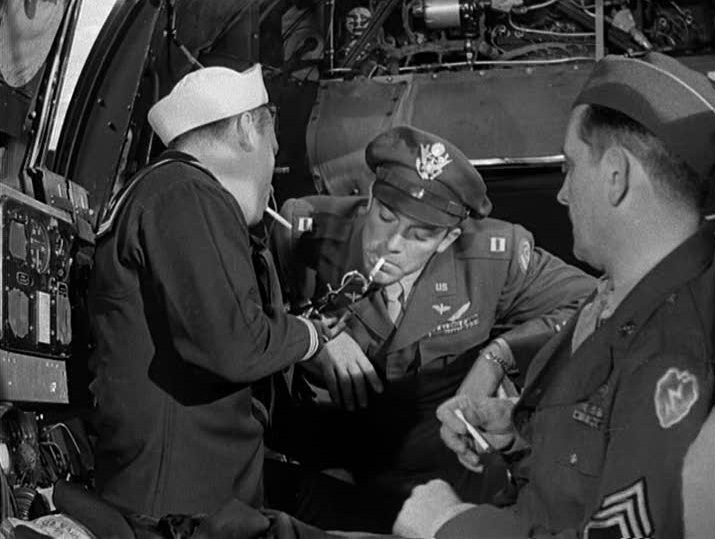
Quick recap: This movie follows three servicemen as they return from fighting in World War II and try to readjust to civilian life. Al, a sergeant in the Pacific, returns to his loving family and job as a banker. Fred, who was in the Air Force, comes home to an uncertain future as he and his wife are barely able to make ends meet. Homer, a veteran from the Navy who has had both of his hands removed, must cope with his new disability as well as try to build a relationship with his fiancee.

bonding over a good smoke

bonding over a good smoke

Fun (?) fact:  Harold Russell, who played Homer, was nominated for an Oscar for Best Supporting Actor. The board thought he was a longshot to win so they created a fake award for inspiring courage for his fellow veterans. And then he won the Oscar.

My thoughts: Growing up, I always had this idealized view about World War II. In my mind, America universally supported the war effort and when soldiers returned home, they were greeted as heroes and were given everything they needed as reward for keeping us safe.  I became an adult during the war in Afghanistan and Iraq and was able to see more realistically what solders are faced with: unemployment issues, disabilities that aren’t necessarily easy to spot, and the inability for us civilians to truly relate to what they have gone through during combat. After watching this movie,  I realize that soldiers have always faced these issues. I can’t comment as to how things have gotten better over time, but it just seems sad to me that these issues are still very much present.

The movie clocks in at almost 3 hours, but it is important to see each character as they navigate through their old life again.  It was heartbreaking to watch each character return to their family, especially Fred. He had done so much during the war, saving countless lives and yet comes back to his parents living in squalor, his wife MIA and no job. Most people who have seen the movie tend to focus on Homer’s character- the veteran who has had both hands amputated. And there is good reason for that, especially considering he was a real veteran. But for some reason, it is Fred’s story that really stuck with me. His character also had to deal with ‘combat trauma’, what we now call PTSD and it was moving to see him trying to recover from the past the horrors of war, yet knowing that it will never really be gone.

Final review: 4/5. The only issue I had with the movie was the ending. Everyone ends up happy and ‘back to normal’. It would’ve been nice to have had a grittier ending, but I’ll take it.

Up next: Who Framed Roger Rabbit?