#236- Strangers on a Train

Quick recap: Guy is a tennis star who hates his wife. Bruno is a creepo that hates his father. When the two meet ( as strangers, on a train), Bruno decides that it would be fun if the two could switch places and murder whom the other hates.

Strangers on a Train 3

Making small talk is difficult for some people

Fun (?) fact: Alfred Hitchcock wanted the character of Bruno to be gay but that wasn’t really something you could say back then. Instead, he and Robert Walker worked together to suggest Bruno’s homosexuality with elaborate gestures and fancy clothes without having to actually point it out.

Strangers on a Train pic 2

It was a success!

My thoughts: Strangers on a Train just might be my favorite Hitchcock film. It’s not his best, but I had the most fun watching it. Everyone knows Hitchcock for his horror films, but I much prefer film-noir Hitchcock, where he can put his dark humor to good use.

There is a lot to love about this movie, but it’s the film techniques Hitchcock uses that make Strangers on a Train so stunning. I know there are technical terms for all the camera work but I’m not even going to pretend I have a clue what I’m talking about here and just say it was really, really, really……good. There were many scenes with Bruno where he was just off in the distance, but the perspective made him seem so much more formidable. My favorite example of this was during the tennis match, where the audience moved their heads back and forth to watch the ball, while Bruno’s gaze was fixed squarely on Guy. It was beyond creepy. The scene in which Miriam is murdered is also amazing. Hitchcock somehow filmed the encounter through the perspective of Miriam’s glasses that were knocked to the grass when Bruno grabbed her.
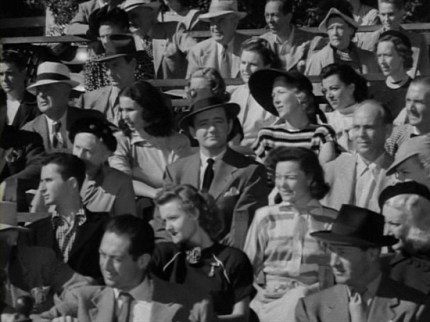
ec97b4ecb0a8ec9588ec9d98_ec9db4ec8381ed959c_ec82aceb9e8ceb93a4-strangers_on_a_train-1951-ac3-1ch-1cd-ace-avi_002963546


The dialogue and acting were top notch and although it was a very dark movie, there were many scenes that made me laugh. Like Shadow of a Doubt, many of the characters casually talk about murder and gruesome ways of dying as if it is a common hobby to do so. Which it kind of is? There has always been a fascination with that sort of thing so although it seems off-putting, it’s something we all do. As for the murder itself, I never really understood why Guy could never go to the police and explain what happened. There didn’t seem to be a lot of evidence, and it’s not like the police leading the investigation came from Manitowoc County (I’m topical!) so they probably would’ve been reasonable. The ending also seemed to be wrapped up a little too neatly. One second Guy was the number one suspect and the next second his name is cleared completely. Granted, there wasn’t much of a case to begin with but it was definitely a weak spot in an otherwise enjoyable film to have it all dropped so quickly.

Final review: 4/5

Up next: Storm over Asia

#218- Detour

Quick Recap: There are many reasons why hitchhiking is a bad idea, one of them being that you might be accused of murder.

24waeew

Or it might be Rodney Dangerfield. You just never know!

Fun (?) fact: Tom Neal, who played the main character Al, was convicted of killing his wife in 1965. I’d add something witty here, but that’s just sad and Tom Neal was an asshole.

detour-1945-1

Tom Neal is an example of someone you wouldn’t want to pick up.

My thoughts: As I have most likely mentioned before (but am currently too lazy to verify), I have an extreme fear of being accused of a crime I didn’t commit. There are some people who go so far as to save all their receipts for the sole purpose of having an alibi in case they are in a situation that would warrant it, but (as mentioned before) I’m too lazy to do that. Plus, knowing my luck, if I did keep all of my receipts and was accused of a crime, the prosecution would probably use that as evidence that not only was I guilty, but that it was premeditated. And exhibit B would probably be this entire paragraph, so it’s for the best that I get on with the review and stop incriminating myself.

So…..Detour. IMDb calls this film one of the best B-movies ever made, which, on the surface sounds like an oxymoron. I get it, though. Director Edgar G.Ulmer had a very small budget and instead of trying to create what would’ve been really bad scenery, he just had fun with it. Case in point, the beginning of the movie shows Al hitchhiking his way west and later heading east. There wasn’t a budget to show both directions, so Ulmer simply reversed the film. The result is Al hitching with his left thumb and riding in cars where the driver is on the right side. There are also many scenes where Al is staring off into the distance as his voice explains what he is thinking. Low budget, yes, but the story is simple enough to have not needed an expensive set.

The main plot of the film is about as outlandish as you might expect: Al hitchhikes to LA to reunite with his girlfriend and along the way gets picked up by a really rich guy. The rich guy dies and Al realizes that if he calls the police, it’s going to look really suspicious. So he instead buries the body, switches identities and continues on his way. Being the idiot that he is, Al picks up his own hitchhiker, who just happens to be a woman that knew the dead rich guy and now she is in on what happened. The two fight about what to do and in one of the best (worst?) scenes I’ve encountered on this list, the woman locks herself in a hotel room to call the police on Al. On the other side of the door, Al pulls as hard as he can on the phone cord and when that doesn’t work, kicks down the door. That’s when he finds the cord wrapped around the woman’s neck and she too is dead. Rotten luck, indeed. It’s such a wonderfully silly story, but somehow, it works. The acting wasn’t great but it didn’t need to be to get the point across.

Final review: 4/5. And thanks to the Hayes code which stipulates that murderers aren’t allowed to get away with their crimes, Al is picked up at the end of the movie and brought to justice.

Up next: The Good, The Bad, and The Ugly

#197- Gun Crazy

Quick recap: Bart Tare is into guns. Like, really into guns. But not in that way (killing people). His wife on the other hand is totally into guns AND killing people. I guess you could say they are………gun crazy!

csi_miami_yeah

Fun (?) fact: During the credits it says that the script was written by MacKinlay Kantor and Millard Kaufman. In reality, there was no Kaufman, but instead a guy named Dalton Trumbo, who was blacklisted at the time.

dude REALLY loves his guns. Can't say that enough

dude REALLY loves his guns. Can’t say that enough

My thoughts: With all of the talk on gun control and me being a crazy person who thinks not everyone should have all the guns, I wasn’t expecting much from this movie. The late 40s/early 50s were a different time when guns were used mostly for recreation and not terrifying mass murders, so a young boy with a fascination with guns didn’t really register with people that this was alarming. Case in point, the very beginning of the movie has a young Bart break into a hardware store to steal a gun. The reason he stole it was because his mean old teacher took away his other gun when he was showing it off to the class. That was the punishment, by the way- bring a gun to school and it will get taken away……and that’s about it.

Teaching_Firearm_Safety_in_the_Classroom

The director went out of his way to show that Bart was a sweet kid (I know this because he guns down a chicken in a flashback scene and then cries about it. Aww.) and it wasn’t guns that made him violent. Instead, what caused his crime spree was all the woman’s doing. Annie Laurie Starr is the Bonnie to Bart’s Clyde and from the very beginning of their relationship, it’s pretty obvious that the reason Bart loved guns so much was because he really wasn’t all that bright. He is told on several occasions that this woman was no good and yet he couldn’t resist her. She talks him into robbing every chance they get, which is bad enough, but then (according to her), Starr has this habit of getting nervous and killing people. This, understandably, gets the two of them into trouble with the law until they are finally cornered and must surrender. In one of the more beautiful moments of the film, Bart, who hasn’t killed anyone or anything since that chicken, turns the gun on his wife, who was about to shoot his friends. Gunfire is returned and Bart is also killed. The final shot is of them in the marsh, their dead bodies lying slumped against each other.

It might be the ridiculousness of the plot or how ‘B-movie’ certain scenes felt, but I really enjoyed Gun Crazy. It was a lot of fun and didn’t take itself too seriously. I kept expecting some larger discussion about guns, but really, it just came down to an idiot in love with a woman who kills.

Final review: 4/5

Up next: Little Big Man

#188- White Heat

Quick recap: A gangster with mommy issues gets outgangstered. Totally a thing. Look it up.

Nothing weird going on here!

Nothing weird going on here!

Fun (?) fact: In between takes for White Heat, James Cagney liked to go up to co-star Edmond O’Brien and show him poetry he had written.

My thoughts:  Knowing that this was a gangster film, I was expecting violence but it being the 1940s, I wasn’t expecting anything super realistic. I was right in a way because the deaths were your typical ‘clutch the chest, fall over’ fare, but White Heat is pretty dark for its time. Many descriptions peg the main character Cody (not a very gangster name, tbh) as ‘psychopathic’ and ‘homicidal’ and that is very true. He doesn’t blink twice when offing someone and in some scenes, he seems to relish the torture he inflicts on his victims. It’s not that I wanted a gangster with a heart of gold, but I wasn’t expecting one so gangster-y.

As mentioned above, everything Cody does is for his mother. He runs the gang, but only gives orders that he knows she would approve of. I really liked her character because she didn’t put up with anything. In one scene, Cody is planning on giving himself up to police and when she is questioned later on, she plays the role perfectly of mom who doesn’t know anything, but will kick your ass if you keep asking. I had very little sympathy for Cody throughout the film, but what little I could muster was because of her and how true his love was. Plus, she left hiding to go buy the gangsters strawberries, so you can’t really hate someone who does that.

White Heat surprised me by how complicated it was, from both sides. The FBI obviously had no computers back then, but still managed to stay one up on the gang at all times. Cody, too, always thought ahead, like when he paid someone to rob a store many states away so that he could confess to it later on, thus providing an alibi for the much larger crime of a train robbery. In an effort to get Cody to admit his deception, the FBI plants one of their men as his cellmate to gain his trust. When Cody decides to break out, the FBI arranges a getaway car so that his relationship with agent Hank Fallon was still intact. And it’s not really a criticism of this film, but this constant life of being on the run made me wonder what the benefits of being a gangster really are. From the very beginning with the train robbery, everyone lives in constant fear of getting caught and must perform bigger heists to keep the money flowing in. I may just be lazy, but the lifestyle just seems like a lot of work. There were a few scenes of the gangsters counting their money, but besides buying high priced suits, what did they use it for? Being a gangster fit Cody because he was crazy, but I don’t know about the other ones.

Look, Ma, I'm on top of the world!

Look, Ma, I’m on top of the world!

Final review: 4/5

Up next: The Firemen’s Ball