#106- The Conversation

Quick recap: Surveillance expert Harry Caul (Gene Hackman) records a conversation for a mysterious client and comes to the conclusion that the couple he heard are going to be murdered. I’d say this is a good lesson about the dangers of eavesdropping, but that’s this guy’s job so this is more of a story about doing a job really well.

Homer: Marge, my ears are burning! Marge: Homer, we weren't talking about you. Homer: No, my ears are really burning. I wanted to see what was inside so I lit a Q-Tip Homer: Marge, my ears are burning!
Marge: Homer, we weren’t talking about you.
Homer: No, my ears are really burning. I wanted to see what was inside so I lit a Q-Tip

Fun (?) fact: Continuing with my coincidence fact series, The actress who plays Ann in The Conversation played Laurie in American Graffiti. It’s like the 6 degrees of Kevin Bacon except nothing like it all, and much more boring. You’re welcome!

My thoughts: With a title as simple as The Conversation, I knew that the movie was either going to be awesome or worse than The Dead, which at least gave me hope that someone would expire by the end of the movie (Spoiler alert: no one did).  But with The Conversation,  I already knew I was getting something that every movie has, except for all those silent films, of course. Luckily, director Francis Ford Coppola cut to the chase and showed the aforementioned conversation first. What was said between the couple sounded a little off but gave no indication or hint as to how the rest of the movie would turn out.
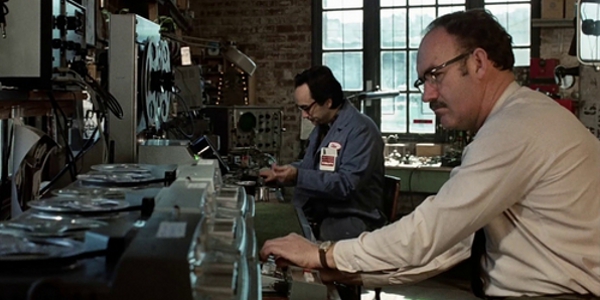
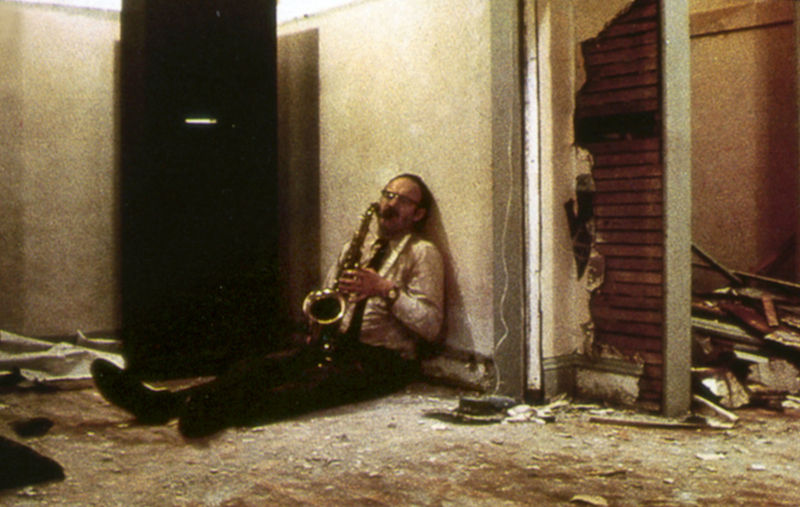
Don't be fooled! This is The Conversation, but there is no actual conversation going on right now Don’t be fooled! This is The Conversation, but there is no actual conversation going on right now

As you can imagine, The Conversation is an introspective film that gives more information about Harry Caul than the actual mystery of the couple. Caul is an anti-social man who would rather listen in on other people than give any information about himself. He is also extremely paranoid, which makes sense when your job is to basically spy on other people. On the other hand, he spends so much time lost in his world that he misses all these big clues around him. For example, during a convention about spy equipment (which is just as interesting as you can imagine), a competitor slips a ballpoint pen into Caul’s pocket that will record his conversations the rest of the night. IRONY! I knew the second I saw the pen what it actually was, but Caul didn’t think twice. As he becomes more concerned about the fate of the couple, Caul decides to destroy the tapes instead of handing them over and potentially having blood on his hands. After a drunken party at the spy convention, he sleeps with a woman who-you guessed it- stole the tapes! It was completely obvious what was going to happen which I thought was silly except after thinking about it, the whole scene just made me feel even more sorry for Caul and understanding his loneliness.

I have to stop here. At this point, when the tapes were stolen I was prepared to give this movie a 2/5 because although some of it was interesting, it was also rather boring. But then, as Caul followed the couple to the hotel room to find out their fate, my opinion changed. I LOVED this movie. The ending was much more complex than I ever expected it would be and I have many questions. Although this movie is 40 years old, I’m going to hold off revealing anymore spoilers. Francis Ford Coppola, the guy who directed the Godfather movies, has said that The Conversation is one of his personal favorites and I completely understand why.
8095-the-conversation

Final review:  5/5. I’m tempted to watch the movie again to see what other clues I might be able to pick up that will help me with the ending.

Up next: E.T

#67- Kiss Me Deadly

Quick recap: Mike Hammer is a private eye, known for working divorce cases. One night while driving, he helps a young woman, Christina, escape from her nameless attackers. They eventually catch up to the two, making Hammer crash the car. When he finally wakes up, he is in the hospital and Christina is dead. Instead of letting things go, he decides to pursue who Christina was and who was out to get her.

The title sequence was run backward for some reason and confused me more than it should have

The title sequence was run backward for some reason and confused me more than it should have

Fun (?) fact: A federal unit whose job it was to investigate what corrupted youth in the 50’s, named this movie the number one menace to teens.

A terrifying picture of corrupted teens

A terrifying picture of corrupted teens

My thoughts: Psycho not living up to my expectations made me even less excited to enjoy this movie. I joke a lot about how easily audiences were influenced back then and maybe that’s why movies seem so tame, but then something like this comes along and changes my perception.I would argue  Kiss Me Deadly has parts that are just as violent as what I’m used to seeing nowadays. It was refreshing to know that stuff like this existed, but it also made me wonder why people glorify directors like Hitchcock being the master of horror and thrillers. I’m beginning to think he might be a little overrated.

One of the aspects I loved about this movie was that no one was particularly a good person. Mike Hammer is the protagonist, which typically pegs him as the square, but he is far from it. For one thing, his job in divorce proceedings is to get as much dirt as he can on both partners and then screw them out of money. he is also heavily involved with his secretary, but doesn’t make it official and throughout the movie he has no issues making out with any woman who will have him. And he’s definitely not what the bad guys were expecting him to be. In an early scene, Hammer finds out that he is being followed by someone. Instead of running away, he fights the guy and then bashes his head against the wall repeatedly. Later on, while interrogating an old man, Hammer gleefully breaks a rare vinyl record that the man loves. It made me more intrigued with the mystery since I wasn’t invested in the characters as much.

There was A LOT of kissing. So much kissing.

There was A LOT of kissing. So much kissing.

The mystery itself was sub par. It was exciting to see the next clue and what would happen next, but I got confused several times trying to figure out what Hammer was looking for. Even now, I’m still not sure what Christina, the girl from the beginning of the movie, had to do with all of this. On the other hand, I don’t really care. There were so many twists that I gave up trying to keep up and just enjoyed what I was watching. With all of the action going on, I was reminded of my favorite television show, Lost. I won’t spoil anything, but as each season went by, I became more and more intrigued by the mystery. By the last few episodes, I realized that the reveal, whatever it was, wouldn’t satisfy me. And that’s precisely what happened here. When Hammer finally finds the box Christina has been hiding and opens it up, it really doesn’t matter what’s inside because it has been a hell of a journey so far. And I guess the director felt the same because the contents of the box are never revealed. An homage to this can be seen in Tarantino’s Pulp Fiction. The final scene of the box being opened and starting a nuclear explosion was a nice surprise and matched with all the Cold War drama going on in real life. kiss-me-deadly-1

Final review: 4/5. I wouldn’t call this required viewing, but it was a lot of fun to watch and gave me hope for similar classic films

Up next: Onibaba

#62- Citizen Kane

Quick recap: Charles Foster Kane, newspaper magnate, dies and his last word is ‘rosebud’. A reporter is sent out to investigate what the word means, in hopes of getting to the bottom of who Kane really was.

1f01_015


Fun (?) fact: It’s no secret that William Randolph Hearst wasn’t a fan of Citizen Kane, seeing as how the main character parallels many points from Hearst’s life. Orson Welles has stated several times that the inspiration for Kane was based off of several sources, not just Hearst. Nevertheless, one time Welles and Hearst were in an elevator together, during the San Francisco premiere of the movie. Kane asked Hearst if he would be attending and Hearst ignored him. As he got off on his floor, Welles replied, ‘Charles Foster Kane would have accepted.’

pretty sure I have a thing for Orson Welles now.

pretty sure I have a thing for Orson Welles now.

My thoughts:  I can predict that this post is going to be more rambling than usual.I’d like to say it’s because it will be hard for me to describe the greatness that is Citizen Kane, but in all reality it’s mostly because I have the flu. As an early Christmas present to all of my readers, here is a helpful tip for you: the flu shot is bullshit.

Citizen Kane has been a movie I have been wanting to watch for a long time because it’s on everyone’s ‘best of’ list. It’s also a movie I have dreaded watching because it’s on everyone’s ‘best of’ list. And seeing  as how Psycho turned out, I turned my expectations way down. Luckily, from the first few minutes I was hooked. I’m a fan of non-linear movies or really any film that defies traditional storytelling and this movie is the father of them all. It starts out with the death of the main character and the viewer only finds out who Kane was through flashbacks. I especially loved the newsreel scene at the beginning, announcing Kane’s death. It was so realistic PLUS it had my favorite old movie trope- spinning newspapers!!

I think the reason I loved this movie so much is how Charles Foster Kane is brought to life. Each person interviewed had a different perspective on Kane, some negative and some positive. I went from feeling sorry for Kane as he was taken away from his home and instead brought up by the bank to swooning over him as he refused to acknowledge his vast amounts of money, only wanting to help the poor. And then as he became even more wealthy, his personality began to change.  The pivotal scenes showcasing the segue from All-American Good Guy to Kind of a Jerk happened during his first marriage. At the beginning of the marriage, he and Emily can’t stay away from each other. Both are in good spirits and have high hopes for the future. But with each scene, all set at the breakfast table but with different years, the couples drift apart physically and emotionally. It was a powerful way to show the damage being done.

As Kane continued his rise to fame and money, he became even more eccentric- buying statues and other works of art and then doing nothing with them. It is during his second marriage that he decides to build an estate, Xanadu. He and his wife relocate here and it is at Xanadu that I could finally see what Kane had become. The scene where Susan is begging to not have to sing again is heartbreaking, as well as when she finally leaves him.  The estate itself is ornate and gorgeous but at the same time desolate and depressing. It was the perfect place to match what Kane had become.

I could write a whole post focusing on the special effects and cinematography of Citizen Kane but there isn’t much to say that hasn’t already been analyzed a million times over. My two favorite aspects of what makes this such a remarkable movie are 1) the makeup effects turning Kane from his early 20s to old age. It was so hard to believe it was the same person at times and it wasn’t until after the movie that I found out that Welles was only in his early 20s himself when he made the movie. And then 2) I had no idea this was a thing, but I loved how the camera focused. This is called ‘deep focus’. I can’t really describe it but basically it wasn’t just an actor staring into the camera and saying his lines.

it's not a spoiler for a movie made in the 40s.

it’s not a spoiler for a movie made in the 40s.

Final review: 5/5. This movie lives up to all the hype and then some. It is truly a must see for anyone.

Up next: let’s go with Woman in the Dunes. If I keep putting that title here, I will eventually watch it.


#44- All the President’s Men

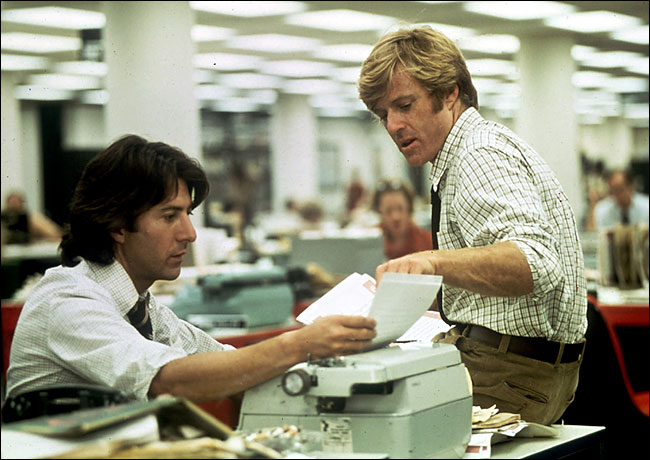
Quick recap: In the early 70’s,  journalists Bob Woodward and Carl Bernstein were responsible for bringing the Watergate scandal to light. What starts out as a minor break in at the Democratic Headquarters eventually leads higher and higher up into the Republican Party and eventually implicating  then-President Nixon. SPOILER ALERT- Nixon is forced to resign.  I apologize if anyone was spoiled by that previous statement.

This was supposed to be an image of 'Deep Throat'. I don't suggest Googling the title.

This was supposed to be an image of ‘Deep Throat’. I don’t suggest Googling the title.

Fun (?) Fact: The movie was originally shot inside the real Washington Post office, but workers kept trying to get screen time so they rebuilt the office on a sound stage . The office shown on the film has meticulous details like real stickers and phone books that had been used during the scandal.

My thoughts:  I love politics. I love movies. But I do not enjoy political movies, for the most part. In fact, the only movie I can recall really loving was ‘Frost/Nixon’, so maybe I just have a thing for Nixon? Personally, I find him to be one of the most interesting presidents we have had. Not one of the best, but interesting.

Richard Nixon's Head


This movie was odd in that I was really drawn to it at the very beginning and very end, but the middle was a little tedious at times. Maybe it was because I already knew the outcome, but I was rather bored sitting through several scenes of Woodward and Bernstein calling people. It just seemed too true to life for me at the point. On the other hand, the film did a great job turning phone calls into AMAZING REVELATIONS!. I’m thinking of one scene where Bernstein calls the librarian and asks her about books that have been checked out. She admits to seeing the person but then a few minutes later denies ever hearing the man’s name. Riveting stuff, really. It was around this point, that I had my own AMAZING REVELATION. As I was watching Woodward and Bernstein combing through the library records, it occurred to me that I was looking at this film from the entirely wrong perspective: This movie was not about Watergate, but instead about journalism itself. After realizing this, I found myself enjoy the movie much more.

Being married to someone who was a journalist at one point and eventually changed careers because print media is dying, made this movie all the more poignant. I was amazed by how much WORK went into blowing a scandal open like this. Every tiny detail had to be researched and then confirmed by several sources before it went to print. The journalists involved gave every waking moment to investigating the scandal and it paid off. I can’t really comment on the state of things now, seeing as I don’t have first hand information, but I imagine that investigative journalism just isn’t the same anymore. There is one scene in the beginning of the movie where Woodward is trying to figure out a name on a list. He asks his boss, who happens to know what the man’s title is and it is that knowledge that helps move the investigation further along. Had this happened in modern times, Woodward would’ve simply Googled the name, maybe emailed the guy and waited around. I love me some technology, but there is something to watching how all of the clues are being put together without a use of a computer, just by talking to people. I loved how Woodward and Bernstein could make people talk. It wasn’t like the sources had a reason to give info and many were afraid to do so, but they helped anyway and it helped bring down the presidential office, eventually. I see it on Twitter, both political parties always looking for their ‘Watergate’, but the thing is, that was a once in a lifetime story, and even then may have amounted to nothing if it hadn’t been for those two.  It’s a truly fascinating film to watch, if only to see the final death knell of traditional investigative journalism.

Robert-Redford-Screening-All-the-Presidents-Men-Revisited-in-Washington-DC


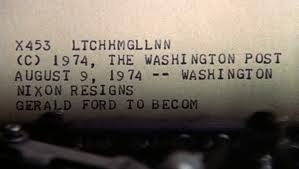
Final review:  4/5. The final few moments are some of the best in cinema history: Woodward and Bernstein writing the piece that finally blows everything open, as they watch Nixon’s inauguration on tv and the metaphor of the cannons blasting. And then summing up the rest of the events of Watergate, using the typewriter. Watch this movie, if only for these scenes. allthepresidentsmentypewriter

Up next: The Silence of the Lambs