#35- Tsotsi

Quick recap: Tsotsi is a leader of a gang that spends its time robbing and killing people to get what they want. After doing some pretty messed up stuff, Tsotsi takes it further by shooting a woman, stealing her car and then driving away, only to realize there is a baby in the backseat. He makes a decision to abandon the baby but then changes his mind and decides to raise it. It’s like 3 Men and a Baby, except with a lot more violence and the baby almost dying.

The movies are much more similar if you are the kind of person to misunderstand movies and hate Tom Selleck

The movies are much more similar if you are the kind of person to misunderstand movies and hate Tom Selleck

Fun (?) Fact: 

The soundtrack was so interesting to listen to! I’d never heard this style before but it really adds to the mood of the film.

My thoughts: This movie was so hard to watch. I knew it wasn’t going to be a field of flowers and kittens but I wasn’t expecting something so bleak. The film takes place in a slum in Johannesburg, South Africa where crime is rampant and everyone is just trying to survive. The main characters in the film are so bad. In the first few scenes, they stalk a businessman onto his train and then crowd around him. They warn him that they are going to take his money and then one guy pulls out a very sharp, thin ice pick and shoves it into the man, killing him almost instantly. It’s such a cold way to die. One of the members confronts Tsotsi after the ordeal, saying that it makes him sick to kill someone like that. He is severely beaten for this. The point is, as bad as these guys are, they are also trying to survive, like everyone else.

Tsotsi is such a complex character. He seems emotionless at the beginning and yet he starts to crack a little after killing the businessman. After deciding not to abandon the baby after the carjacking, Tsotsi shows that he needs to feel a sense of love and belonging, just like everyone else. But after growing up in the slum, he doesn’t have the skills to care for a child. The baby is constantly crying, and after trial and error he realizes that he is hungry. In the only way he knows how, Tsotsi pulls a gun on a woman with a baby and forces her to breastfeed. It is her compassion and kindness to the baby that brings him to start to remember things about his own childhood.

It is revealed that Tsotsi’s real name is David and he once had a home with a mother and father. In one flashback, David’s mother is dying and she wants to hold his hand for comfort. His father comes in and orders David to go away. He runs and hides from his father and then watches in horror as his father viciously kicks his pet dog and breaks its back. It’s almost unbearable to watch this scene. David runs away and goes to live in a pile of cement cylinders.
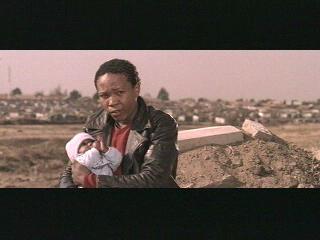
showing the baby where he came from

showing the baby where Tsotsi came from

In the end, Tsotsi makes the right decision to return the baby back to his parents. Although the plot itself is riveting, it is the actors who really make the movie shine. Their performances are so authentic that it was hard to remind myself that this was only a movie and not a documentary. On a personal level, this movie made me really think about the kids I teach. Many of them grow up in unimaginable situations and it’s easy to forget that beyond the tough exterior is just a child who wants what we all want. The film is a great reminder that although there is plenty of evil in the world, there is compassion and decency to do the right thing.

Final review: 5/5. If you can stand the violence, this is required viewing.

Up next: A Fish Called Wanda
 

#34- Metropolis

Quick recap: Metropolis is a future dystopian urban society where class issues abound. You’ve got the workers who keep the city flowing and alive and then there are the wealthy members who have helped create the city and now spend their time going to crazy parties and frolicking through the meadows. And as if you had a hard time understanding the difference, the workers live way, way underground and the wealthy people live way,way above ground. The story centers around Freder, the son of the man who rules the city and a woman named Maria who just sort of shows up in the catacombs underground. The two of them spend their time trying to bridge the gap between the increasingly impatient workers and the wealthy businessmen. There’s also a crazy inventor and machine man, for good measure.

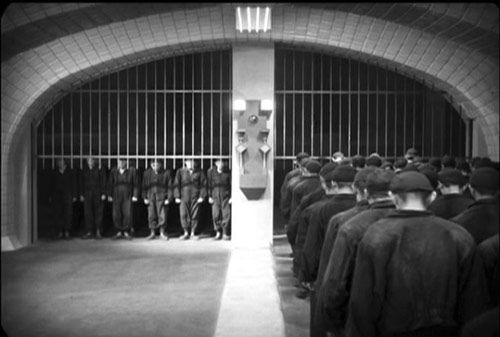
turn that frown upside down, fellas!

turn that frown upside down, fellas!

Fun (?) fact:  Although director Fritz Lang was Jewish, he was given a ‘pass’ from the Nazi party because they loved the film so much. Being a smart person, he fled Germany right after getting the pass.

My thoughts: I have been looking forward to this movie ever since I got started on this project. After watching so many American silent films, I had become bored by the same plot points and same actors. After watching The Cabinet of Dr. Caligari, I began to have a little more hope. Dr. Caligari was not a favorite movie of mine but I could appreciate a director choosing to do something so fantastical rather than everything Griffith was churning out. Although I am now watching movies out of order, I loved getting to go back to the silent film era for a bit and be completely impressed and in awe of what I was watching.

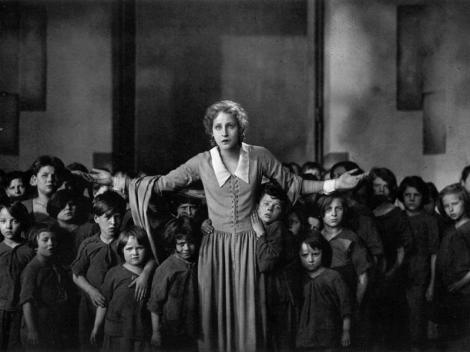
One of the most important elements of Metroplis is that the plot is complex. The film centers around the idea that the hands and the brain need the heart to mediate. Hands being the workers and brains being the industrialists and the heart being Freder.  The characters, too, are as complex as the plot. I like that Maria’s origin is never discussed, just that she showed up one day, promising a mediator. I loved the scene where she is introduced. She brings all the workers’ children above ground to the garden so that they can meet ‘their brothers and sisters’. Considering that this movie was made in the 20s, it’s still a concept people have trouble with- that we are all human and all the same.

tumblr_lyzn5uAmOG1qf4yar

The message of the movie was a little muddled, but not in a negative way. Some people see it at face value, that it is nothing more than a sci-fi film. But there is also a bunch of religious imagery- the Tower of Babel, the apocalypse, the 7 deadly sins, Maria ,who brings a savior. There were parts that seemed more morality play than epic movie. Another thought is that the movie carries a rather heavy political message. The workers have been mistreated but they are integral to the city staying alive. At the same time, the industrialists are overbearing, heartless jerks but they too are necessary to the city. I saw many parallels in the movie with the political climate at the time in Germany. I’m not really sure who The Mediator is supposed to be, though. Is he government or is this a pro labor union film? The messages might not have been intentional, but it is interesting to look for them, nonetheless.

I think my favorite part of the movie was the machine man, or as I refer to her- Evil Maria. Rotwang, the inventor, captures Good Maria at some point and create a machine in her image that will turn the workers into a mob, intent on bringing the city down. Evil Maria was definitely bad but I loved her crazy expressions and Evil Dancing. It was also an interesting plot point to have the workers, who have been seen as helpless victims, turn into a destructive mob. They get so out of hand that they begin breaking machines and consequently flood their city where the children are.

How do you solve a problem like Evil Maria?

How do you solve a problem like Evil Maria?

Final review: 4/5. I happened to watch the 148 minute version which was an unforgettable experience and yet not something I want to repeat anytime soon. I was completely riveted with all the details of the city of Metropolis as well as the machine man.

Where I watched it: Alamo Drafthouse. Watching a silent film on the big screen has been one of my favorite experiences of this list so far

Up next: Tsotsi


#33- The Ascent

 Quick recap: The movie centers around two Soviet Partisans who go off in search of food for their group. Along the way, they are captured by Nazis and interrogated. And then everyone dies, except one guy who tries to kill himself but is unsuccessful. I’m not a fan of spoiling movies, but if you are looking for a good war movie where everyone is saved at the last second by their troop, this ain’t it.

happy-cat-is-happy-3667


Fun (?) Fact:    Depressing fact: The director of this film, Larisa Shepitko, died in a car accident a couple of years after ‘The Ascent’ was released, so this was her last movie.

basket1


My thoughts: In case the hint hasn’t been picked up yet, I’ll just go ahead and say that this was a DEPRESSING movie. Depressing in the sense that after it finally ended, I curled up in a ball and regretted ever doing this list, but then I looked at cat pictures and felt a little better. I’m still going to need a few years of therapy.

As I have stated before, I don’t like to look up information about the movie before watching it ,so all I had to go on was that 1) this is a war movie and in the war movies I have seen, everything is gritty but then people get rescued and the Americans always come out on top. GO USA. and 2) the movie is called ‘The Ascent’, which I took to mean that the Soviets would climb out of their situation and everything would be ok. Boy, was I wrong. The film is in black and white and most of the scenery consists of snow and trees. There is barely any music, except when someone is about to be tortured or about to die. That alone would be depressing enough but then there are the characters. Besides the partisans, the Nazis capture an old man who has been working for them but who they no longer trust, a woman who helped hide the two men and who has young children to care for by herself, and a child. One of the partisans decides to step up and admit that he orchestrated everything but of course that does no good. The other partisan begs for his life and is allowed to join the Nazi police. He is immediately told to help walk the prisoners, his friends, to the gallows where he puts a noose around everyone’s neck and helps them to be executed. Seeing his terrible choice, he attempts to hang himself several times but is unable to die. He considers escaping but knows he would be shot dead on the spot so he is left to endure staying at this camp.

carrot_cat_smile1


I think what got under my skin the most was the lack of violence and torture shown. At one point, one of the partisans has a star branded into his chest. I was thankful to not have to watch that but instead the camera focused on his face which was so much worse. In the scene at the gallows as everyone is hung, the camera focuses on a young child forced to witness the deaths. As he sees everyone hanging, he sheds a tear and it’s just awful. I don’t claim to know much about war movies but this different perspective combined with the saddest ending ever, makes for me, a more realistic view of war. Nowadays, directors try to top each other with the goriness but this movie, made in 1977 does the opposite and creates scenes I can’t get out of my head.

The most poignant part of the film was the scene in which the interrogator kept trying to get information and the partisan only answered in response, ‘What were you before the war?’ It was a question I had never thought about before, that the Nazis were, at some point, regular people with regular jobs and families, not the monsters that they eventually became. War is hell, y’all.

zenktty


Final review: 5/5. I really wanted to give ‘The Ascent’ a 1 because it bothered me so much, but that’s precisely why it needs a 5. Schindler’s List is seen as the go to ‘World War 2’ movie, but my vote is for this one as essential viewing.

Up next: Metropolis

#32- The Host

Quick Recap: The story starts with an American screwing up by dumping a bunch of toxic chemicals into the Han River in South Korea. Several years later, the chemicals produce a fish monster that can crawl around on land and devour people. A little girl, Hyun-seo, is taken hostage by the monster and it is up to her family to save her since everyone else thinks they are crazy.

from The New Yorker

from The New Yorker

Fun (?) Fact: I’m just going to go ahead and spoil this by saying the following fact is in fact, not fun. The movie is based off of a real incident in 2000 when a mortician working for the U.S. Military poured a bunch of formaldehyde down a drain in South Korea, sparking controversy. The film is not meant to be anti-American specifically but North Korea apparently loved the movie so just let that one sink in for a second.

SteveUrkel


My Thoughts: Horror, as a genre, doesn’t do much for me. Setting aside the fact that EVERYTHING ON EARTH scares me, I think most horror films rely too much on gore and shock and let the plot fall by the wayside. So I love when I get the chance to watch a horror movie that stays with me long after the horror has passed.

I know absolutely nothing about Asian monster films, except that many of them should be taken at more than face value. The very first scene of the movie recreates a real life incident that polluted the environment and led many South Koreans to no longer trust the US, so the director isn’t going for subtle here. On the other hand, most of the movie centers around the family and what they go through in order to save Hyun-Seo and not really so much on how much the US sucks. It was enough to make me feel a little uncomfortable and guilty watching what South Korea must think of us.

The family of Hyun-Seo consists of her dad, useless and lazy, her grandfather who has made mistakes in the past but is trying his best to keep everyone together, her aunt, a medal winner in archery and her uncle, an alcoholic. I wondered for a second if Wes Anderson didn’t have a hand in creating these characters. I most enjoyed seeing how much they fought and yet would do anything for the girl. I won’t spoil all of the hardships the family goes through in rescuing Hyun-Seo, but there are many and it was interesting to see how they reacted to each situation.

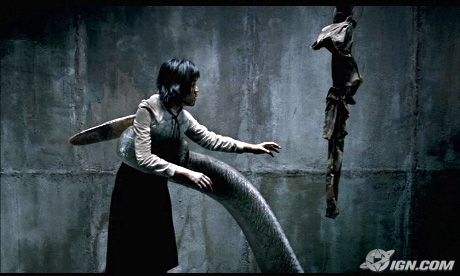
Of course, no review would be complete without a review about the monster itself. I admit to getting chills the first time the monster is spotted as it hangs upside down under a bridge. As more people gather, the monster quickly uncurls itself and jumps into the water. People begin to throw food at it and then all of sudden it springs up and starts gobbling everyone in sight. As far as monsters go, it’s not scary in the sense that I would have nightmares, but more of a traditional, Godzilla style scary. I was most uneasy watching it regurgitate its victims.

one of my favorite scenes

one of my favorite scenes

One more thought: the movie is called The Host because the monster holds a deadly virus. But it doesn’t actually and it turns out people are just being used for experiments. There is also a plot point where the US decides to help and orders a substance called ‘Agent Yellow’ which will kill the virus. I think the monster by itself was scary enough but I guess adding the virus element gave the director another chance to show how the US has a tendency to put itself into situations it doesn’t belong in.


Final Review: 4/5. I was gunning for a strong 3 most of the movie but the ending pushed it to a 4 because there is nothing I love more than an ending that doesn’t solve everything.

Where I watched it: Alamo Drafthouse. I recently finished reading’The Orphan Master’s Son’, a novel about North Korea. One of the main characters is an actress and in one scene she is shocked that anyone would want to watch a movie on anything other than the big screen. After seeing The Host there, I completely agree.

Up Next: The Ascent