#126- The Thief of Bagdad

Quick recap: A thief-who lives in Bagdad- has a lot of fun stealing stuff until he falls in love with the princess. Basically it’s like Aladdin but without the monkey and the altruistic reasons. And without Genie (RIP Robin Williams).

Instead of getting a Middle Eastern guy to play the Thief of Bagdad, they got Douglas Fairbanks-the whitest name ever.

Instead of getting a Middle Eastern guy to play the Thief of Bagdad, they got Douglas Fairbanks-the whitest name ever.

Fun (?) fact: The special effects for this movie are amazing, considering it was made in 1924. During one scene, as Fairbanks is jumping in and out of the large pots, he actually installed trampolines in each one to make it easier to hop.

I suspect this was also done with special effects. Can't be sure, though.

I suspect this was also done with special effects. Can’t be sure, though.

My thoughts: A bonus fun fact: I started this blog chronologically, but after sitting through 9 silent films I couldn’t take it anymore and gave up. It wasn’t even that they were bad, but that they were so EPIC.  It was hard to continually sit through something so heavy and long (that’s what she said) and know that the next movie would give me no reprieve. But then I saw A Clockwork Orange at the Alamo Drafthouse several months later and it renewed my passion. All that to say I made the right choice to watch randomly so that when the time came for another silent movie, I’d be ready.

The Thief of Bagdad comes from the 1001 Arabian Nights collection of stories  so it’s basically your quintessential adventure movie. Fairbanks, who plays Ahmed the Thief, was the go to actor for all things adventure, starring in movies such as Robin Hood, The Three Musketeers and The Black Pirate. He spends the entire movie flexing his muscles and practically winking at the camera, to show the audience how awesome he is. It was difficult to root for him at times because he was a thief just for the sport of it instead of helping others.Not that I was expecting much, but Aladdin is the only story I know from Arabian Nights and that guy stole bread to give to children. Kind of a lot to live up to, though.  Fairbanks was enjoyable to look at, although the thin lips bothered me. Was that a fashionable thing to have or did all people in the 20s just have naturally thin lips? This bothers me more than it should.
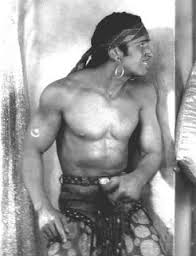
Not a complaint, but it seems like he should've been able to steal a shirt at some point.

Not a complaint, but it seems like he should’ve been able to steal a shirt at some point.

If there is any reason to watch The Thief of Bagdad, it’s the setting. Director Raul Walsh had the set built on 6 1/2 acres of land and spared no expense. Every detail is beautiful and ornate. The fact that it was made in 1924 makes it all the more inspiring to think of the work that went into making this movie.

Final review: 4/5. When you take into account that the story came from an ancient book, the racism is not as bad as I expected.

Up next: Singin’ in the Rain

#95- Nanook of the North

Quick recap: Nanook (who’s name isn’t really Nanook) is an Eskimo (Inuk) who must fight daily (with guns) for survival. Along with documenting Nanook’s life (most of it is staged), the film also captures his family ( not really his family) and how they manage to adapt to the bitter cold.

On the other hand, there is a scene with a baby playing with puppies so it isn't all bad

On the other hand, there is a scene with a baby playing with puppies so it isn’t all bad

Fun (?) fact: Shortly after the film’s release, it was revealed that Nanook had died of starvation. Actually, it’s more likely he died at home of Tuberculosis, which is somehow better?

Is ANYTHING real? No.

Is ANYTHING real? No.

My thoughts: Nanook of the North is considered to be the first wide released documentary, which right off the bat I disagree with because so much of it is staged. One article I read put it in the genre of ‘docudrama’ which is a little better, I suppose, but still doesn’t reflect the level of fakery that was sold to the public. Before I continue ranting any more, I feel it best to point out that Nanook of the North ,  regardless of what it has been classified as, is a perfectly fine film all its own. I could’ve watched images of the landscape for many hours and the characters were also endlessly fascinating, real or not.

More huskies, less fake hunting

More huskies, less fake hunting

And now back to your regularly scheduled rant.

I knew going into this that I would potentially be watching something culturally insensitive, as the 20s weren’t known so much for their embracing of diversity as they were known for treating groups like a zoo attraction. One of the very first pieces of text describes the Inuk people (called eskimos) as a happy, simple people. And then the rest of the movie is spent justifying this statement. During one scene, Nanook’s family travels to a trading post, run by the ‘white man’ . While there, they encounter a gramophone for the first time and Nanook hilariously tries to bite the record, to see what it is (he knew what one was in real life). A minute later, one of the children has a stomach ache from eating so much and the man gives him some castor oil. In seconds, the child was smiling brightly and rubbing his stomach and licking his lips as if the oil were the best thing he had ever had in his entire life. Some of the scenes were truly touching, like when Nanook was showing a young child how to hunt with a bow and arrow. But overall, the simplicity of this family bothered me. The best example of this being the final scene, when the family has barely survived a sudden snowstorm. They find shelter in an abandoned igloo and, with faces radiant with happiness, lay down to sleep. It was supposed to be an example of the enduring strength of this man, but to me, came off once again like an attraction at the zoo.

The hunting scenes didn’t bother me as much as they apparently did to audiences when the movie came out. By the time Nanook and his family were being filmed, most of the families in the tribe had started using guns to hunt for food. But since guns kill things easier than a spear, they were left out of the film. I guess I didn’t care so much about these scenes being reenacted because it was hard for food to come by and so you have to work with what you have. And even though Nanook had moved to more modern forms of hunting, he still knew the ways of his ancestors.

Final reveiw: 3/5. A beautiful film filled with lies, but still a work of art.

Up next: Another surprise, apparently.

#34- Metropolis

Quick recap: Metropolis is a future dystopian urban society where class issues abound. You’ve got the workers who keep the city flowing and alive and then there are the wealthy members who have helped create the city and now spend their time going to crazy parties and frolicking through the meadows. And as if you had a hard time understanding the difference, the workers live way, way underground and the wealthy people live way,way above ground. The story centers around Freder, the son of the man who rules the city and a woman named Maria who just sort of shows up in the catacombs underground. The two of them spend their time trying to bridge the gap between the increasingly impatient workers and the wealthy businessmen. There’s also a crazy inventor and machine man, for good measure.

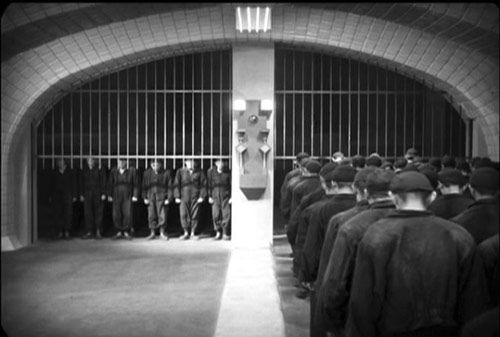
turn that frown upside down, fellas!

turn that frown upside down, fellas!

Fun (?) fact:  Although director Fritz Lang was Jewish, he was given a ‘pass’ from the Nazi party because they loved the film so much. Being a smart person, he fled Germany right after getting the pass.

My thoughts: I have been looking forward to this movie ever since I got started on this project. After watching so many American silent films, I had become bored by the same plot points and same actors. After watching The Cabinet of Dr. Caligari, I began to have a little more hope. Dr. Caligari was not a favorite movie of mine but I could appreciate a director choosing to do something so fantastical rather than everything Griffith was churning out. Although I am now watching movies out of order, I loved getting to go back to the silent film era for a bit and be completely impressed and in awe of what I was watching.

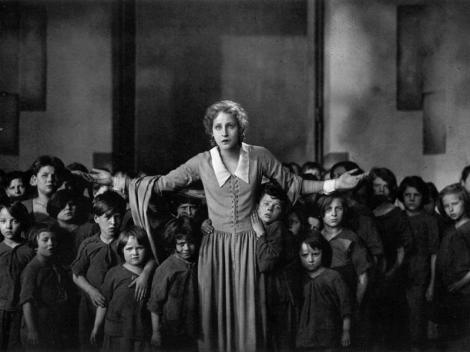
One of the most important elements of Metroplis is that the plot is complex. The film centers around the idea that the hands and the brain need the heart to mediate. Hands being the workers and brains being the industrialists and the heart being Freder.  The characters, too, are as complex as the plot. I like that Maria’s origin is never discussed, just that she showed up one day, promising a mediator. I loved the scene where she is introduced. She brings all the workers’ children above ground to the garden so that they can meet ‘their brothers and sisters’. Considering that this movie was made in the 20s, it’s still a concept people have trouble with- that we are all human and all the same.

tumblr_lyzn5uAmOG1qf4yar

The message of the movie was a little muddled, but not in a negative way. Some people see it at face value, that it is nothing more than a sci-fi film. But there is also a bunch of religious imagery- the Tower of Babel, the apocalypse, the 7 deadly sins, Maria ,who brings a savior. There were parts that seemed more morality play than epic movie. Another thought is that the movie carries a rather heavy political message. The workers have been mistreated but they are integral to the city staying alive. At the same time, the industrialists are overbearing, heartless jerks but they too are necessary to the city. I saw many parallels in the movie with the political climate at the time in Germany. I’m not really sure who The Mediator is supposed to be, though. Is he government or is this a pro labor union film? The messages might not have been intentional, but it is interesting to look for them, nonetheless.

I think my favorite part of the movie was the machine man, or as I refer to her- Evil Maria. Rotwang, the inventor, captures Good Maria at some point and create a machine in her image that will turn the workers into a mob, intent on bringing the city down. Evil Maria was definitely bad but I loved her crazy expressions and Evil Dancing. It was also an interesting plot point to have the workers, who have been seen as helpless victims, turn into a destructive mob. They get so out of hand that they begin breaking machines and consequently flood their city where the children are.

How do you solve a problem like Evil Maria?

How do you solve a problem like Evil Maria?

Final review: 4/5. I happened to watch the 148 minute version which was an unforgettable experience and yet not something I want to repeat anytime soon. I was completely riveted with all the details of the city of Metropolis as well as the machine man.

Where I watched it: Alamo Drafthouse. Watching a silent film on the big screen has been one of my favorite experiences of this list so far

Up next: Tsotsi


#8- Way Down East

Quick Recap: A young country girl, Anna,  is sent to her cousin’s house and falls for a man named Sanderson. Sanderson seduces Anna and holds a mock wedding just so he can sleep with her. After discovering she is pregnant, Sanderson admits to the scam and leaves. Soon after, Anna’s mother dies and she eventually gives birth to a baby boy who dies in infancy. Anna is forced to find work after her landlord discovers she has no husband. She eventually finds work with a farming family who are very religious, but kind. It is revealed that Sanderson lives just a few houses down. Things are going well and Anna even begins to fall in love with David, the Squire’s son. Everything comes crashing down when the Squire finds out Anna had a child out of wedlock. She explains her side of the story and then runs away. Even though finding out she is not who he thought, David chases after her and dramatically rescues her from an icy river. All is forgiven and the two eventually marry.

Fun (?) Fact: The icy rescue scene at the end of the movie was done without special effects.

My Thoughts: I do my best not to read about the movie ahead of time so that I won’t form any opinions beforehand. So when I do have an idea, it is nice to know that it sometimes matches up with what is true. Take, for instance, the movie’s premise of a girl ruined by her mock marriage. The whole thing seemed incredibly outdated for 1920, until I later read that the movie is based on a very popular play from 1890. Of course Lillian Gish was wonderful, although I would love to see her play a villain just once instead of the innocent, everything-that-can-go-wrong-does-go-wrong character. Besides the outdated (for its time) plot, I was bored with the subplots of all the other couples falling in love. Apparently there is a revised version so maybe some of this is taken out? I guess I do appreciate the lightheartedness that was put into some of the scenes. I can imagine young couples going on a date to see this movie because it is essentially a romance. I don’t know who in their right mind would bring a date to Birth of a Nation or even Intolerance,  so good for Griffith for branching out a little. The ice rescue scene at the end was pretty amazing and just shows how talented Griffith was.

Final Review: 2/5. Once again, this is my personal opinion in the movie and not necessarily what someone else might think. I am not a romance movie kind of girl so it wasn’t really my cup of tea. I much preferred Intolerance but I would rather watch this than Broken Blossoms. I’m still drinking because of that one.