#143- Amores Perros

Quick recap: Three seemingly unconnected stories are told, although everyone crosses passes with another at some point. Each story has something to do with love as well as something to do with a dog. Thus, Amores Perros.

Octavio y Susana, a story about a guy who is in love with his brother's wife. He also makes money dog fighting.

Octavio y Susana, a story about a guy who is in love with his brother’s wife. He also makes money dog fighting.

Fun (?) fact: For once, I put my 3 years of Spanish to good use because I knew that ‘Amores Perros’ means ‘love dogs’. Awww, love dogs. I love dogs! Upon doing some research, I found out that it is actually an expression, meaning roughly, ‘love’s a bitch.’ Oh.

Daniel y Valeria, a story about a guy finally getting to be with his mistress, a model. She has a horrible car accident and ultimately loses her leg.

Daniel y Valeria, a story about a guy finally getting to be with his mistress, a model. She has a horrible car accident and ultimately loses her leg.

My thoughts: In its synopsis, Netflix said Amores Perros was the ‘Mexican Pulp Fiction‘. That excited me because I love me some Tarentino. He has a way of mixing outlandish gore and humor so that you can’t help but fall in love with his movies. I also love the idea of other Tarentinos out there, with their own beautiful, twisted ideas in other countries. But then I watched the first scene, which featured a dying Rottweiler, completely covered in blood, and I knew that I had stepped into something closer to Funny Games than Pulp Fiction. Damn.

El Chivo, a story about a former hitman who now wants to be reunited with his estranged daughter.

El Chivo, a story about a former hitman who  wants to be reunited with his estranged daughter.

The dying dog scene was traumatic all by itself, but then the next scene featured a dogfight with people around the arena sweeping up the buckets of blood and hauling off dead dogs. The movie had a disclaimer before the opening credits that no animals were actually harmed, but everything was so realistic. As I looked up trivia about Amores Perros, I learned that the dogs were actually just playing and the director edited the scenes to make it look like fighting. As for the dead dogs, they were just heavily sedated. That’s all well and good and legally I can see how that wouldn’t be considered ‘harmful’, but most dogs if given a choice, wouldn’t care to be knocked out for a long amount of time.

So, as you can see, it was nearly impossible to get past all the gruesome dog deaths. It reminded me of all of those people who whine that they can’t sit through movies like Marley & Me, knowing that the dog will die in the end. They have no idea that there is much worse out there. And for those people who have watched Marley & Me as well as Amores Perros, what the hell is wrong with you??

Besides torturing dogs for two and a half hours, the theme of love also carried throughout the movie. And by love, I mean people being awful to each other. In the first story, Susana is married to Ramiro who abuses her and robs people on the side. His brother Octavio is in love with her and shows it by practically raping her every chance they are alone together. So, basically what I took from this movie is that people who are mean and cruel to dogs are also awful people in real life.

Final review: 3/5. I see why so many people love this movie, but it was just too much for me.

Up next: Monty Python and the Holy Grail

#142-Close-Up

Quick recap: Close-Up is a semi-documentary about a man who pretended to be famed Iranian director Mohsen Makhmalbaf and was later arrested for it.

Not Mohsen Makhmalbaf

Not Mohsen Makhmalbaf

Fun (?) fact: All people involved in the case play themselves, although many of the scenes are recreated.

Not Mohsen Makhmalbaf

Not Mohsen Makhmalbaf

My thoughts: If you are looking for a documentary with twists and turns, this isn’t it. It’s simply about a man pretending to be someone else. I knew this going into the film but a small piece of me still expected there to be something shocking at the end, like Sabzian murdering everyone or actually being the director Makhmalbaf. It always annoys me when directors take creative license with the truth (*ahem* Foxcatcher) by exaggerating or making up events, but in this case I could’ve handled a bit more suspense.

That’s not to say I didn’t enjoy Close-Up. Being a bit underwhelmed with the case made it possible for me to instead focus on the people involved. As I’m sure the director intended, I felt sorry for Sabzian from the moment he entered the screen. From his story, we learn that he is just a poor man with a minimal wage job who ran with the chance to be seen as a famed director because he wanted respect. His mother is also in the film and she is even more sad than Sabzian. They seemed like good people, even though he was caught up in a case like this. There were many times that the family implied there were ulterior motives to take money and burgle the house, but that doesn’t seem likely. As one of the family members put it, Sabzian was a sick man, the sickness being poverty, and the only way to get better and stop doing illegal things would be to get a decent job and find something to do with his life.

The family’s account of the deception seemed straightforward enough, yet I found it hard to believe that they were really all that hurt by Sabzian. They seemed like decent enough people but there were times, especially when the father became suspicious, that it felt more like they were just being cruel instead of turning him into the authorities. In a couple of the scenes it felt like Sabzian was being mocked, although that could also be because he really wasn’t that good of a fake and gave himself away so easily.

The most powerful part of the film arrives at the end as Sabzian meets up with the director he impersonated. After buying a plant for the Ahankhah family, Makhmalbaf and Sabzian ride to the family’s house where the director becomes the mediator between the two parties. The apology felt real and gave me hope that everything turned out ok.

Not Makhmalbaf

Not Makhmalbaf

Final review: 3/5. An intriguing film about truth but not really something that kept my attention for long.

Up next: Amores Perros

#139- Farewell, My Concubine

Quick recap: This is the story of two men, Douzi and Shitou, whose friendship spans over 50 years in China.

best friends, being bros, doing bro things

best friends, being bros, doing bro things

Fun (?) fact: This is going to be a big one, so be prepared:

Ready?

China banned this movie. I KNOW. Crazy right?!

showing young boys being beaten and tortured was cool for China, but not the homosexual vibes going on between the two characters

showing young boys being beaten and tortured was cool for China, but not the homosexual vibes going on with Douzi

My thoughts: You guys, opera is badass. Seriously. I know next to nothing about it, and what little I do know concerns Italian opera. I think I was aware that China had their own productions but I wasn’t aware how, well, badass it all was. Chinese opera has the same themes as opera around the world: love, death, war, but they have an added element of acrobatics, amazing feats of strength and stunning costumes. Watching Farewell, My Concubine makes me want to hunt down a show and watch it live because although the movie was good, it’s not the same as watching the real thing.

The plot is straightforward enough: two friends stay close for over 50 years. But oh my god, the things these two men went through. I don’t know if you are aware of this, but China has some really messed up history. At times, it felt like the director was going for melodrama, with one tragedy occurring after another, but then again Farewell, My Concubine takes place during a very turbulent time in China’s history. Although this story is fictional, I imagine most of what the movie portrays is something someone lived through at some point.

One thing that really captured my attention was the depth of the characters. Douzi is the main character, whose story starts with his mother abandoning him at the training headquarters for the Peking Opera. He is initially rejected because of an extra finger on his hand, but his mother chopped it off and walked away. The training was brutal, with boys constantly being beaten with swords and expected to be perfect. Douzi is strong, but feminine, and so is trained to perform the Dan (female) roles. Throughout the movie, he maintains his feminine personality, to the point of being overly dramatic, like many people thought homosexuals acted back in 1993. Shitou is the more masculine of the two, but very caring. He has a very short temper but somehow endless patience for Douzi. I really enjoyed not having to pick a protagonist and root for one person because everyone in this film had faults.

the story is that a king is defeated in war. All his soldiers abandon him, except for his horse and concubine. The concubine stands until the very end and then kills herself with his sword.

the story is that a king is defeated in war. All his soldiers abandon him, except for his horse and concubine. The concubine stands until the very end and then kills herself with his sword.

Final review: 5/5. Many of the scenes were very difficult to watch but I was engrossed the entire 3 hours and at the end, it felt like it was almost too short of a film

Up next: Tongues Untied

#138- The Conformist

Quick recap: A spy has been given the task of assassinating an Anti-Fascist, who happens to have been a mentor of his.

Conformista_8

Fun (?) fact: I got nothing. For a movie so aesthetically pleasing and for something so complex, I was expecting a bevy of information but all IMDb gave me was the Italian Censorship Visa # (56307 for all my censorship visa nerds. I know y’all LIVE for that kind of stuff)

seriously. This movie is beautiful. It's an art form all by itself

seriously. This movie is beautiful. It’s an art form all by itself

My thoughts: First of all, hi everyone! I’m back from my month long hiatus where I participated (and won) NaNaWriMo. A good time was had by all.

I wanted to ease back into this blog with a comedy or something that I could make fun of easily but this was next on the list, so here we are: The Conformist. The title itself is a whole philosophical discussion about man’s true need to conform to society and especially political beliefs. Or something like that. Marcello Clerici, the main character ,is a Fascist because that’s just what many powerful people in Italy were, but he ultimately failed to conform because he couldn’t carry out his duties as a member of the secret police. Or something like that.

even insane asylums are beautiful

even insane asylums are beautiful

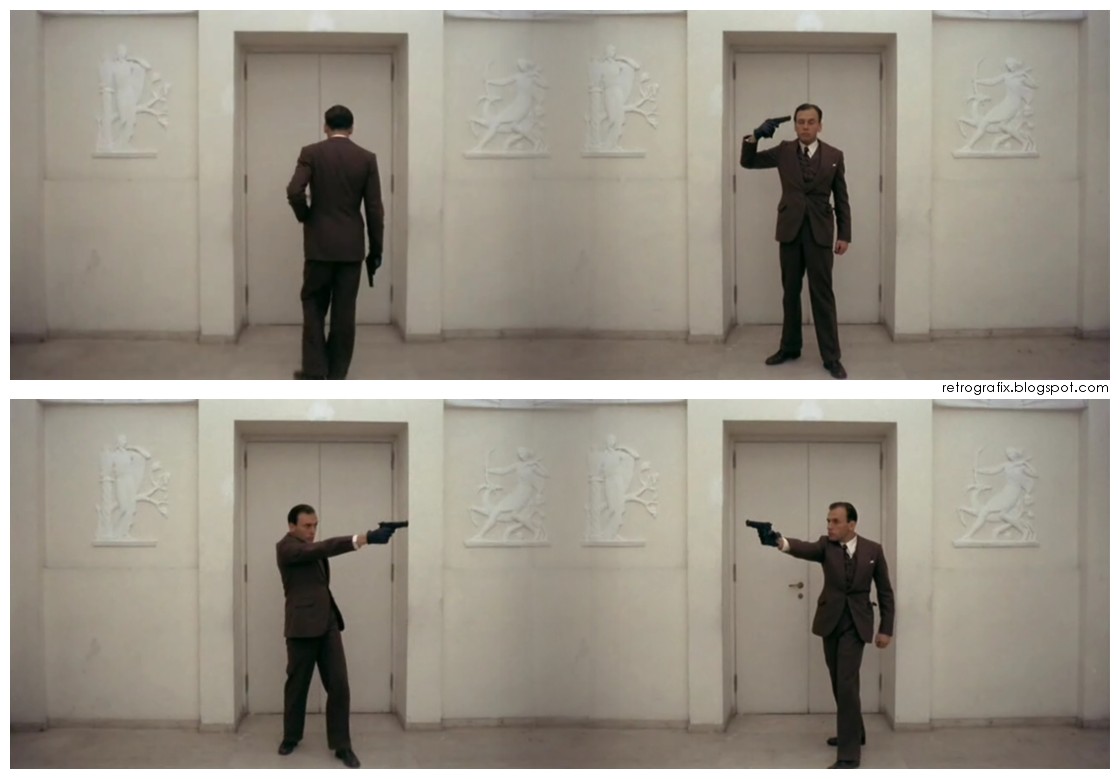
As beautiful as the film was, the non-linear storyline was confusing, especially in the beginning ,but I got used to it about halfway through. Clerici shares a flashback in the beginning of the film where he talks about being bullied by neighborhood boys because his family was wealthy. A chauffer befriends him and then tries to sexually assault him. Clerici shoots him and is able to escape. At the end of the film, as Mussolini has fallen, Marcello walks around with another Fascist pal and comes across Lino, the guy he thought he had killed. He suddenly freaks out and starts labeling everyone around him as a Fascist and implicates them in the murder of the professor and his wife. Director Bernard Bertolucci implies that the only reason Clerici is a Fascist is because of childhood sexual trauma and repressed homosexual urges, which is a pretty damning statement but not really how that kind of thing works.

By far, the best part of the scene is the murder of the professor and his wife, who Clerici has fallen in love with. Prior to the assassination, he warned Anna to stay in France but she didn’t listen. When her husband is stabbed to death (by a gang of spies and it takes FOREVER) she runs out of the car for help. She sees Clerici in the car and starts screaming because that’s pretty messed up, but he just sits there and lets her get murdered. It’s such a dark part of the movie that it is hard to believe that this movie was released in 1970.

Final review: 4/5. This is a complex movie that was way ahead of its time and certainly stands with more modern movies.

The Conformist 002

Up next: Farewell, My Concubine