#152- The Life of Emile Zola

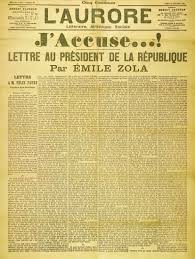
Quick recap: Emile Zola was a French writer in the 1800’s who wrote several books about the state of his country. He was most famous for an article called ‘J’Accuse’ where he condemned France for wrongfully imprisoning  Alfred Dreyfus for suspected treason.
This movie is chock full of newspaper montages!

This movie is chock full of newspaper montages!

Fun (?) fact: Emile Zola was maybe murdered? OOPS, sorry.

*spoiler alert* Zola dies and was maybe murdered. You know how much I hate giving away the endings to films almost 80 years old.
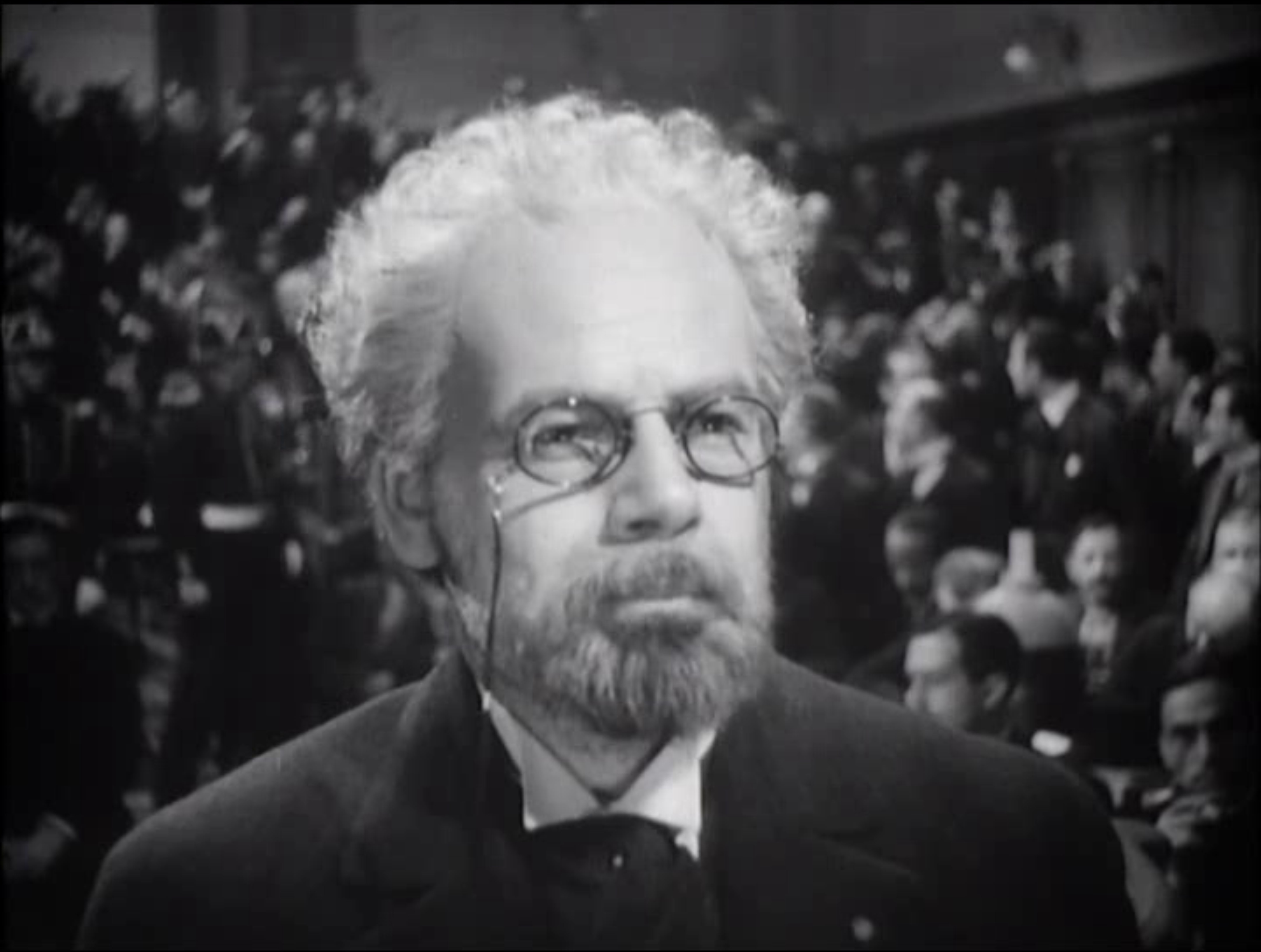
He looks like a more dignified Colonel Sanders. Sorry, had to get that out of my system.

He looks like a more dignified Colonel Sanders. Sorry, had to get that out of my system.

My thoughts: Although I love getting to watch some old favorites like my last film review, there is something satisfying about sitting down to watch a movie that I know nothing about. Before last night I had never heard of the name ‘Emile Zola’ or any of his works. I won’t go so far as to say that I am a fan, but it’s nice to have knowledge about something previously unknown to me.

I thought The Life of Emile Zola was a French film but actually it’s an American one about someone French, which means British accents for some reason. That’s a pretty common thing even now (I’m looking at you Tom Cruise in Valkyrie) but it still annoyed me a tiny bit. Despite this, the acting was superb. Even though this film was made in 1937, it felt like it could’ve easily been made in the 50’s. Paul Muni, who played Zola did a remarkable job, especially during his 6 minute speech in the courtroom at the end of the movie.

Emile Zola waters down actual events into something less complicated, a fact that makes sense given the time but also makes me a little angry. For example, in real life Dreyfus was wrongly accused and convicted partly because he was Jewish. This film came out right in the middle of the rise of Hitler and so movie execs didn’t want to take a stand. So the word ‘Jew’ is seen exactly one time in reference to Dreyfus and never uttered once. Like I said, it makes sense but also diminishes from the story a little.

Final review: 3/5. I really did enjoy this film and stayed interested almost the entire time, considering this was just about a writer’s life.

Up next: Straw Dogs

#150- The Player

Quick recap: Griffin Mill is a Hollywood studio executive who is sent death threats from an unknown writer he passed over for a script. Being the jerk that he is, the suspects are endless.

2014-06-04

Fun (?) fact: None of the celebrity cameos were written into the script. Basically, they just showed up, improvised their lines and got put in the film. Julia Roberts, among others, did her cameo for free.

Player2

My thoughts: Oh, Robert Altman, why must you toy so with my emotions? First, you bring me The Long Goodbye, arguably one of my favorite finds on this list but then you disappoint me so deeply with Nashville. My wounds are still healing from that heartbreak. When I saw that The Player was filled to the top with celebrities, my heart sank once again and I longed for the wit that was Elliott Gould.

The beginning of The Player was a hot mess, even more than Nashville with its 30 plus subplots. It was filmed in one long take with actors galore discussing ‘Hollywood’ stuff, most of which went too fast for me to get. It wasn’t until about 10 minutes into the movie that I realized Tim Robbins was the main character. In fact, for at least 2/3 of the film it’s easy to get lost in the sea of characters and to forget that there really is a plot. Most of the time it just felt like Altman was bragging about all of the cool friends he has.

Tim Robbins’ performance was perfect and I’m a little surprised why so many people look to Shawshank Redemption as his best, when it is clearly this movie. No one can play asshole quite like he can. I enjoyed seeing him slip further and further into the role of slimy Hollywood studio executive until he was completely gone.

The only saving grace for this film came from the most unlikeliest of places: Lyle Lovett. Yes, THAT Lyle Lovett.

url

He wasn’t onscreen too often, but when he did appear, I loved every minute. I should note here that The Player is considered a comedy, a fact I find most surprising since I didn’t find much to laugh at. I think part of the issue is that the comedy relies  so heavily on the cameos, most of which I either didn’t recognize or care about. It kind of reminded me of watching Golden Girls as a kid. Most of the references were so specific to the time period in which the show took place that it took away from the hilarity a bit. Lyle Lovett, however, kept me interested until the very end. Someone should make a movie starring just him in this role. I’d pay good money to see that.

Final review: 2/5. I get the larger theme that this is a parody of what goes on in Hollywood, but since I’m not a studio executive, the humor was lost on me.

Up next: a Ferris Bueller Quote-A-Long at the Drafthouse!

#149- Back to the Future

Quick recap: Marty McFly accidentally travels 30 years into the past where he must help his parents meet before he and his siblings are erased forever.

Don't start getting ideas, Michael Bay

Don’t start getting ideas, Michael Bay

Fun (?) fact:  Thomas F. Wilson, who played Biff, improvised the ‘butthead’ line as well as the ‘make like a tree and get out of here’ line. He also gives out FAQ cards to fans when they ask him about the movie.

What not to do when time traveling

What not to do when time traveling

My thoughts: Unlike Jaws, I do have memories of seeing this movie at some point in my adolescence. It wasn’t a favorite then, although I remember being entertained by it. In the years since, not much has changed. Back to the Future is one of those movies I would watch anytime it was on tv or if someone put it on, but it isn’t something I would seek out on my own.

If I had to put my finger on the best part of the movie, I’d go with Michael J. Fox’s performance. Casting did a perfect job choosing him as the lead character. On the surface, he’s a normal teenager with the typical problems of school, having a girlfriend and being embarrassed by his parents. On another level though, he is a very thoughtful kid, befriending an eccentric scientist and then doing everything he can to help him. Getting his parents together was selfish, I suppose, but he really took to heart who his parents were and who they eventually turned into. It’s these layers that made me appreciate the movie so much more than when I originally watched it.

But mostly, Back to the Future is about time travel. The action scenes were good, although the science a little fuzzy. I like that the answer to why this was possible at all was the ‘flux capacitor’ as if that’s all you really need to know. The only issue I have is how easily McFly was able to change events into the future. he mentioned being mayor to Goldie one time, and he latched on to the idea. He played guitar at the end of the movie, where Chuck Berry’s cousin just happened to be, thus creating rock and roll. At least it all turned out for the better, in the end.

rainingdonuts

Final review: 4/5. Very enjoyable and also a movie that perfectly captures the 80’s. Oh, does it ever.

roads-1420135354-great-scott-nike-announces-functioning-back-to-the-future-kicks

Up next: The Player

#147- October (Ten Days that Shook the World)

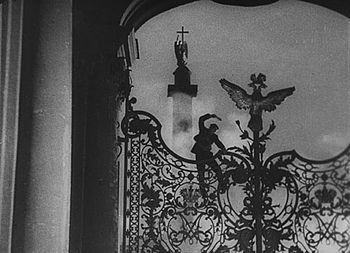
Quick recap: October is a silent propaganda film chronicling the Bolshevik revolution and storming of the Winter Palace.

Fun (?) fact: The actual storming of the Winter Palace wasn’t very photogenic on account of the chaos, so scenes from October are now used as historical evidence.

350px-Eisenstein_Zimnii

My thoughts: Propaganda films fascinate me for many reasons, but I mostly look forward to watching them because it’s fun to see if I will fall into the agenda the film pushes. Salt of the Earth is a great example of this. I anticipated watching October even more because I have little to no knowledge of Russian history and wanted to see if that would affect my thinking in any way.

A little history before my review: First, the Tsarist government was overthrown and a new government was set up of mostly aristocrats. They were then overthrown by the working class, who formed the Bolshevik party. From there, they elected their own members and the Soviet Union was born. I learned none of this from the movie, by the way. After October finished, I rushed to Wikipedia and read up on what the hell I had just watched.

So, October is not the sort of movie anyone should watch without context, like I chose to do. All I saw was two hours of people running around with guns and it was all very confusing. Add to that, the director put in artsy images to drive home his point, all of which went over my head. For example, in one scene a fat guy with really bad teeth was shown talking and looking important. Spliced in with that guy was an image of a really creepy bird that kept turning its head. Afterwards, I learned that the bird was actually a peacock, the symbolism being that the aristocrat was preening, as a peacock does.

also, this dead horse hanging from a bridge was symbolic of something

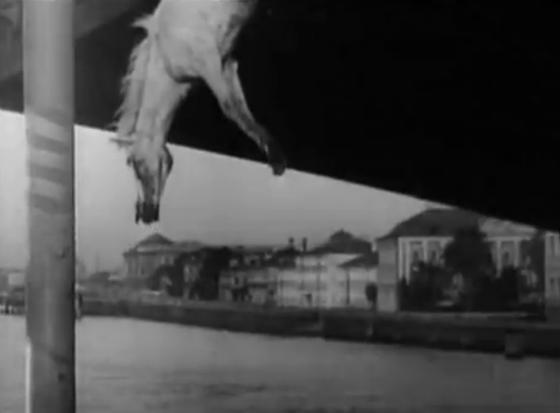
also, this dead horse hanging from a bridge was symbolic of something

October surprisingly works really well as a propaganda film. As a moviegoer in the 20s I would’ve probably been moved by the Bolsheviks’ idea of helping the working class and poor.Director Eisenstein turned everything black and white, trying to show clearly who was working for the good of the people and who wasn’t. It’s easy to get caught up in something like that, especially seeing images of people starving while bureaucrats sit in their fancy houses and dine on fine food and expensive alcohol.   Time is on my side though and I know how this story turned out and so in watching this film in 2015, I was mostly unmoved.

Final review: 2/5. It would’ve earned a 1, but watching October has spurred my interest in Russian history so that’s not a bad thing to take from this.

Up next: The Story of a Cheat