#137- Manhunter

Quick recap: Will Graham, former FBI profiler, is talked into helping solving a particularly gruesome serial killer case. Watch closely and you may see our good friend Hannibal Lecter pop in to lend a hand!

Lector reminds me more of a grown up Eddie Munster than terrifying serial killer

Lector reminds me more of a grown up Eddie Munster than terrifying serial killer

Fun (?) trivia: The scene where Graham visits Lecter was actually filmed at an art museum in Atlanta. Also noted that ‘Lecter’ is spelled ‘Lecktor’ in the film.
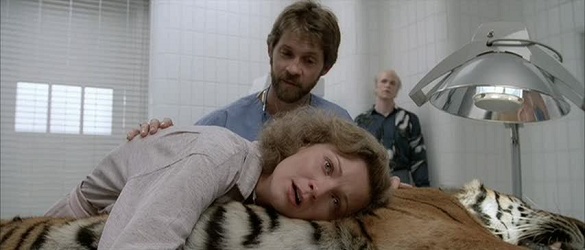
Random vet creepily puts his hand on McClane's back as she lays on a sedated tiger, while Dollarhyde stands in the corner and watches. Weird.

Random vet creepily puts his hand on McClane’s back as she lays on a sedated tiger, while Dollarhyde stands in the corner and watches. Weird.

My thoughts: Oh, boy. I’m going to try my best not to compare this movie to Silence of the Lambs because you just can’t. It’s superior, Anthony Hopkins is superior and so it wouldn’t be fair to this movie. I’m also not going to compare Manhunter to its remake Red Dragon, which was released in 2002. Why? Because this movie is a hot mess all on its own without needing any further comparisons.

If I had to put my finger on Manhunter’s biggest problem, it would be that it is an 80’s movie. How 80’s you ask?

tumblr_mnjqj0gySP1qdv594o1_500

Yeah. Director Michael Mann is also known for a little show called Miami Vice so that explains the color choices. I really can’t fault anyone for that because it was the style at the time. What I can fault the movie for, however, is the music. Oh my god, the music. Someone on that crew figured out what a synthesizer was and just went NUTS on the soundtrack. It’s pretty awful. The worst scene is when Dollarhyde the serial killer, watches the girl he likes get back from a date with another man. As he sits in the car, his heart about to break, the most 80’s sounding song comes on and it completely ruins the moment. Totally inappropriate, just like the decision to use Prince on the Batman soundtrack.

Concerning the plot, I was surprised with how gritty Manhunter was.  I remember reading the book a long time ago and really enjoyed it. The scenes where Graham imagines the dead women with mirrors in their eyes was creepy. I wouldn’t go so far to call it horror but it was unsettling, at least. The acting was pretty good, although Graham’s habit of always talking to himself was a little weird. I get the point that he was trying to understand the killer’s point of view but those scenes just seemed silly.

Wheeeeeeee!

Wheeeeeeee!

Final review: 2/5.

Up Next: Nothing for a month. For some stupid reason, I’ve decided to try NaNoWriMo this year where I will be writing a novel in 30 days. See you guys in December!
#130- The Burmese Harp

Quick recap: Set during World War II, this movie follows a group of Japanese soldiers who have just crossed over into Burma, the main character being a guy who plays a Burmese harp. After being told the war is over, the Burmese Harp guy goes on a mission to find another group of soldiers to ask them to surrender instead of fighting to their death. The soldiers refuse and are all killed. Burmese harp guy is supposed to go back to his group who are currently in an internment camp but instead decides he would be more useful in other places.

url

Fun (?) fact: Godzilla’s requiem theme from the 1954 movie ‘Gojira’ can be heard during several parts of this film. Because nothing goes better together than a story of a Buddhist monk and Godzilla.

My thoughts: The Burmese Harp is a war movie in the sense that it is set during World War II and the characters are all soldiers. Thankfully, and I say that solely because I have had more than my share of war movies lately, the theme is less war centered and revolves instead around pacifist themes. Yay for not having to sit through confusing battle scenes and lots of blood and guts. Everything is coming up Mary!

The downside of making this sort of movie is that pacifism is sort of dull. The Burmese Harp is a beautiful film, don’t get me wrong, but ‘beautiful’ can only keep my attention for so long. The whole thing reminded me of reading Siddhartha when I was in high school. It too is a beautiful book about a man’s journey to spiritual fulfillment, but just know that if you choose to read it, don’t expect there to be much,if any, action. The only real action this movie has is when all of the Japanese soldiers are killed when they refuse to surrender. Even then you never really see a fight, just the aftermath. Also, that scene happens during the first half hour of the film while the next hour and a half is filled with a lot of walking and singing. Lots of walking and singing.

One thing I did enjoy about this film is watching Mizushima, the Burmese Harp guy, realize his calling. After being injured, he begins to make his way back to the internment camp to join his squad. On the way, he steals a Buddhist robe and also begins to take on the role of a monk. His journey takes him all the way across Burma where he sees bodies strewn about. He begins to bury and burn the bodies, hoping to give them a little bit of dignity in the end. I’m sure it must have been a very difficult decision to stay in a foreign land, adopt a new lifestyle and never see your friends again. But that’s sort of the point of being a monk, to put others before yourself.

I feel a little guilty for not being as in to this movie as I would’ve liked to be. It seems right up my alley, especially since I find myself identifying more with the pacifism side than the war side. But it just didn’t do much for me. I feel like this movie was made more for the Japanese people than me as an American. There was plenty to identify with and learn from, but in the end I felt like it would be more powerful for those who have lived through the horror directly.

Final review: 2/5. Not my cup of tea but a beautiful film, nonetheless.

Up next: HORRORFEST 2014

#123- Dead Man

A big thank you to S for recommending this movie. My favorite part was that it was an ‘art house’ film that didn’t make me want to drink heavily. 

Quick recap: Johnny Depp plays William Blake (not the poet), an accountant on the run from the law. After murdering a guy, Blake is shot. Thus begins his journey as a dead man (wanted for murder) and a dead man (because he got shot).

Johnny Depp pre judging himself on later film roles

Johnny Depp pre judging himself on later film roles

Fun (?) fact:  Many of the lines spoken by Nobody are taken from the real William Blake’s poetry.

My thoughts: My thoughts on Johnny Depp the actor are as follows: I have none. I’m aware of his career and I’ve seen many of his films but I wouldn’t call him a favorite by any means. Or even an actor that I hate (yeah, Bill Paxton, you’re still number one for that). I don’t really think it’s that big of a deal that he has done so many films with Tim Burton because he is well suited for those roles. It is nice, however, to watch a movie like Dead Man and be reminded how talented Depp really is.

Of the many aspects of the film, it was the scenery I was drawn to most. I read trivia that cinematographer Robert Müller ‘s idea to shoot in black and white was based off of Ansel Adam’s photographs. For a fantasy film, the setting was entirely realistic and I imagine that’s exactly how it would’ve looked and felt back in the 19th century. With the school year starting, my wanderlust has picked back up and I now find myself fantasizing a trip up north to make my own trek through the woods that Blake and Nobody rode through.

images

What interested me most about Dead Man is that although there are plot elements, the emphasis is really on the journey. There aren’t any monologues concerning Blake’s thoughts on his impending death or what he will leave behind. He is just along for the ride and for whatever happens. The scene where Nobody brings him to his tribe is a great example of this, as Blake just lays there and watches what is being done around him. He doesn’t fight death or argue about it. It just is.

Final review: 5/5. I’m shocked at this rating because immediately after watching it, I had planned on giving it just a 3. Considering I’m still talking about it to people and thinking about the meaning behind some parts, I felt it best to bump it up to a more deserving score.

Dead-Man-6

Up next: The Thin Blue Line

#122- Cinema Paradiso

Quick recap: A film maker recounts his life as a young boy in 1950’s Italy when he fell in love with movies.  

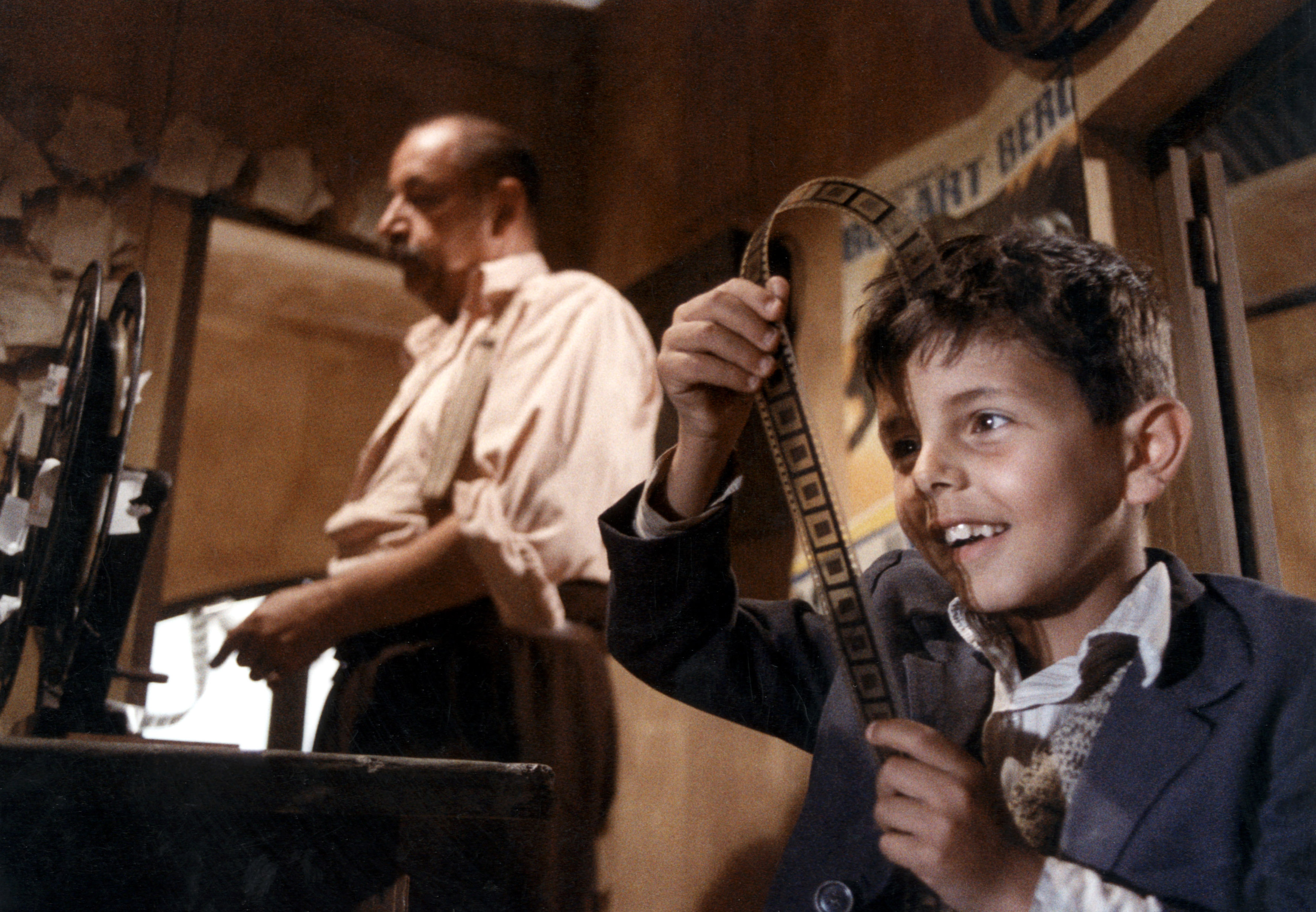
specifically, Toto fell in love with the dirty scenes his mentor Alfredo took out of the film

specifically, Toto fell in love with the dirty scenes his mentor Alfredo took out of the film

Fun (?) fact: Filmmaker Giuseppe Tornatore meant for Cinema Paradiso to be an obituary for movie theaters as a whole but when his movie was successful he quietly dropped that idea.

My thoughts: My feelings on Cinema Paradiso have been difficult to put into words because my thoughts are all over the place. I enjoyed the movie very much and might even recommend it to someone looking for something different to watch. But was it a ‘good’ movie? When I die, am I going to look back and say, ‘thank god I had the privilege of seeing this movie’? To the second question first, probably not. To the first, well- that’s the hang up.

I want to like this movie. It’s right up my alley- foreign, not well known, quality acting, an interesting plot. On paper, I should be raving about how this movie changed my life and yet here I am. The problem lies in that Cinema Paradiso is really two films. I watched the much edited version streaming on Netflix, but the original is almost 3 hours long. Maybe that would’ve changed my mind by watching the full thing ,because the pacing seems really off. The first half of the movie is about Toto as a boy, finding a true friend in film projectionist  Alfredo. It’s unbearably sweet how the two interact and help each other out. I especially connected with the concept that movies are magical and bring people together. It reminded me of watching random classic films on tv as a kid. I never really understood what was going on, but it felt important and something that should be respected. When the Cinema Paradiso burns down, Alfredo is caught inside and Toto saves his life. By this point, I was completely hooked.

And then, in one of my least favorite movie tropes, Alfredo (who has been blinded by the fire) is feeling young Toto’s face. The camera moves toward him and then when it goes back to Toto, he has magically turned into a teenager. Yuck. Teenage Toto isn’t nearly as interesting as super adorable kid Toto. He has become very sweet and quiet, not the hellraiser I was used to in the beginning. And he’s in love, of course. The rest of the movie revolves around him trying to get the girl while Alfredo has taken on a ‘wise sage’ role. He convinces Toto to walk away from his job as a projectionist, move to Rome, and never come back. And so he does, which includes dropping the girl he has loved. It isn’t until 30 years later, following Alfredo’s death, that he returns to his old town. Sure, he’s a big shot filmmaker now, but he doesn’t seem all that happy with his life. I think the director was trying to show that following your dreams means making sacrifices but besides the career, he doesn’t seem too successful.

The one redeeming scene comes at the very end of the movie, as Toto sits in a private movie theater and finally watches all the pieces of film Alfredo had cut out for being too ‘obscene’. It’s basically just a supercut of people making out, which is a little weird, but also sweet. This scene didn’t make up for the second half of the movie, but it helped a little.

Final review: 3/5. That was a hard one.

Up next: Dead Man