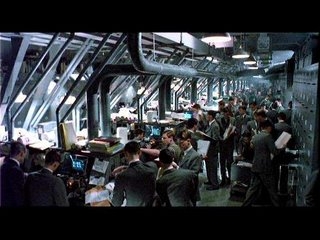
#70- City Lights

Quick recap: Charlie Chaplin plays the Tramp, a guy just trying to get by. As he bounces along the city, he falls in love with a blind woman and becomes friends with a millionaire who only seems to like him after he has been drinking.

City-Lights-Charlie-Chaplin


Fun (?) fact: The gibberish heard at the beginning of the film as the statue is being revealed was done by Chaplin. It is the first time his voice can be heard on film.

My thoughts: I was lucky enough to get to enjoy City Lights on the big screen at the Alamo Drafthouse. I almost went insane at the beginning of this project, sitting through all of those silent films. Many of them were good, but it still wore on me after awhile. It’s the very reason I decided to change things up and watch the movies in a random order, rather than chronologically. My love for the silent film almost returned with Metropolis and now I can fully embrace it again with this film. These early films were created for the big screen and I doubt I would’ve enjoyed Chaplin as much if I had been sitting at home. One of the best parts of the experience was not the movie itself, but being able to participate as an audience member. We collectively swooned when the Tramp was courting the Blind Woman and laughed when he got himself into another situation. I don’t use the word often but it was delightful, being a part of this. I felt like I had been transported back in time, watching it as if it had just come out.
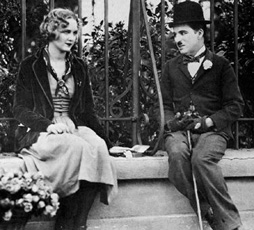
city-lights-3


I admit to not knowing much about Chaplin before watching City Lights. I knew him as a silent film star and to me that meant a lot of slapstick. At the time this film was made, ‘talkies’ had started creeping into the moviegoer’s experience. Despite the trend, Chaplin firmly believed that he could make a successful silent film, and he was proven correct tenfold, seeing as how this movie is considered as one of the greatest of all time. From the very first scene, when the Tramp is napping on a statue that has just been revealed to the public, I was hooked. Chaplin had a way to convey emotions so eloquently without saying a word. He is charming, to the point of being adorable. He is a good person, just trying to get by. And when bad things do happen to him, he takes it all lightly and pushes forward. One of my favorite scenes that show what a genius Chaplin is, occurs right after he and the Millionaire have fallen into the water. The Millionaire invites the Tramp back to his house, and as they ascend up the steps, he turns around and grabs the flower he had bought from the Blind Woman. It was such a simple gesture, but the way he does it conveys all of the love that he has for this woman.

I was a little apprehensive about seeing all the slapstick comedy because it’s not really my thing. I was worried that the outdated form would distract me from the movie, but it did the opposite. Instead, it showed me the beauty of a perfectly timed bit. The scene where the Tramp becomes a boxer in order to earn money for the Blind Woman is like watching ballet. It was very funny, but also beautifully done. I think I laughed hardest during the scene when the Tramp swallows a whistle and makes a sound every time he breathes. Once again, Chaplin has no need to say anything because his face is so full of expression.

city-lights-prizefighter


And of course, the ending. The ending to City Lights is considered one of the greatest ever done. Not because there is anything spectacular, but because of its simplicity and once again, beauty. Throughout the film, the Tramp does what he can to become closer to the Blind Woman. He cares for her daily after she falls ill and does what he can to find money so that she can continue to live in her apartment. Somehow, the Tramp is able to get enough money to also help the Blind Woman see. The final scene happens when the two meet for the first time and she can finally see. The Blind Woman had been convinced the Tramp was actually a millionaire and the expressions she conveys as she realizes it is really this man in tattered clothing, is perfect. But the real beauty of it all is watching Chaplin as he is so excited to be seen and so, so hopeful. I am not a very emotional person when it comes to movies, but this one really got to me. It was also comforting to hear other audience members sniffling as the lights went back on.


city-lights-1931-charlie-chaplin-silent-movie-review-image-42Final review: 5/5. Of course. If had to choose one movie to make people watch from this list, this would be it.

Up next: Cleo from 5 to 7.

 

#69- Brazil

Quick recap: Sam Lowry holds a low level government job in the not so distant dystopian future. He’s happy with things the way they are, except for the bizarre dreams he has of rescuing a beautiful woman. Once he realizes she is in fact real, he makes it his life mission to find and save her.

Brazil-Daydream

Fun (?) fact: Terry Gilliam, the director of Brazil, was involved in a long battle against a studio company not wanting to release his film. At one point, Gilliam took out a full page ad in Daily Variety asking when the studio was going to release his film.

That's the way to get things done

That’s the way to get things done

My thoughts: Cool story bro: On the day I was going to watch this movie, I had somehow gotten Billy Joel’s ‘My Life’ stuck in my head .(Just kidding. I know exactly how it was done. BLACK MAGIC) After leaving the theater, the curse was lifted and now I have the theme to Brazil stuck  instead. It’s not as bad as Billy Joel, because, let’s face it, nothing is. Also, there were a ton of variations to the theme so it’s almost like a new song each time.

Billy-Joel-285x300


So, besides this being one of my husband’s favorite movies (not one of several husbands. One of several movies), I love Monty Python and therefore, knew I would enjoy Brazil. The movie did not disappoint, but I admit to being a little confused by the whole thing. I hadn’t read up on the movie beforehand so I didn’t know that it is commonly characterized as a ‘dystopian satire’. It’s a totally apt description. The very beginning of the film involves an innocent man being whisked away from his family, presumably to be executed. I was a little surprised by the violence, but then one of the officers makes the wife sign away her husband, making sure she signs in the correct spots. She is then given a receipt and everyone leaves. The woman is hysterical by what has happened, yet she stops crying long enough to sign the forms correctly. Another example happens when Lowry goes out to dinner with his mother and while they are eating, a terrorist attack occurs in the restaurant. As people lay dying and bleeding to death, Lowry’s table continues eating as if nothing has happened. The waiter even brings over a partition so they won’t be bothered by the gruesome scene. I am blown away how Gilliam was able to  blend the dystopian scene with satire so seamlessly.

The dystopian society itself interested me tremendously. In this ‘retro future’, everyone is materialistic, and yet they are surrounded by the shoddiest things. Lowry’s apartment, for example, is fully automated so that he doesn’t have to lift a finger in order to get ready for work. However, nothing works right: His alarm is set wrong, he has to plug in several wires just to answer the phone, and his breakfast is ruined when the machine pours the coffee all over the toast. Also, as a major plot point, there are these pipes that are everywhere. When his heating system breaks down, Lowry phones the Central Services line to get someone to fix it. Instead, a man intercepts the call and does the work much more efficiently. It is at this point that Lowry’s eyes are open. Another characteristic of this society is that paperwork rules all. Hardly anything gets done because of the vast amount of paperwork involved. Innocent people are routinely killed because the government believes the paperwork is infallible.

Brazil_movieI realize I haven’t really touched on the plot of this movie very much, and there is a reason for that. I feel like this movie will be best be enjoyed if you have no idea what you are getting into. Everything was a surprise and I had no idea how it would all end. The ending, in fact, is one of the main controversies with Terry Gilliam and the movie studio. I feel like the less said, the better about this one. brazil2

Final review: 1/5 and 5/5. Much like Moulin Rouge, I imagine Brazil to be polarizing. Many people will dismiss it as too weird, but I respectfully disagree. I would love to watch it again to see what else I pick up on, humor-wise.

Up next: Cleo from 5 to 7


#68- Onibaba

Quick recap: Two women, an old woman and daughter-in-law, make a living by killing soldiers and then selling their armor for money in medieval Japan . One day, the old woman kills a soldier who was wearing a demon mask. She then uses the mask to keep her daughter-in-law from having sex with the creepy guy next door, because that’s apparently how problems were solved back then.

the good old days

the good old days

Fun (?) fact: When the old woman removes the demon mask from the dead soldier, she is greeted with a gruesome, disfigured face. The director has stated that the makeup effects were supposed to symbolize A-bomb survivors and how they were seen as outcasts.

My thoughts: I realize that I have seen a lot of foreign films lately, which has its pros and cons. On one hand, I’m getting to watch something that most people claim they know about, but really don’t. On the other hand, I have to be really cautious to remember that ‘foreign’ isn’t a genre of movie. As I watched Onibaba, I was reminded on several occasions of another Japanese film, The Woman in the Dunes. In reality, there really isn’t much the two have in common, except for their language. This project has become a bit more complicated as I am starting to reassess some of my views on movies.

Since I mentioned genre, I think it’s fitting to add that Onibaba  is considered a horror film to many people. That strikes me as odd because the mask doesn’t even show up until the last half to two thirds of the film. Most of the film is comprised of the daughter in law sneaking out of her hut to get with the creepy neighbor and the old woman being angry about it. I suppose that the first few scenes that show the woman killing the soldiers and then throwing them in a pit may seem scary, but I wouldn’t classify the whole film as ‘horror’. The mask itself was rightfully scary, especially when the daughter-in-law encountered it in the reeds and the final scene where the old woman finds she can’t remove the mask is also unnerving. But not a horror film ,in my opinion.

I'd say this demon was just bad at getting its picture taken, than scary

I’d say this demon was just bad at getting its picture taken, more so than scary

Another reason why I don’t believe Onibaba to be a horror film is because the movie doesn’t center on the mask, but instead the conflict between the two women. Hachi, the creepy neighbor returns from war at the beginning of the movie with bad news. His friend, the old woman’s son, and daugther-in-law’s husband, has been killed. As can be expected, everyone is sad about the whole affair, although not very long because Hachi almost immediately starts hitting on the daughter-in-law. She refuses him at first, mainly because that would be a jerk move, to see another guy while you are still living with your mother-in-law and your husband has only recently died. But soon, feelings overtake her and she starts sneaking out and having sex with him. Now if this had been a modern movie, we might have expected the old woman to sit the girl down and tell her to stop being a jerk. But of course, that’s not what happens. Instead, the old woman tries to convince the girl that a demon will get her if she continues seeing Hachi. The girl doesn’t listen because, you know, sex. So then the old woman tries to come on to Hachi and offer herself instead. He refuses because the old woman is kind of creepy. It just seems like a lot was done to keep the girl from seeing Hachi instead of actually talking to her. I found the situation much more amusing than scary.

On a different note, I am once again surprised by what was allowed back in 1964. There is lots of random nudity and of course sexual scenes. I’m pretty sure there is male frontal nudity as well because at some point the young couple just said ‘screw it’, and started running around naked to piss off the old woman. The scenes where the soldiers are killed are also violent, almost on par with what you might see today.

This actor really played up the role of 'creepy neighbor' more so than 'sexy man'

This actor really played up the role of ‘creepy neighbor’ more so than ‘sexy man’

Final review: 2/5. The movie ends when the old woman realizes that she is being punished for meddling in between her daughter-in-law and Hachi but also Hachi gets killed so everyone learns a valuable lesson about something. I wouldn’t sit through this again or even recommend it.

Up next: Cleo from 5 to 7 or Brazil

#66- Murmur of the Heart

Quick recap: Laurent is a 15 year old boy who desperately wants to lose his virginity(don’t they all?).IMDb describes this movie as a ‘jolly coming of age story’, which I totally agree with, except for the incest.

Fun (?) fact: Director Louis Malle says the movie is mostly autobiographical, except for the sexual relations with his mother. What a relief!

My thoughts: So, Murmur of the Heart is a French film.  I feel like it’s important to point this out because I just don’t believe something like this would’ve ever been ok to American audiences. When looking at it from my perspective as an American girl, every scene seemed outrageous- from the young boys smoking, to the priest coming on to Laurent, and of course, the incest. But maybe if I had been French, only the last scene would’ve been shocking. I recognize that a different culture is at play here so there is no point in judging that, but it’s also impossible to ignore my natural bias.

For starters, I never really warmed up to the character of Laurent. Once again, it might be my bias, but I could never identify with him. Through the entirety of the film, I felt like I was watching something that wasn’t meant for me. As a girl, I have my own share of stories of what it was like in high school as I matured and the awkwardness of it all. And how intimidating it was when I got to college and it felt like all of the guys had so much more experience than I did. But then while watching this movie I realized that a boy going through puberty was no walk in the park, either. For Laurent, it was even more rough having two older brothers constantly pushing him to lose his virginity. It was one of those moments where I felt like I was going ‘behind the scenes’ and entering into a world I knew nothing about.

Everyone seemed to have a relaxed attitude about sex in the film, which once again, seemed shocking to me but might be the norm elsewhere. The second half of the movie takes place in a sanitarium where Laurent recovers from a heart murmur (get it?!? He had a legit medical condition but it was also his symbolic heart! So. Deep). Although he had suspected it, he learns that his mother is having an affair and he wishes her good luck in the endeavor. When she leaves for a couple of days to spend time with her lover, Laurent turns even less likable. There is one girl that he has set his sights on but when she rejects him he calls her a lesbian and becomes upset. Her parents witness the whole thing and even though they seemed offended they didn’t even have him thrown out. Then in a later scene, during Bastille Day, Laurent is back to talking to the girl. He continues to say offensive things and tries to kiss her, but she never really gets too angry about the whole thing. It was as if everyone had the attitude of ‘boys will be boys’.

And finally, we come to the scene with Laurent and his mother. I think the less said about it the better, although I will mention how grateful I was that the entire encounter was only implied and nothing was shown. After it is over, Laurent’s mother tells him that she will think of the time fondly, but that it will never happen again. Laurent seems satisfied by this and I guess the whole thing gave him courage because he ends up sneaking out and having sex with some girl. When he comes back into the room the next morning, he sees his entire family waiting on him. His father talks sternly to him at first but then everyone bursts out laughing, and the movie (thankfully) ends.

Final review: 2/5. On a positive note, I’ve been learning French and was quite pleased to recognize about 10 different words during the movie.

Up next: Kiss me Deadly