#261- Pink Flamingos

Quick recap: Divine is in a battle against Raymond and Connie Marble to keep her title of ‘Filthiest Person Alive’.

6a0133ed4a0a3a970b0133ed52b5d1970b

one of the few shots I’m willing to post on here.

Fun (?) fact: I’m never eating eggs again!

giphy

Let’s instead remember much happier times

My thoughts: The hell?

Okay, but really, WHAT did I just watch? Unspeakable acts with chickens, abundant nudity, and eating real dog poop, apparently. I’m stuck in a conflict between being absolutely shocked at what I sat through but also knowing that was John Water’s point so he’s getting the result he was going for by me freaking out. On the other hand, SHE ATE REAL DOG POOP. I try to be as open minded as I can, but this was just too much. Do you know how much I used to love eggs?? Sunny side up, scrambled, hard-boiled, it didn’t matter. After Pink Flamingos, I can never look at one again without gagging.

I feel obligated to at least point out that in the most messed up way possible, this movie has heart. I can’t believe I’m saying this after all that I saw, but it was (almost) heartwarming to see all the friends and family who supported Divine and were willing to do anything for her, even if it meant committing murder. There were some legitimately funny things in this movie because that’s how shock entertainment goes and I especially loved John Waters as the narrator. There was a fun, campy aspect to the whole thing and it looked as if everyone genuinely enjoyed their time making the movie. So, there’s that.

dgg

You and me, both, couch.

Final review: 2/5. Should you watch Pink Flamingos? Sure! Knock yourself out and then throw out all of your eggs just like I have done.

Up next: Touch of Evil
 

#260- Rashomon

Quick recap: Three men discuss a recent murder and realize no one’s story can be trusted.

01

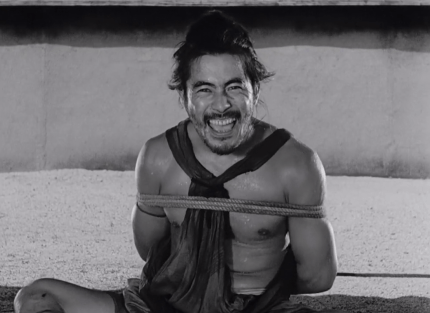
He played unhinged perfectly, especially when he hissed

Fun (?) fact: Director Akira Kurosawa had trouble capturing the rain in the background so he added black ink to the rain machine.

tumblr_mxd720rzJf1qlh9eeo1_500

My thoughts: If you look at most modern trials, especially the high profile ones, it’s always extremely hard to prove what really happened. Even with a ton of evidence and a signed confession, that doesn’t always mean the defendant is guilty, or if he is guilty, has a really good lawyer that convinces the jury otherwise. This refusal for anyone to own up to anything makes for good entertainment, although it doesn’t necessarily make for good justice. Rashomon presents a unique case where everyone owns up to a murder, but no one tells the truth about who really did it, proving that things don’t really change.

6kvYFgz

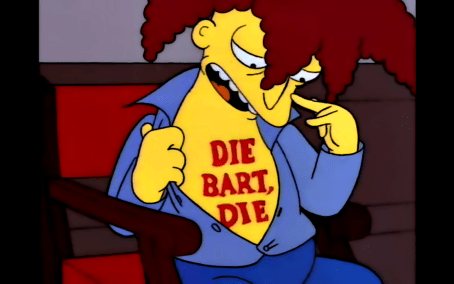
It’s German for ‘The bart, The’

Rashomon is a complicated film, even by today’s standards. The camera work, the frequent flashbacks, the conflicting stories all come together to make something fascinating and beautiful. The main theme (I think) is that human beings naturally suck and shouldn’t be believed or trusted. There’s a murdered man and everyone has his own interests at heart: The bandit, the wife, the murdered man himself, and the Woodcutter who saw it all. All stories are believable until questioned and then the process begins again with a new version. For me, the most complicated issue was the wife who claims she was raped. My initial reaction was that even if she enjoyed it, of course it’s still rape. Not even a question. But the bandit and husband disagreed and were quick to label her a whore, someone who will forever be damaged. It was very frustrating to watch, especially considering the recent conversations about assault that have come up because of the Stanford case. In the end, the Woodcutter settles the discrepancy by saying that yes the woman was raped but she also wanted out of her marriage and this was her escape, no matter how horrible the end result. For a movie made in 1950, it made me consider viewpoints I hadn’t entertained before.

Though I’m still not sure I trust the Woodcutter’s version of events, I appreciate that for all his hypocrisy, he is still a redeemable character. It showed me that although there is plenty of evil in this world, many bad things that happen occur because of selfishness and misguided acts. It’s important to remember that there is good, even when it feels like no one is being honest.

tumblr_n5wzbvzRtt1rm3u4ao1_400

Final review: 5/5

Up next: Pink Flamingos

#259- Paris, Texas

Quick recap: Travis Henderson (played by Harry Dean Stanton) is a man who has lost everything. With help from his brother, Travis slowly acclimates back into society and hatches a plan to reunite with his son and wife.

Paris-Texas-3

Fun (?) fact: A Scottish band named ‘Texas’ took their name from this movie and a Scottish band named ‘Travis’ took their name from the main character.

paristexas

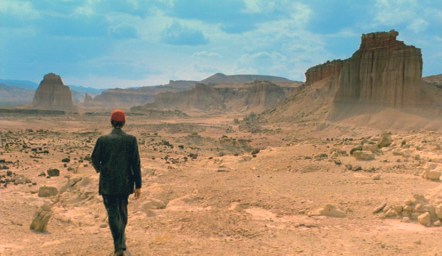
My thoughts: Oh my god, I want to go to West Texas. I say that a lot, but this time I’m super serious, you guys. Watching Paris, Texas brought about this wanderlust that I haven’t felt in a long time- like, since a week ago. Will it actually make me load the car and set out on an adventure? Probably not, until the next time I watch something beautiful and then I’ll start the process all over again.

So, yeah, this film is perfect to just stare at. In the least pretentious way I can put this, every scene is a masterpiece. Every conversation, every person staring off into the distance, every lingering hug felt Important and Meaningful, even when maybe it wasn’t. This is one of those movies I could see myself putting on when I’ve had a bad day and just want something pretty to take my mind off of things. According to the IMDb trivia section, Kurt Cobain and Elliot Smith considered this movie to be their favorite and I can totally see why.

That’s not to say I was enamored with the plot, though. My biggest issue is the treatment with the 8 year old, Hunter. I get that Travis wanted his family back and it’s great that at the end he realized that this wasn’t the way to go about it, but who the hell leaves their kid by himself in the middle of Houston?? Now, I live in Houston and I think it’s a wonderful place, but that’s just crazy. No amount of well intentioned hipster self-discovery is going to change that. The director wanted me to identify with the protagonist but Realistic Me just couldn’t see past what Travis was doing to that little boy. And believe me, I teared up when Hunter reunited with his mom but what if she didn’t want to see him? It’s like, ‘ I know you left your kid 4 years ago because you couldn’t handle parenting and now you work in a strip club in Houston, but surprise! Here’s your kid again and I’m going to disappear for you to figure it out all over again!’ What an ending.

imgres

Final review: 3/5

Up next: Rashomon


#258-The Bridge on the River Kwai

Quick recap: A group of PoWs build a bridge in a Japanese camp while another group of British soldiers make plans to blow the whole thing up. It sounds much more wacky than it actually was, sorry to say.

the-bridge-on-the-river-kwai

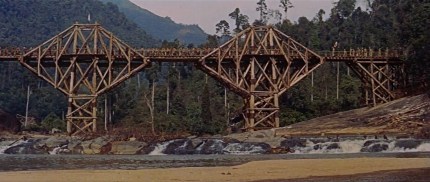
Elephants helped build the bridge and took breaks whenever they damn well pleased.

Fun (?) fact: The story is loosely based on the relationship between Lt. Col. Toosey and Maj. Risaburo Saito, who was actually a reasonable guy. Toosey defended him during the war crimes tribunal and after he died, Saito went to England to visit his grave.

Philip_Toosey_1942

Lt. Col. Toosey, whom the character Col. Nicholson is based on

My thoughts: War is hell, man. This is the thought I had not while watching the movie, but earlier today as I was scrolling through pictures of actual PoW camps from WWII. Not that I expected a film made in 1957 to be so realistic, but looking at a photo of the character Shears, with his muscles upon muscles and golden skin tone from hours of manual labor, next to a photo of a real PoW, all skin and bones, it startled me, to say the least. And, maybe unfairly, took away somewhat from what I had been feeling about the film.

The Bridge on the River Kwai is based loosely on real life, so I can’t down the tone too much. In the film, Col. Nicholson is the leader every soldier wants. He’s a rule follower to the point of risking his life to do what’s right and it pays off for him and his men. He eventually convinces Col. Saito, head of the Japanese camp ,to allow Nicholson and his officers to take over constructing the bridge, because it just so happens that a few of the men are engineers. It’s oddly convenient, but this is supposed to be the inspiring tale to end all inspiring tales, so let’s just run with it. The British soldiers respond much better when they are aren’t constantly threatened with death and so the bridge is built just in time.

Meanwhile, British forces are planning on blowing up the very bridge the soldiers worked so hard to construct, because, like I’ve said, war is hell. Had the movie only focused on the soldiers, I would’ve written off the whole film as shmaltzy, patriotic entertainment, but adding this element of Allies essentially working against each other makes everything so much more complicated. I wanted to root for Shears, who escaped the camp in the beginning, only to come back to help destroy it, but I also really liked the eventual friendship between Saito and Nicholson. In the end, SPOILER ALERT the bridge gets destroyed and it felt like a defeat. That might not have been the purpose of the movie, but that’s what I’m taking away from it. It felt unfair for everyone because three of the British soldiers on this secret mission died, the bridge was blown up and the train that the Japanese sent would’ve been used to transport sick soldiers to another camp. So, not all the heartwarming when you think about it. All I learned from this movie is that there are never any easy decisions in war and the decisions you think you are making for the good of many, might not be good after all.

Final review: 4/5. Alec Guiness as Col. Nicholson is worth watching for his role alone.

Up next: Paris, Texas