#193- Within Our Gates

Quick recap: A newly single woman devotes her time trying to raise money to keep a school open

Alright, let's just jump on in!

Alright, let’s just jump on in!

Fun (?) fact: This film was thought to be lost forever, until it was discovered in the 90s in Spain

My thoughts: A little over three years ago, this was the movie that broke me.I had just started this project and at the time, had decided to watch the films chronologically. This meant that the first 15 or so would be silent films, which I was cool with at first, but it soon managed to drain my entire soul and made me wonder why I I ever thought this would be a good idea. It wasn’t that Within Our Gates was a particularly bad film, but instead what broke me was that it was another film. With a change in direction and plenty of time separating the remaining silent films, I am glad I decided to hold off on this one until I could truly appreciate it for what it is.

What makes Within Our Gates so unique and important is not its plot or special effects, but instead its cast: all African- Americans. You know what movie was also popular around this time? Birth of a Nation, a movie that attempted to prove that black people weren’t ‘true’ people and couldn’t possibly have the intellect of other races. And then this film comes along, and turns that idea completely upside down. The main character is an educated school teacher, who only wants to do good in the world. She comes across a school for African-American children in the south, where it was very difficult to be black (and still is, but that’s another story for another time). The point of the movie is not just to tell a story, but to prove that all races are in fact equal and that all people deserve equal rights. This was in 1920, mind you, way before the Civil Rights movement started gaining momentum.

At times, it’s hard to tell where this movie is going. It felt like director Oscar Micheaux wanted to throw in every single problem African- Americans were facing without really building up much of a plot. Within Our Gates gets bogged down with issues at times, but considering how rare this sort of film was (and still is, honestly), it makes sense that he saw an opportunity to be heard and ran with it.

this_is_theWithinOurGates_original

Final review: 2/5. No, I wouldn’t want to watch it again, but that doesn’t lessen the cultural impact or its worth in any way.

Up next: The Sound of Music
#167- The Jazz Singer

Quick recap: The son of a well respected Jewish Cantor, Jakie Rabinowitz, is expected to follow in his family’s footsteps. Instead he becomes a jazz singer because that’s how you rebelled in the 1920s.

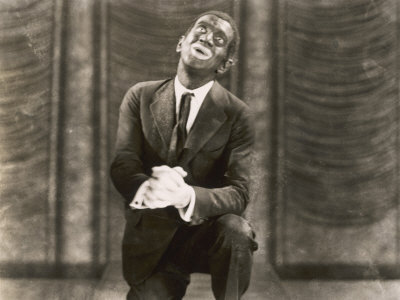
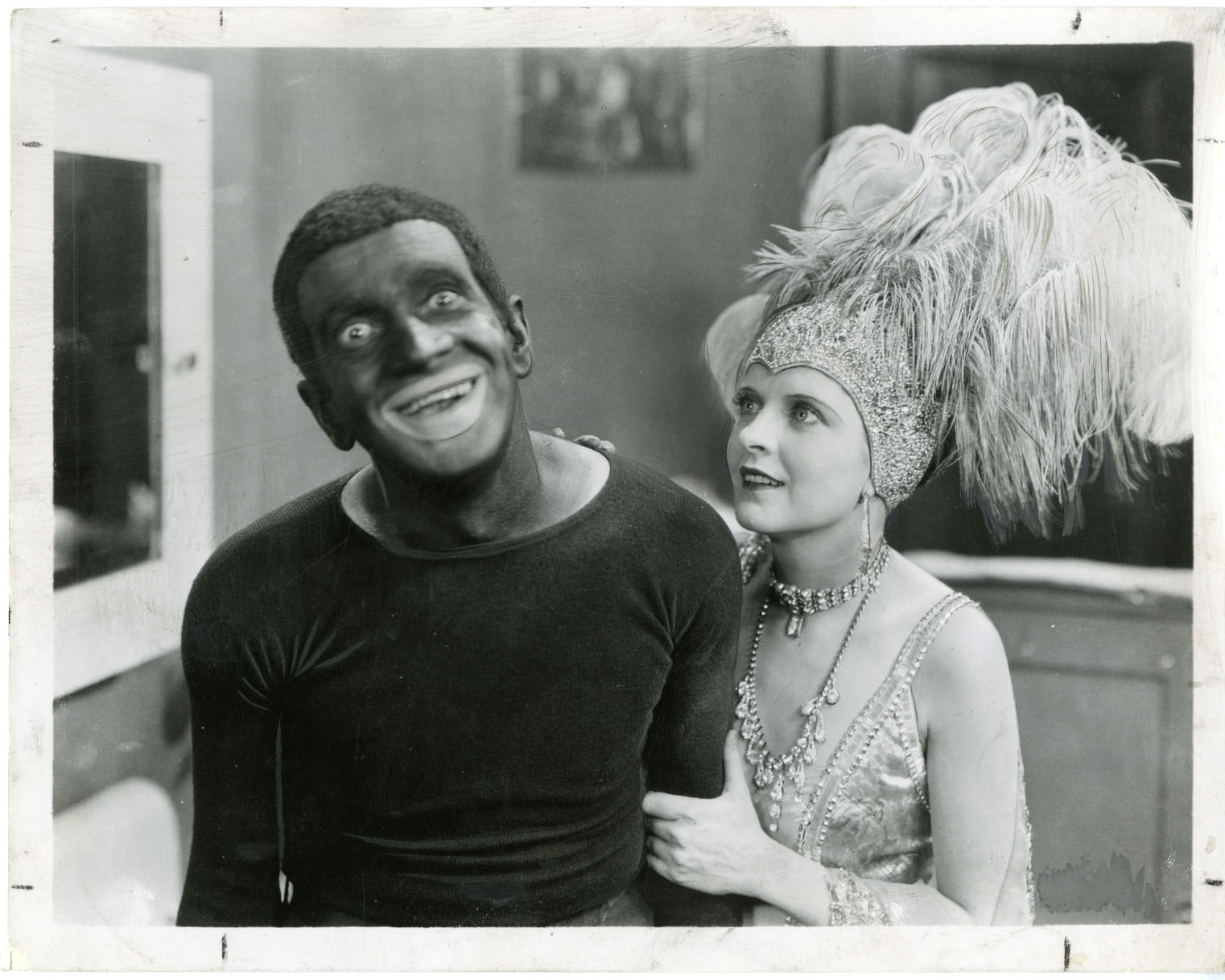
it's the Black Face that ultimately won his parents over.

it’s the Black Face that ultimately won his parents over.

Fun (?) fact: Although The Jazz Singer was the first movie with audible dialogue, it did not mean that movie studios stopped making silent films. The technology was still really expensive at the time, often doubling the budget of a film.

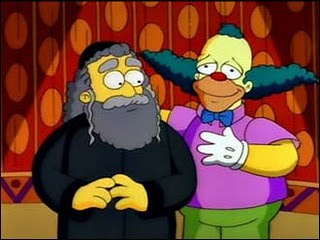
the episode 'Like Father, Like Clown' is an homage to 'The Jazz Singer'

the episode ‘Like Father, Like Clown’ is an homage to ‘The Jazz Singer’

My thoughts: The Jazz Singer is one of those movies I know is important and yet before last night, I didn’t know anything about it except that it had sound and was about a jazz singer. Never in a million years would I have predicted it would be about the battle between tradition and the modern Jewish family because it seemed like a light hearted, fluffy comedy musical.

Starting with the positive, I thought the story was sweet overall with the father finally coming around and welcoming his son back into the family before dying, although he never actually told his son that. Small details, I suppose. Moving on, I also appreciated the pace of the movie since silent films have a history of dragging on during certain times. The audio can only be heard in a couple of scenes along with the singing and it surprised me how excited I got when sound was introduced. I of course have grown up with ‘talkies’ as have most people alive today, and yet there is something special about witnessing something for the first time, like people in the 20s did.

What I didn’t love about The Jazz Singer is Al Jolson. I realize he is ‘the jazz guy’ and deserves to be the main character, but the dude creeped me out. First of all, the movie ages him from a cute 9 or 10 year old boy to a man in his late 40s who looks like he has been cooped up in the morgue for the past 20 years embalming dead people. At no time did I see Jolson as cute or sexy or anything other than ‘creepy undertaker’.

jazz-singer

The whole ‘blackface’ thing was also more racist than I imagined, if that were even possible. The movie is about a minority (the Jewish people) and how they come to terms with tradition versus modern times. And Jakie, played by Jolson has this revelation that he needs to be ‘true to my race’ as he is in blackface! The end of the movie is supposed to be sweet as Jakie’s mother is in the audience and her son sings a song about her (‘Mammy’, seriously). All I could think about is that maybe Jakie’s father had a point and he should’ve stayed a Cantor instead.

NOPE. Now he just looks like a racist creepy undertaker.

NOPE. Now he just looks like a racist creepy undertaker.

Final review: 2/5. Yay for historical importance but the rest of the movie is a little ridiculous.

Up next: The Adventures of Robin Hood

#147- October (Ten Days that Shook the World)

Quick recap: October is a silent propaganda film chronicling the Bolshevik revolution and storming of the Winter Palace.

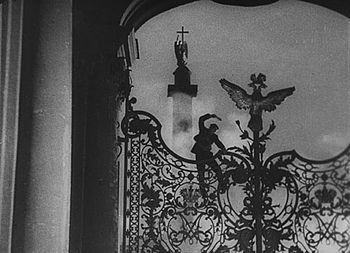
Fun (?) fact: The actual storming of the Winter Palace wasn’t very photogenic on account of the chaos, so scenes from October are now used as historical evidence.

350px-Eisenstein_Zimnii

My thoughts: Propaganda films fascinate me for many reasons, but I mostly look forward to watching them because it’s fun to see if I will fall into the agenda the film pushes. Salt of the Earth is a great example of this. I anticipated watching October even more because I have little to no knowledge of Russian history and wanted to see if that would affect my thinking in any way.

A little history before my review: First, the Tsarist government was overthrown and a new government was set up of mostly aristocrats. They were then overthrown by the working class, who formed the Bolshevik party. From there, they elected their own members and the Soviet Union was born. I learned none of this from the movie, by the way. After October finished, I rushed to Wikipedia and read up on what the hell I had just watched.

So, October is not the sort of movie anyone should watch without context, like I chose to do. All I saw was two hours of people running around with guns and it was all very confusing. Add to that, the director put in artsy images to drive home his point, all of which went over my head. For example, in one scene a fat guy with really bad teeth was shown talking and looking important. Spliced in with that guy was an image of a really creepy bird that kept turning its head. Afterwards, I learned that the bird was actually a peacock, the symbolism being that the aristocrat was preening, as a peacock does.

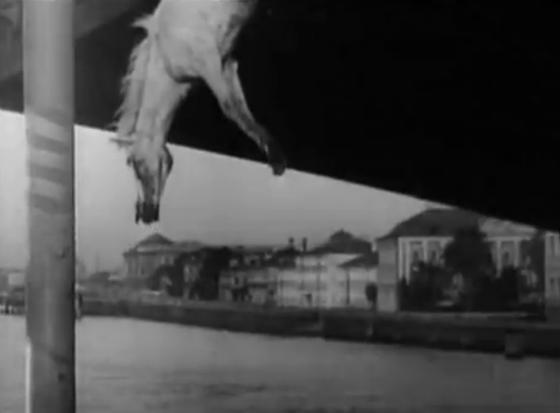
also, this dead horse hanging from a bridge was symbolic of something

also, this dead horse hanging from a bridge was symbolic of something

October surprisingly works really well as a propaganda film. As a moviegoer in the 20s I would’ve probably been moved by the Bolsheviks’ idea of helping the working class and poor.Director Eisenstein turned everything black and white, trying to show clearly who was working for the good of the people and who wasn’t. It’s easy to get caught up in something like that, especially seeing images of people starving while bureaucrats sit in their fancy houses and dine on fine food and expensive alcohol.   Time is on my side though and I know how this story turned out and so in watching this film in 2015, I was mostly unmoved.

Final review: 2/5. It would’ve earned a 1, but watching October has spurred my interest in Russian history so that’s not a bad thing to take from this.

Up next: The Story of a Cheat

#146- Steamboat Bill, Jr.

Quick recap: William ‘Steamboat Bill’ Canfield is a-you guessed it- steamboat captain. When he receives word that his son is coming to visit (and whom he hasn’t seen since he was a baby), Steamboat Bill looks forward to having a strong, muscular man such as himself to help with chores on the ship. Instead, he gets this guy:

That stare is going to haunt me for years to come.

That stare is going to haunt me for years to come.

Hilarity then ensues.

Fun (?) fact: One of the most famous scenes in this movie occurs when William Canfield Jr. (played by Buster Keaton) is almost crushed to death by the side of a house. This scene is later recreated for an episode of Arrested Development by none other than the character Buster.

not caused by a loose seal

not caused by a loose seal

My thoughts: I have discovered a perk to silent movies: I can watch them when The Kid is awake since I don’t need sound to understand them. Hearing the music coming from my computer, he came over to investigate. He watched for about two minutes before declaring the whole thing, ‘silly’ and then walking away, presumably to torture the cats. An apt, although quite succinct review, if I ever heard one.

I had heard of Buster Keaton before, although I have never seen anything he has been in. I always thought of him as another Charlie Chaplin, mainly because those are the only two silent film stars I can name. I do see similarities, though Chaplin seems much sweeter in his movies. Keaton plays the part of the ‘awkward son’ very well, and I admittedly laughed during the scenes where Bill Sr. tried to change Bill Jr.’s look into something more masculine. On that note, most descriptions of Steamboat Bill Jr. call Keaton a ‘dandy’, which I suppose is an appropriate adjective although one not used very much anymore. Dandy just seems like such a……. ‘dandy’ word. I’m not sure what I would call him, although with the ukelele and beret, ‘hipster’ might not be too far off.

You don't understand my prog rock, DAD

You don’t understand my prog rock, DAD

The relationship between father and son lacked the warmth I had come to expect from silent films. Sure, in the end, father learns to accept son, but it was only at the very end and after Jr. had saved Sr.’s life. Jr. only won favor because he finally ‘manned up’. Then again, this is the 1920s we are talking about, so maybe my expectations were too high. Mostly, I thought of another father and son while watching this movie:

That's right, I like to reference movies I just reviewed

That’s right, I like to reference movies I just reviewed

Finally, the typhoon scene is what most people know about this movie, but I just found it…..weird. Maybe it was because it just looked like someone turned on a heavy duty fan on a clear day or maybe it was because houses don’t fall down like that, I don’t know. I didn’t find it very funny and thought it a weak ending to the story.

Final review: 3/5. Not the best, but I’m hoping to enjoy other Keaton films more.

Up next: October (Ten Days that Shook the World)