#199- Orphans of the Storm

Quick recap: Two orphans (Louise and Henriette) find themselves caught in the middle of the French Revolution

If it's DW Griffith, expect a Gish or two

If it’s DW Griffith, expect a Gish or two

Fun (?) fact: Griffith made parallels between the French Revolution and Bolshevism, which he feared might happen to America. The Bolsheviks, however, were inspired by the films and used certain techniques for their own propaganda.
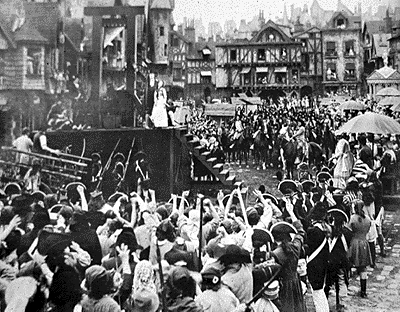
French Revolution or Obamacare death panel verdicts being carried out? THANKS, OBAMA

French Revolution or Obamacare death panel verdicts being carried out?
THANKS, OBAMA

My thoughts: Seeing as how I am one movie away from 200, it seems only fitting that I close out this second set of films with my final one from DW Griffith. We’ve had a long, strange ride, me and Griffith. I hated Birth of a Nationmostly loved Intolerance, became inconsolable from Broken Blossoms and completely forgot that I saw Way Down EastAnd now, here we are with what might be the grandest of all films and definitely the one with most plot.

I feel it’s important to note that A Tale of Two Cities is non-ironically my favorite book of all time. I’m not really sure why I latched onto it back in high school- maybe because of the doomed love story ( the best kind of love story) or maybe because it is so beautifully written. Anyway, Griffith got his inspiration directly from the book, which is probably why I enjoyed this film so much. I’ve always wondered why no one has made a major motion picture of A Tale of Two Cities and now I know it’s because Griffith did a damn fine job. I can’t believe I just wrote that sentence. But really, even more than a doomed love story, I love that he used the two sisters to symbolize the different parts of the revolution and how complicated everything actually was.

In the film, Louise goes blind from an illness so her sister takes her to Paris to hopefully be cured. While there, Henriette is kidnapped by the aristocracy and her sister is forced to beg for food to survive. Both stories are equally tragic as Henriette escapes and subsequently falls in love with the nephew of the Countess while still hanging on to hope that her sister is alive. I was glued to the screen watching the revolution grow and finally explode into violence. It still blows my mind that something so epic could’ve been created in the early 1920s, when you consider how much work must have gone into it all. I began to get very impatient at the end, as Henriette is accused of helping the aristocracy and sentenced to the guillotine. I knew that there was no way she would actually die, and the drawing out of the final pardon seemed a little much. Still, it all ended well and I was left with the concept that maybe I love Griffith after all, even though he has subjected me to over 15 hours of silent movie footage.

I googled 'French revolution cat' for fun, and found this. No idea.

I googled ‘French revolution cat’ for fun, and found this.
No idea.

Final review: 5/5. So long, Griffith

Up next: My Own Private Idaho

#195- All that Jazz

Quick recap: Joe Gideon is so busy with his job as a choreographer, as well as keeping up with his girlfriend, ex-wife and daughter that he doesn’t pay attention to a life threatening heart condition.

Always with the jazz hands, or 'Fosse hands', since this is basically a biography about Bob Fosse

Always with the jazz hands, or ‘Fosse hands’, since this is basically a biography about Bob Fosse

Fun (?) fact: Shirley MacLaine says that she is the one who gave Bob Fosse the idea of All that Jazz while he was recovering from a heart attack.

John Lithgow in All that Jazz

John Lithgow in All that Jazz

My thoughts: I had no idea who Bob Fosse was before watching All that Jazz, which is kind of ridiculous considering my love of Chicago and my like of Cabaret. Not knowing who he was didn’t detract from the film, even though it is a thinly veiled biography about his life. Instead, I researched his life afterward and it made the ending (which I’ll get to in a minute) all the more sad. I think that if I had known about him beforehand, it wouldn’t have had the same emotional impact that it did.

Essentially, All that Jazz is about a dying man who either doesn’t know he is dying, or refuses to believe that he is. The very first scenes show Joe Gideon in his element, casting the dancers for his new show and flirting with just about everyone. And then there is a scene with Gideon where he appears to be backstage with a woman all dressed in white. He is flirtatious with her as well, and it took me awhile to figure out the structure, that this wasn’t part of his real life, but a way for the audience to gain insight into who he was and where he started. Throughout the entire movie, I don’t think I could call Gideon loveable or even very likeable, but a part of me still rooted for him, and even during the final number where he sings about dying, I hoped he would pull through. In a weird way, I was in my own state of denial that this would be the ending, even though Fosse foreshadowed the death from the very beginning with the woman in white. I also loved the scenes that started each day, with Gideon in the shower, popping pills and then doing jazz hands in the mirror. His energy is drained eventually until he can’t even say his line, ‘It’s showtime, folks!’.

I could go on for several more paragraphs about this movie but I’ll skip ahead to the scene that impacted me most. As Gideon slips further and further into his own mortality, he starts hallucinating about the people he cares for, in the form of musical numbers of course. The final number is the one that did me in, with Gideon singing, ‘I think I’m gonna die’. It’s the perfect finale and lasts for almost 10 minutes, as he sings and works his way through the ‘audience’, full of friends, family and co-workers he wants to say goodbye to. What made this so sad for me was that all of this was going on in his head and he never actually got a chance to really say what he wanted to say. I wouldn’t say that his life was filled with regrets, but he was the sort of person who lived for the moment, and not really the future.Had he taken better care of himself, this could’ve all been prevented. It just seemed like a realistic depiction of how many people die, with loose ends. The woman in white shows up and Gideon starts moving toward her, as the number begins to wind down. It was beautiful the way he was shown slipping away, and then the last scene was of the dead body being put into a bag. It was such a cold, jarring ending that made me feel as if I had lost someone I personally knew, and wasn’t really watching a movie.

The 1979 Best Picture nominee ÒAll That JazzÓ will be screened as the next feature in the Academy of Motion Pictures Arts and SciencesÕ ÒGreat To Be NominatedÓ series. The Bob Fosse film, based on FosseÕs own life as a womanizing, drug-using choreographer, will screen on Monday, May 7, at 7:30 p.m. in the AcademyÕs Samuel Goldwyn Theater. Several members of the cast and crew, including actors Deborah Geffner, John Lithgow and Kathryn Doby; film editor Alan Heim; associate producer and assistant director Wolfgang Glattes; executive producer Daniel Melnick; production sound mixer Chris Newman; production designer Philip Rosenberg; cinematographer Giuseppe Rotunno; and music editor Michael Tronick will participate in a post-screening discussion. Pictured here: Roy Scheider (center) and dancers.

Final review: 5/5. I’m tempted to watch it again before having to mail it back to Netflix, I loved it so much

Up next: The Kid Brother

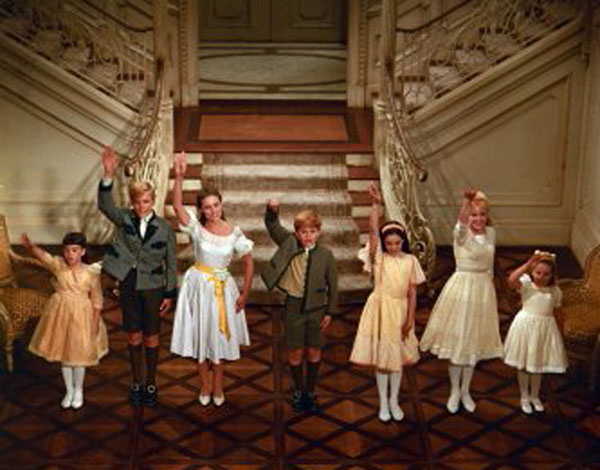
#194- The Sound of Music

Quick recap: A singing nun takes on the role of governess for 7 children and teaches their widower father about love.

The hills are ablaze with the euphonious symphonies of descant

The hills are ablaze with the euphonious symphonies of descant

Fun (?) fact: Julie Andrews fell several times while on the mountain

funny-hills-sound-music

My thoughts: Oh, Sound of Music. I fell in love with this movie as a kid after my music teacher showed it to us in its entirety. I have since seen many more ( sometimes better) musicals as an adult, but this one still holds a special place in my heart. Since I am familiar with this movie, watching it again for the list was more about whether it holds up as much as it did when I was little rather than if it is actually a ‘good’ movie.

When I told my husband that I was going to be watching The Sound of Music, he scoffed at how schmaltzy it is. This is coming from someone whose favorite Christmas movie is It’s a Wonderful Life, but that’s for another post.Anyway, while watching it, I could definitely see some schmaltziness, but it just didn’t bother me like I feared it would now that I am a jaded, cynical adult. Like, for instance, how quickly the children latch on to Maria when they are known to have driven several governesses away, including one that only lasted a couple of hours. She’s just someone that you can’t help but want to do good by, though. And Julie Andrews was made for this role. The kids can be eye rollingly cute at times but it is her that completely makes this movie into something wonderful.

Above all things, I love The Sound of Music for, what else, the music. I love every single song and was pleasantly surprised by how many of the lyrics I remembered ( the cats were not impressed with my singing, by the way, especially one who bit me throughout the movie). Edelweiss is still my favorite because of its simplicity and yet all the complicated things it stood for. For a kid just getting acquainted to the ‘adult’ world, this movie was a perfect bridge between childhood and adolescence. It was the first time I really understood the Nazi regime and how terrible everything was, and yet there was a happy ending so that I could still have hope. It may be schmaltzy, but it’s my kind of schmaltzy.

SOM3_L-1

Final review: 5/5.

Up next: All that Jazz

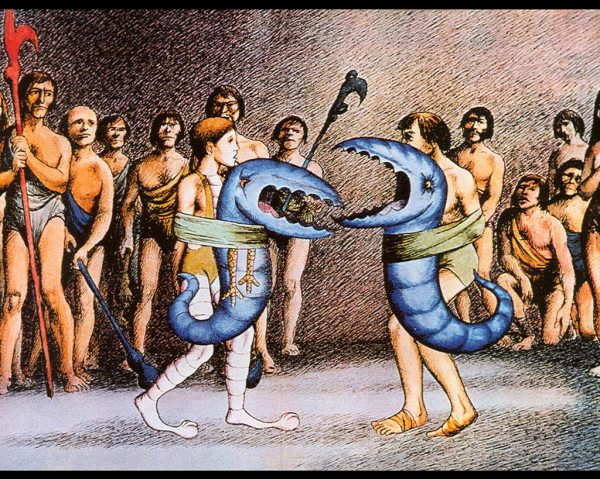
#186- Fantastic Planet

Quick recap: A race of super huge blue people (Draag) oppress a race of teeny tiny humanoids (Om).

how I feel at the end of the week

how I feel at the end of the week

Fun (?) fact: The ‘Om’ race is a word play on the French word for man, ‘homme’

This movie had a lot going on

tbh, how congress should solve most issues

My thoughts: I’m still choosing movies at random, so it surprised me how many science fiction films I have seen lately,this one being my second French sci-film when I thought there weren’t any. Actually, Fantastic Planet started out in Czechoslovakia but had to be moved to France because Communists aren’t really fans of being made fun of. Go figure.

I full heartedly expected to not like this movie, but within minutes of its opening sequence, I was sucked in. For starters, I had no idea that Fantastic Planet would be animated, and man is it a trippy movie. It kind of reminded me of the Monty Python sequences, but much longer and weirder. The planet that the Draag live on is as strange as it gets, which I loved because the director could’ve used a somewhat familiar landscape but instead just threw in a ton of crazy plants and animals just for the hell of it. There is a scene where the planet is covered in crystals and the Om protagonist, Terr, gets caught in one. His master, Tiwa, simply whistles and the crystals disintegrate. Why crystals? Why whistling? No clue, but it adds to the idea of these humanoids being trapped in such an unfamiliar place.

fantastic-planet

As with most sci-fi and horror films, the best ones are those that can be related back to real world events. In the case of Fantastic Planet, it is literally about the Soviet invasion in Czechoslovakia. It was very easy to see the parallels while watching the movie, which is nice, but not so glaringly obvious that it felt preachy. In the movie, Terr is kept as a pet by the Draag child Tiwa. Through an accident, he is able to absorb the lessons his owner listens to, thus gaining all knowledge he will need later on to defeat the Draag. The ending is an optimistic one: the Om travel to the Strange Planet, an uninhabited place where the Draag send their meditations. While there, they are able to find their weakness and use it to overpower them. The Draag, knowing that they have lost, admit defeat and give the Om their own planet to live on without fear of extermination, named Terr.

Final review: 5/5. I don’t know how popular this film is, but anyone who loves science-fiction should watch it, if they haven’t already. Essential viewing.

Up next: Requiem for a Dream