#325- The Man Who Shot Liberty Valance

Quick recap: An aging senator recounts his younger days in the town of Shinbone and the tale of the man who shot Liberty Valance.
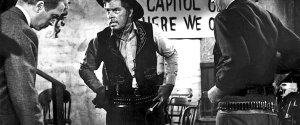
Is THIS the man who shot Liberty Valance??
No. That’s actually Liberty Valance

Fun (?) fact: There’s no set reason why director John Ford chose to film in black in white but the prevailing idea is that both John Wayne and James Stewart were playing characters 30 years younger than their actual ages and it would’ve really shown in color.
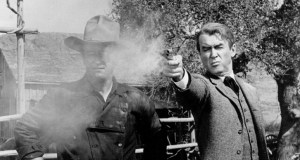
You’d think this would be the man who shot Liberty Valance because here he is shooting a gun but once again, WRONG

My thoughts: I’m afraid I’m starting to get a little burned out on James Stewart. He always seems to play the good guy, even when he’s accidentally an asshole. This film is perfect proof of that. Spoiler Alert: Stewart, who played Ransom Stoddard was not actually the man who shot Liberty Valance. To his credit, he didn’t know about it initially and the man who ACTUALLY did the killing gave him his blessing to go on being the legend, but still. Tom, played by John Wayne, was the real man who shot Liberty Valance and this story is about him.

As far as I can tell, having watched a total of two John Wayne films to date, Tom is your basic character. This movie is even the first time Wayne refers to someone as ‘pilgrim’ so that was a fun surprise. And it made sense, because Ransom made a pilgrimage to Shinbone after his run-in with Valance, albeit against his will in the beginning. Tom is a tough guy with a heart of gold and all he really wants is to settle down with his girl Hallie, who SPOILER ALERT, is not his girl at all. Much to everyone’s surprise, apparently, she is a strong independent woman who would like to choose her own destiny. Destiny that leads to Ransom. So, really, this is a classic case of jealousy but the weird kind of jealousy that involves shooting and allowing someone to continue on to Washington to become a decorated senator while you die drunk and alone.

Unlike the moral ambiguity of the paragraph before, Lee Marvin as Liberty Valance is a straight up evil guy. Absolutely no redeeming qualities whatsoever. Like, he truly terrified me and that’s saying something. His comic opposite was the Marshall Link, who had some funny spots but when you stop and think about all the people he allowed to die because of being a coward, is much less funny.

Although Westerns typically all follow the same format of good guy/bad guy fight, The Man Who Shot Liberty Valance manages to weave in a bunch of moral questions. Lee Marvin is absolutely bad but are Tom and Ransom absolutely good? Does it matter? And what does that do to one’s legacy? In a way, this is the western for people who aren’t too sure about westerns. Give it a chance.


Final review: 5/5

Up next: Badlands
 

#323- Sunset Boulevard

Quick recap: Joe Gillis is hired by an aging film star to help her get back into show business. As with most things in life, it goes horribly wrong.

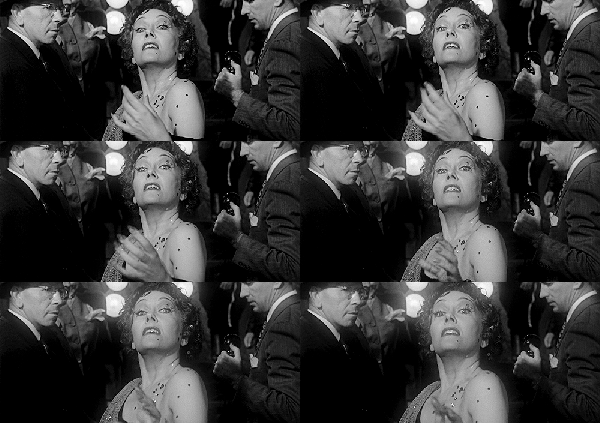
me, moving closer to Thanksgiving break

Fun (?) fact: This will probably seem more ‘basic fact than ‘fun fact’, but Gloria Swanson, who played Norma Desmond was an actual silent film star back in the day and her servant Max was an actual director. All those pictures Norma has in her mansion are real life photos of Swanson.

My thoughts: How in the WORLD did Gloria Swanson not win a Best Actress award for her role in this film? People love to hate on the Academy, and although I’m mostly ambivalent about what a group of people seems worthy, this is a true outrage. There was a lot to love about this movie and believe me, there will be gushing later on, but it is Swanson who makes Sunset Boulevard into the classic that it is. Everything about Norma Desmond is so wonderfully over the top that it makes every scene pure gold. I was lucky enough to watch this movie on the big screen and every time Swanson appeared, a group of guys behind me cheered. When she said something sassy, I could hear them gasp audibly and say out loud,’ oh NO!’. Anyone who can invoke such a response 67 years later deserves all the awards and praise.

I LOVED this movie. Oh my god, did I love this movie. I loved it in the way that after it was over, I was sad for awhile because I can’t imagine how I was able to function in life up to this point having not seen Sunset Boulevard before.  It was just that good. The story, the characters, the shocking twists and turns, all of it. And not only that, but it really brought to life how traumatizing it was for the film industry to switch to sound. We see it ( or maybe mostly I see it) as a merciful thing to move to talking, but it really was an art form in its own right. It reminds me of the silent actor Raymond Griffith  in All Quiet on the Western Front. He lost his voice due to illness as a child and sound coming to film meant the end of his career, even though he was a considerably popular star. Several silent film era stars were asked to star as Norma Desmond but a few had mental issues and others had turned into recluses. For all the glamour we see, Hollywood can be a really sad scene.

Final review: 5/5. Go see it if you haven’t yet.

Up next: the Big Chill

#322- Vertigo

Quick recap: reasonable behavior- developing a fear of heights after seeing a guy fall off a roof. Unreasonable behavior- falling madly in love with the woman you are supposed to be following because her husband thinks she’s crazy. Even more unreasonable behavior- causing more people to jump to their deaths from a roof.

Another reference I now understand!

Fun (?) fact: Vertigo bombed at the box office and Alfred Hitchcock put the sole blame on James Stewart for being too old, despite having collaborated with him several times. They never worked together again 😦

All hail James Stewart!

My thoughts: This is either my 7th or 8th Hitchcock film and they just keep getting better. Hitchcock is best when he goes dark-whether it’s the macabre dialogue in Strangers on a Train or the serial killer plot of Frenzy. Vertigo is no exception. This was my first time watching it and about the only thing I knew was the fear of heights. There’s a twist at the end that I didn’t see coming and when everything is revealed at the end of the film, I audibly gasped. It’s so rare these days to not be spoiled.

Vertigo’s strong points are its visuals, a very Hitckcockian thing to focus on anyway. Every scene looked like danger was just around the corner and it kept me on my toes to figure out what was going to happen next. The shots of John Ferguson freaking out while climbing stairs are iconic but I gravitated more towards the little scenes, such as John watching Madeline at the art gallery or him watching her drive off in her car. It was a wonderfully creepy feeling to not know whom to be more concerned about.

Knowing what I know about Hitchcock, it’s really not much of a surprise how he chose to portray the women in the film. There’s Midge, possibly still in love with John, and jumping at every chance she can to be near him. And then there’s Madeline, who thinks she is the reincarnation of Carlotta Valdes, a woman who died a hundred years ago. Neither woman gives off a strong independent vibe and it’s a little frustrating to watch a whole movie about women fighting over men and needing them to survive. On the other hand, it makes for a compelling movie where you don’t really root for anyone.

always a Midge, never a Madeline

Final review: 5/5

Up next: Sunset boulevard


#318- Night of the Living Dead

Quick recap: Surviving hysterical women and zombies, a black man still can’t manage to get a break. 

Ben knows he’s on his own keeping these idiots alive

Fun (?) fact: Night of the Living Dead is ripe with amazing facts, from the chocolate sauce used for blood to Reader’s Digest warning watching the movie would inspire cannibalism. My favorite, however, is that the word zombie is never used in the film. Not even once.

My thoughts: I typically only fear zombies on a case by case basis. Fast moving ones? nope. Super decomposed ones that groan and like to fight plants? not really. Lumbering ones who look like they have just died and their only purpose is to devour you? Totes. And that’s what Night of the Living Dead had, which is why it worked so well for me. I saw the movie years ago but I don’t remember it having the same impact as it did when I rewatched it this time. Maybe it’s these trying times we are currently in or maybe it was the fact that my cat chose to bite my finger during a particular jumpy scene, but Night of the Living Dead got to me.

So, a few stray observations:

  • I know that almost every horror movie draws inspiration from this film but the opening scene is just like Rocky Horror Picture Show, except that Johnny will never be as annoying as Brad.

Dammit, Johnny

  • Ben is a much nicer person than I would’ve been to Barbra. She was useless the entire time, which I get because of the whole ‘brother eaten by zombies’ thing, but still it made it hard to really root for anyone but him.
  • Zombie children are adorable but they use their cuteness to be absolute savage. Judy never stood a chance

I love how low budget this film is, yet it makes its point so clearly. The scene where the zombies chowed down was gross but it was the scenes where they just stood there hanging out that really bugged me. For something that unnerving, you don’t need millions of dollars to tell a story. The true punch, though, came at the end when Ben is gunned down by police. Those final still shots of the police taking his body using hooks is beyond chilling. If I had watched only that scene, I wouldn’t have been able to tell whether I was watching a horror film or a documentary on police brutality. Director George Romero might not have meant to make such a powerful statement about race, but he did and that’s why this is film is such a true classic.

Final review: 5/5. Essential viewing

Up next: More Horrorfest!