#199- Orphans of the Storm

Quick recap: Two orphans (Louise and Henriette) find themselves caught in the middle of the French Revolution

If it's DW Griffith, expect a Gish or two

If it’s DW Griffith, expect a Gish or two

Fun (?) fact: Griffith made parallels between the French Revolution and Bolshevism, which he feared might happen to America. The Bolsheviks, however, were inspired by the films and used certain techniques for their own propaganda.
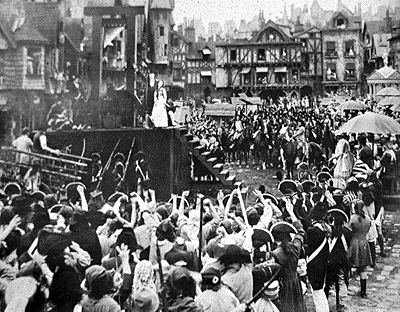
French Revolution or Obamacare death panel verdicts being carried out? THANKS, OBAMA

French Revolution or Obamacare death panel verdicts being carried out?
THANKS, OBAMA

My thoughts: Seeing as how I am one movie away from 200, it seems only fitting that I close out this second set of films with my final one from DW Griffith. We’ve had a long, strange ride, me and Griffith. I hated Birth of a Nationmostly loved Intolerance, became inconsolable from Broken Blossoms and completely forgot that I saw Way Down EastAnd now, here we are with what might be the grandest of all films and definitely the one with most plot.

I feel it’s important to note that A Tale of Two Cities is non-ironically my favorite book of all time. I’m not really sure why I latched onto it back in high school- maybe because of the doomed love story ( the best kind of love story) or maybe because it is so beautifully written. Anyway, Griffith got his inspiration directly from the book, which is probably why I enjoyed this film so much. I’ve always wondered why no one has made a major motion picture of A Tale of Two Cities and now I know it’s because Griffith did a damn fine job. I can’t believe I just wrote that sentence. But really, even more than a doomed love story, I love that he used the two sisters to symbolize the different parts of the revolution and how complicated everything actually was.

In the film, Louise goes blind from an illness so her sister takes her to Paris to hopefully be cured. While there, Henriette is kidnapped by the aristocracy and her sister is forced to beg for food to survive. Both stories are equally tragic as Henriette escapes and subsequently falls in love with the nephew of the Countess while still hanging on to hope that her sister is alive. I was glued to the screen watching the revolution grow and finally explode into violence. It still blows my mind that something so epic could’ve been created in the early 1920s, when you consider how much work must have gone into it all. I began to get very impatient at the end, as Henriette is accused of helping the aristocracy and sentenced to the guillotine. I knew that there was no way she would actually die, and the drawing out of the final pardon seemed a little much. Still, it all ended well and I was left with the concept that maybe I love Griffith after all, even though he has subjected me to over 15 hours of silent movie footage.

I googled 'French revolution cat' for fun, and found this. No idea.

I googled ‘French revolution cat’ for fun, and found this.
No idea.

Final review: 5/5. So long, Griffith

Up next: My Own Private Idaho

#198- Little Big Man

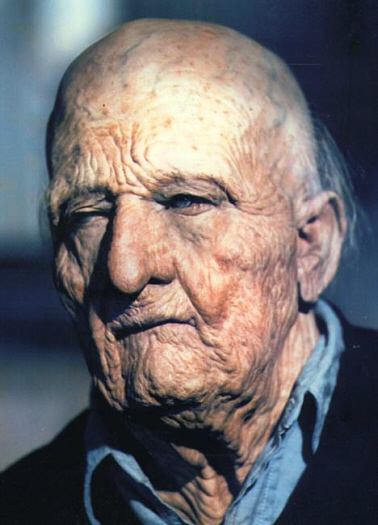
Quick recap: A 121 year old man recounts his various adventures growing up in the wild west.

lbgunfighter

Fun (?) fact: I’m sure there’s some really interesting stuff out there about this movie, but what stuck out most to me was that Dustin Hoffman is 78 years old. No one else seems to think anything of this, but I’m still trying to wrap my head around it.

I don't see him looking like this at 121, but you never know

I don’t see him looking like this at 121, but you never know

My thoughts: As with anything Native American related, it’s usually very difficult to pull off anything that isn’t completely offensive, so I didn’t have high hopes going into Little big Man. In fact, I had already planned some of the snark I would say on this post related to such insensitivity. Alas, that version won’t happen because I thought everyone did a really good job (impressive, even) with the subject matter, managing to create something hilarious and heartbreaking and giving me the motivation to learn more.

Little Big Man is mostly about Jack Crabb’s (played by Dustin Hoffman) relationship with the Cheyenne nation. As a child, his entire family was wiped out from the Pawnee tribe, except for him and his sister, and a member of the Cheyenne took him in. His sister ran away, but he stayed until he was a young adult and became an honorary brother. Sure, there were some questionable things like the manner of speech the Cheyenne had and their various traditions, but overall, they were seen in a very positive light. Crabb fights with white men at some point and once he is discovered as one of them, he is shipped off to a town to learn some religion. It’s from here that the movie begins to bounce back and forth. He goes through every Western cliche you can think of ( helper at a medicine show, gun fighter, helping a woman at a whorehouse, and so on), but that’s what made the movie funny. This is a tall tale, you see, and I never really got whether or not we are supposed to believe it ( think Big Fish), but it was very entertaining, nonetheless.

One of my reasons for liking this movie so much is the way Crabb always finds his way back to the Cheyenne. He is white, yet it is with these people that he connects with the most. There were several stereotypical characters, but they were portrayed with compassion, especially compared to the white people Crabb encountered elsewhere.  The scenes where Custer and his men tore through the villages killing women and children were very difficult to watch and it was shocking, compared to the lightheartedness of the rest of the movie. This movie was made in 1970, at the height of the Vietnam war so there were many parallels to what was going on in that part of the world at the time.

The movie isn’t perfect and my biggest annoyance was how Forrest Gumpy the plot felt at times. For example, Crabb meets up with Wild Bill during his gun fighter stage, and sees him accidentally kill a man. Seven years later, the two meet up again at a bar and out of nowhere, a kid comes in and shoots Wild Bill dead. It turns out the kid was the son of the man Bill killed earlier and Crabb just happened to be there when it all went down. I have nothing against Gumpy, but it got old after awhile knowing that some ironic thing was about to happen.

Final review: 4/5. For a long film, I didn’t get bored once

Up next: Orphans of the Storm

#173-The Battle of Algiers

Quick recap: Although I’d like to just sum up the movie by saying, ‘It’s about the Battle of Algiers, duh,’ I’ll resist the snark for now. Algeria is a country in Africa that up until the early 1960s was under French rule. This movie tells the story of the uprising that lead to the country’s eventual independence.

No, not an up and coming indie rock band

No, not an up and coming indie rock band

Fun (?) fact: The Pentagon screened this movie in 2003 for officers heading into Iraq, where we had a little invading of our own to do. They passed around fliers that said, ‘How to win a battle against terrorism and lose the war of ideas.’

The Clash is now stuck in my head.

The Clash is now stuck in my head.

My thoughts:  This movie made me sad for many reasons, a big one being that I can’t make fun of it because it was actually good. I had all these witty things planned about The Battle of Algiers, which I can never use now because I was absolutely fascinated the whole time. Oh, and the gruesome torture scenes. Those were sad, too.

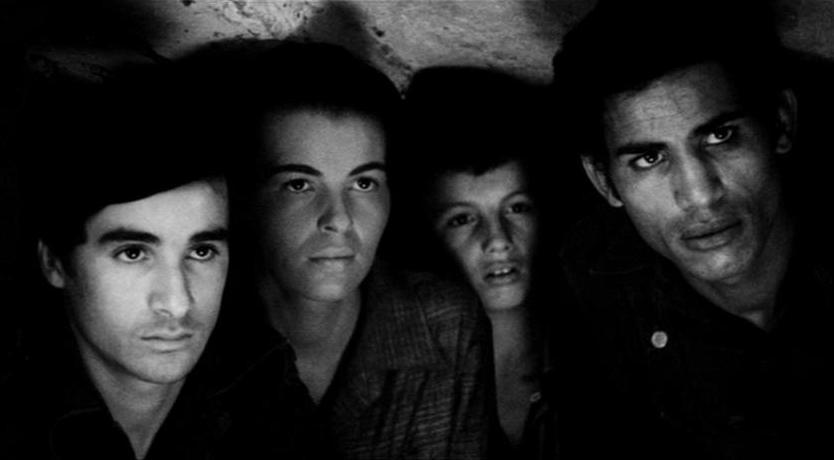
I was only slightly aware of what the Algerian war was, and the little information I had came from the movie Wild Reeds.  I understand why it’s not heavily talked about in the US: a) because it had nothing to do with us and b) because it makes the French government look really bad. When I think of Colonialism, I think of the early 1900s, not the 1950s so it was weird to merge that time period with something so antiquated. I wasn’t able to find how accurate The Battle of Algiers was, but the main events are all true. The movie is shot documentary style, and it made it feel like I was watching a history lesson or a special on the news.

Adding to that style of filmmaking, most of the actors in the movie were mostly unknowns who were cast because of their resemblance to the real people involved. The movie is subtitled in French so I can’t really get a feel as to how the acting shapes up, but I will say that everything felt ‘real’, especially the riot scenes. The torture scenes were incredibly difficult to watch but even more so were the effects of the bombings from the Algerians as well as the French. It’s simply hard to believe that such a thing happened in modern times.

Final review: 5/5. Many scenes are hard to watch, but the movie provides a great beginning point for someone wanting to expand their knowledge.

Up next: The Matrix

#166- Downfall

Quick recap: An account of Hitler’s last days, told from the perspective of his secretary Traudl Junge

This is where that 'angry Hitler' parody comes from

This is where that ‘angry Hitler’ parody comes from

Fun (?) fact: from IMDb: ‘During the war, the majority of the cyanide capsules produced were made in the concentration camps, which made sabotage a real problem. This is one of the reasons why many Germans who committed suicide by cyanide also shot themselves to make sure they would die. This is also the reason why Adolf Hitler‘s beloved dog Blondi was poisoned; he wanted to make sure his batch of cyanide was not fake.’

My thoughts: I know I say it often, but seriously you guys, THIS is the most depressing movie ever. If nothing else, the last 1/2 of the movie is just people killing themselves as well as children and dogs. And it’s all real, which adds another layer of tragedy.

At 166 on the list, Downfall is the most uncomfortable movie I have ever sat through. It started off a little boring, with people calling Hitler crazy (as they were wont to do) because he decided to stay in Berlin, which was close to being occupied by the Russians. World War II history just doesn’t do much for me, I think, because it has been talked about and researched so thoroughly that I feel I know all that I need to know. But at some point, I can’t really pinpoint when, this movie got to me. I think it was one of the scenes with Hitler and Eva Braun or with Traudl Junge, where he seemed almost…..charming. And then with the rest of the SS officers, many of them were seen as almost human, although they were known to have committed some of the worst atrocities in history. I felt intensely guilty having any emotion whatsoever, considering the 6 million Jews that were tortured and killed. But at the same time, it made sense. We would like to paint Hitler and his officers as completely evil because it makes it easier to separate right from wrong, black from white. Reality is much more complicated, unfortunately. Dr. Goebbels and his wife seemed like decently normal people who had a beautiful family, but then they went and poisoned all 6 of the children simply because they didn’t want them to live in a world where the Nazi regime was no longer in power. Eva Braun brought out the softer side of Hitler, if there was one, even though she was just as crazy as he was.

Throughout most of the movie, I felt like I was watching a documentary instead of a bunch of actors recreating scenes. When I was looking up pictures to add to this post (none seemed appropriate), it impressed me how realistic the bunker was compared to the real thing. The casting was also spot on, almost terrifyingly accurate. This made the scenes like the children being poisoned and Hitler and Eva committing suicide all the more difficult to watch.

Most people reach for Schindler’s List when trying to understand all the evil that happened in World War II, but I think Downfall is a necessary companion to show another perspective. My opinion, as well as most of the world’s, will never change about the Nazis or Hitler, but the things I have believed up to this point are no longer as accurate or as simple as they were before.

Final review: 5/5.

Up next: The Jazz Singer