#173-The Battle of Algiers

Quick recap: Although I’d like to just sum up the movie by saying, ‘It’s about the Battle of Algiers, duh,’ I’ll resist the snark for now. Algeria is a country in Africa that up until the early 1960s was under French rule. This movie tells the story of the uprising that lead to the country’s eventual independence.
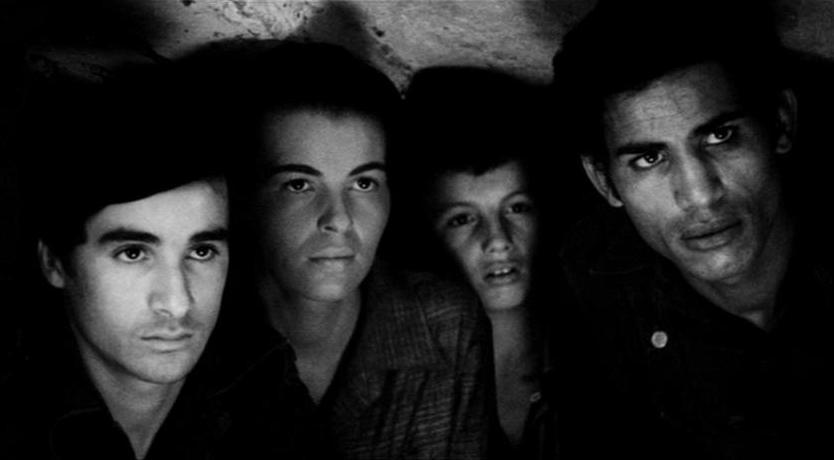
No, not an up and coming indie rock band

No, not an up and coming indie rock band

Fun (?) fact: The Pentagon screened this movie in 2003 for officers heading into Iraq, where we had a little invading of our own to do. They passed around fliers that said, ‘How to win a battle against terrorism and lose the war of ideas.’

The Clash is now stuck in my head.

The Clash is now stuck in my head.

My thoughts:  This movie made me sad for many reasons, a big one being that I can’t make fun of it because it was actually good. I had all these witty things planned about The Battle of Algiers, which I can never use now because I was absolutely fascinated the whole time. Oh, and the gruesome torture scenes. Those were sad, too.

I was only slightly aware of what the Algerian war was, and the little information I had came from the movie Wild Reeds.  I understand why it’s not heavily talked about in the US: a) because it had nothing to do with us and b) because it makes the French government look really bad. When I think of Colonialism, I think of the early 1900s, not the 1950s so it was weird to merge that time period with something so antiquated. I wasn’t able to find how accurate The Battle of Algiers was, but the main events are all true. The movie is shot documentary style, and it made it feel like I was watching a history lesson or a special on the news.

Adding to that style of filmmaking, most of the actors in the movie were mostly unknowns who were cast because of their resemblance to the real people involved. The movie is subtitled in French so I can’t really get a feel as to how the acting shapes up, but I will say that everything felt ‘real’, especially the riot scenes. The torture scenes were incredibly difficult to watch but even more so were the effects of the bombings from the Algerians as well as the French. It’s simply hard to believe that such a thing happened in modern times.

Final review: 5/5. Many scenes are hard to watch, but the movie provides a great beginning point for someone wanting to expand their knowledge.

Up next: The Matrix

#166- Downfall

Quick recap: An account of Hitler’s last days, told from the perspective of his secretary Traudl Junge

This is where that 'angry Hitler' parody comes from

This is where that ‘angry Hitler’ parody comes from

Fun (?) fact: from IMDb: ‘During the war, the majority of the cyanide capsules produced were made in the concentration camps, which made sabotage a real problem. This is one of the reasons why many Germans who committed suicide by cyanide also shot themselves to make sure they would die. This is also the reason why Adolf Hitler‘s beloved dog Blondi was poisoned; he wanted to make sure his batch of cyanide was not fake.’

My thoughts: I know I say it often, but seriously you guys, THIS is the most depressing movie ever. If nothing else, the last 1/2 of the movie is just people killing themselves as well as children and dogs. And it’s all real, which adds another layer of tragedy.

At 166 on the list, Downfall is the most uncomfortable movie I have ever sat through. It started off a little boring, with people calling Hitler crazy (as they were wont to do) because he decided to stay in Berlin, which was close to being occupied by the Russians. World War II history just doesn’t do much for me, I think, because it has been talked about and researched so thoroughly that I feel I know all that I need to know. But at some point, I can’t really pinpoint when, this movie got to me. I think it was one of the scenes with Hitler and Eva Braun or with Traudl Junge, where he seemed almost…..charming. And then with the rest of the SS officers, many of them were seen as almost human, although they were known to have committed some of the worst atrocities in history. I felt intensely guilty having any emotion whatsoever, considering the 6 million Jews that were tortured and killed. But at the same time, it made sense. We would like to paint Hitler and his officers as completely evil because it makes it easier to separate right from wrong, black from white. Reality is much more complicated, unfortunately. Dr. Goebbels and his wife seemed like decently normal people who had a beautiful family, but then they went and poisoned all 6 of the children simply because they didn’t want them to live in a world where the Nazi regime was no longer in power. Eva Braun brought out the softer side of Hitler, if there was one, even though she was just as crazy as he was.

Throughout most of the movie, I felt like I was watching a documentary instead of a bunch of actors recreating scenes. When I was looking up pictures to add to this post (none seemed appropriate), it impressed me how realistic the bunker was compared to the real thing. The casting was also spot on, almost terrifyingly accurate. This made the scenes like the children being poisoned and Hitler and Eva committing suicide all the more difficult to watch.

Most people reach for Schindler’s List when trying to understand all the evil that happened in World War II, but I think Downfall is a necessary companion to show another perspective. My opinion, as well as most of the world’s, will never change about the Nazis or Hitler, but the things I have believed up to this point are no longer as accurate or as simple as they were before.

Final review: 5/5.

Up next: The Jazz Singer

#163- Kandahar

Quick recap: A woman,originally from Afghanistan, travels back to her home country to save her sister before she commits suicide. It’s an understatement to say that this movie is a downer.

Fun (?) fact: Hassan Tantai, who played Tabib Sahid in the film, is under indictment in the US for the murder of an Iranian Diplomat. That was decidedly not a fun fact. Sorry.

A better fun fact- the Pallas's cat lives in Afghanistan. This is the most awesome cat EVER.

A better fun fact- the Pallas’s cat lives in Afghanistan. This is the most awesome cat EVER.

My thoughts: Kandahar is one of those films where I thought I knew the topic but then while watching, realized that I actually had no idea about anything and should really be ashamed of myself. Being an American I can tell you anything you want to know about the events of 9/11 and yet I still don’t really understand why it happened and who attacked us. Kandahar has its flaws, like almost everything else (except perhaps tres leches cake) but if nothing else, it opened my eyes a bit to what had been building in Afghanistan before it spilled over into the rest of the world.

Concerning the plot, Kandahar is a simple story about two sisters, one who is risking her life to save the other one. The threat of suicide is mentioned at the very beginning of the film and it is shocking to hear, but became less so as the film went on. I understand the purpose of adding that element, so that Nafas has a goal and a timeline, but with each new character introduced I found myself wanting to know more about their background and less about the sister. I think this speaks volumes about director Mohsen Makhmalbaf, an Iranian who manages to humanize a region that most of the world ignored before 2001.

The scenery in Afghanistan made for a visually striking film as well, although many parts were shot in other countries. Director Makhmalbaf also spliced in documentary footage with the fictional narrative, which I’m conflicted about. It was easy to tell what was real and what wasn’t, but it only made me long for more truth. I would’ve been just as content to watch a documentary about Afghan women, but that probably wouldn’t have stood out in the film world like Kandahar ultimately did. I think what makes this movie so meaningful is that we know what is going to happen next, and there is nothing to stop it.

Final review: 5/5. Very difficult to get through, but mostly because I wish I could do more.

Up next: A Tokyo Story

#130- The Burmese Harp

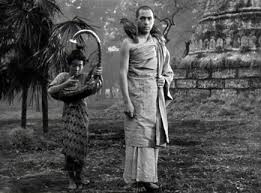
Quick recap: Set during World War II, this movie follows a group of Japanese soldiers who have just crossed over into Burma, the main character being a guy who plays a Burmese harp. After being told the war is over, the Burmese Harp guy goes on a mission to find another group of soldiers to ask them to surrender instead of fighting to their death. The soldiers refuse and are all killed. Burmese harp guy is supposed to go back to his group who are currently in an internment camp but instead decides he would be more useful in other places.

url

Fun (?) fact: Godzilla’s requiem theme from the 1954 movie ‘Gojira’ can be heard during several parts of this film. Because nothing goes better together than a story of a Buddhist monk and Godzilla.

My thoughts: The Burmese Harp is a war movie in the sense that it is set during World War II and the characters are all soldiers. Thankfully, and I say that solely because I have had more than my share of war movies lately, the theme is less war centered and revolves instead around pacifist themes. Yay for not having to sit through confusing battle scenes and lots of blood and guts. Everything is coming up Mary!

The downside of making this sort of movie is that pacifism is sort of dull. The Burmese Harp is a beautiful film, don’t get me wrong, but ‘beautiful’ can only keep my attention for so long. The whole thing reminded me of reading Siddhartha when I was in high school. It too is a beautiful book about a man’s journey to spiritual fulfillment, but just know that if you choose to read it, don’t expect there to be much,if any, action. The only real action this movie has is when all of the Japanese soldiers are killed when they refuse to surrender. Even then you never really see a fight, just the aftermath. Also, that scene happens during the first half hour of the film while the next hour and a half is filled with a lot of walking and singing. Lots of walking and singing.

One thing I did enjoy about this film is watching Mizushima, the Burmese Harp guy, realize his calling. After being injured, he begins to make his way back to the internment camp to join his squad. On the way, he steals a Buddhist robe and also begins to take on the role of a monk. His journey takes him all the way across Burma where he sees bodies strewn about. He begins to bury and burn the bodies, hoping to give them a little bit of dignity in the end. I’m sure it must have been a very difficult decision to stay in a foreign land, adopt a new lifestyle and never see your friends again. But that’s sort of the point of being a monk, to put others before yourself.

I feel a little guilty for not being as in to this movie as I would’ve liked to be. It seems right up my alley, especially since I find myself identifying more with the pacifism side than the war side. But it just didn’t do much for me. I feel like this movie was made more for the Japanese people than me as an American. There was plenty to identify with and learn from, but in the end I felt like it would be more powerful for those who have lived through the horror directly.

Final review: 2/5. Not my cup of tea but a beautiful film, nonetheless.

Up next: HORRORFEST 2014